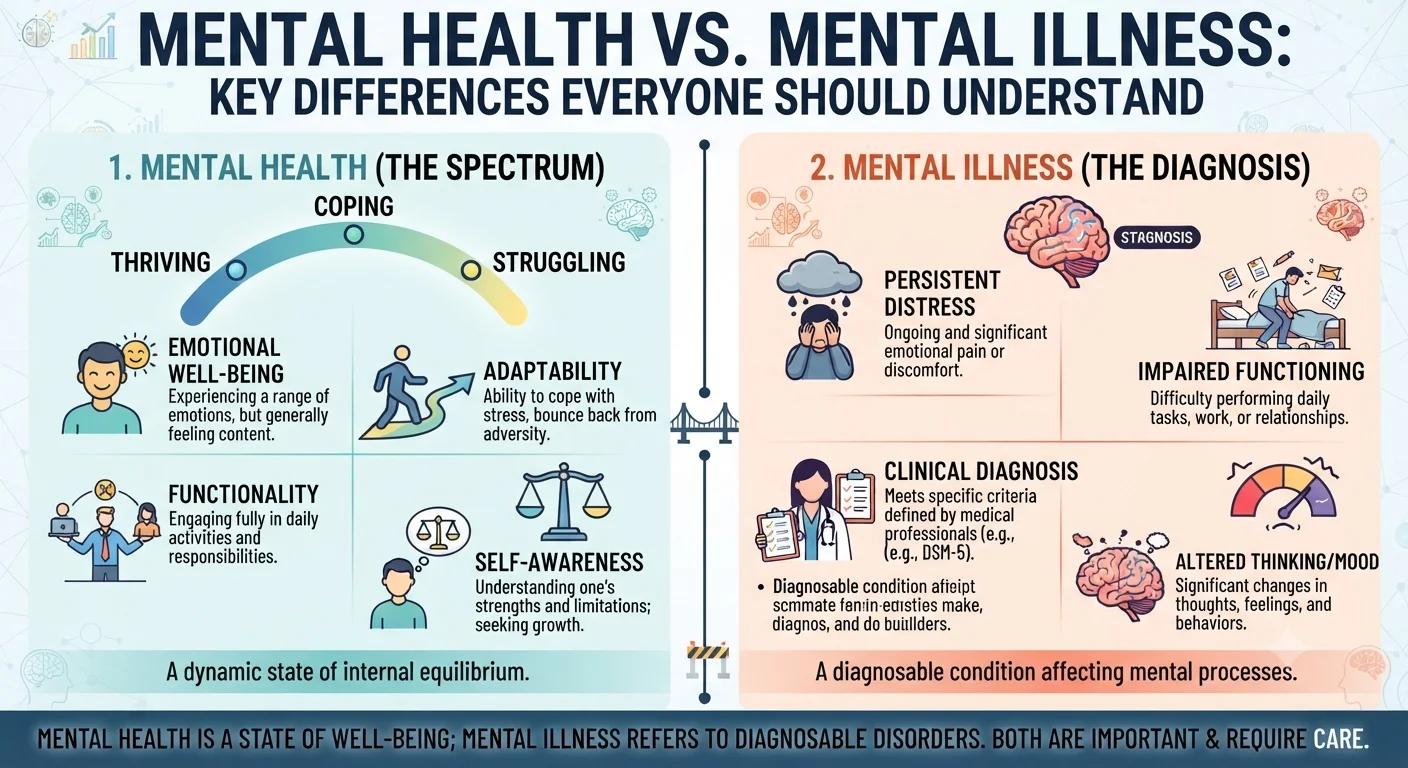
Mental health and mental illness are related but distinct concepts. Mental health refers to a state of wellbeing that everyone has and that exists on a continuum, ranging from thriving to struggling. Mental illness refers to diagnosable clinical conditions that significantly impair daily functioning, meet specific diagnostic criteria, and typically require professional intervention. A person can have poor mental health without a mental illness diagnosis, and a person with a mental illness diagnosis can experience periods of good mental health.
Key Takeaways
- The World Health Organization (WHO) defines mental health as "a state of mental wellbeing that enables people to cope with the stresses of life, realize their abilities, learn well and work well, and contribute to their community."
- Mental illness affects 970 million people globally, according to the WHO's 2022 World Mental Health Report, making it the leading cause of disability worldwide.
- In the United States, approximately 1 in 5 adults (57.8 million people) experienced a mental illness in 2021, according to the National Institute of Mental Health (NIMH) 2023 data.
- Despite the scale of mental illness globally, the WHO estimates that more than 75 percent of people with mental health conditions in low and middle-income countries receive no treatment at all, primarily due to stigma, lack of providers, and cost barriers.
- Mental health conditions are diagnosable, treatable medical conditions, not character flaws, moral failures, or signs of weakness.
What Is Mental Health? The WHO Definition
- Key Takeaways
- What Is Mental Health? The WHO Definition
- What Is Mental Illness? Diagnosis and Classification
- Key Differences Between Mental Health and Mental Illness
- Spectrum vs Diagnosable Condition
- Temporary vs Persistent
- Self-Manageable vs Requiring Professional Intervention
- Most Common Mental Illnesses Globally
- Depression: Facts and Statistics
- Anxiety Disorders
- Bipolar Disorder
- Schizophrenia
- How to Protect Your Mental Health Daily
- When to Seek Professional Help
- Breaking the Stigma Around Mental Illness
- Frequently Asked Questions About Mental Health and Mental Illness
Mental health is not simply the absence of mental illness. The World Health Organization's definition, last updated in 2022, frames mental health as a positive state involving three dimensions: individual wellbeing (feeling good and functioning effectively), effective coping with the normal stresses of life, and productive contribution to one's community.
This definition makes two important points. First, mental health is something everyone has, not something possessed only by people who have never experienced psychological difficulties. Just as physical health describes the entire spectrum from illness to peak fitness, mental health describes the entire spectrum from severe disorder to flourishing. Second, mental health is not a static state but a dynamic condition that changes over time in response to biological, psychological, social, and environmental factors.
The WHO's 2022 World Mental Health Report introduced a more nuanced framework distinguishing between four states: flourishing (strong mental health and no mental illness), struggling (poor mental health but no diagnosable mental illness), languishing (moderate mental health but no mental illness, a state described by sociologist Corey Keyes and popularized by organizational psychologist Adam Grant), and living with a mental illness (which may coexist with either good or poor mental health depending on the individual's circumstances and support).
This framework helps explain why two people with the same anxiety disorder diagnosis may experience very different qualities of life, and why some people without any diagnosed condition nonetheless experience significant impairment and suffering.
What Is Mental Illness? Diagnosis and Classification
Mental illness, also called mental disorder, refers to a wide range of conditions that affect mood, thinking, and behavior and cause significant distress or impairment in social, occupational, or other important areas of functioning. Mental illnesses are diagnosed according to criteria specified in two major classification systems: the Diagnostic and Statistical Manual of Mental Disorders (DSM-5-TR, published by the American Psychiatric Association in 2022) and the International Classification of Diseases (ICD-11, published by the World Health Organization in 2022).
To receive a mental illness diagnosis, a person's symptoms must meet specific criteria regarding type, severity, duration, and the degree to which they impair daily functioning. This diagnostic threshold distinguishes clinical mental illness from the normal psychological distress that everyone experiences at times. Feeling sad after a loss is a normal emotional response. Experiencing persistent, severe depression that impairs work, relationships, and self-care for two or more weeks, regardless of external circumstances, meets the DSM-5-TR diagnostic criteria for a Major Depressive Episode.
Mental illnesses are classified into broad categories including mood disorders (depression, bipolar disorder), anxiety disorders (generalized anxiety, panic disorder, social anxiety, specific phobias), psychotic disorders (schizophrenia, schizoaffective disorder), trauma-related disorders (PTSD, acute stress disorder), eating disorders (anorexia nervosa, bulimia nervosa, binge eating disorder), substance use disorders, personality disorders, neurodevelopmental disorders (ADHD, autism spectrum disorder), and others.
The biological basis of mental illness is complex and involves interactions between genetic vulnerabilities, neurochemical systems, brain structure and function, and environmental stressors. Neuroimaging research has identified consistent structural and functional brain differences associated with conditions including major depression, schizophrenia, and bipolar disorder, reinforcing the understanding of these conditions as medical disorders rather than lifestyle choices or character failures.
Key Differences Between Mental Health and Mental Illness
Spectrum vs Diagnosable Condition
Mental health exists on a continuous spectrum. Every person's mental health fluctuates based on life circumstances, stress, relationships, physical health, and countless other factors. On any given day, the same person might experience high mental wellbeing or significant psychological distress, and both are normal parts of the human experience.
Mental illness is a categorical clinical designation that requires meeting specific diagnostic criteria. While researchers debate whether mental illnesses are truly categorical (present or absent) or dimensional (existing on a continuum of severity), for clinical and practical purposes a diagnosis indicates that symptoms have crossed a threshold of severity and duration that distinguishes clinical disorder from ordinary variation in psychological experience.
This distinction means that experiencing poor mental health, including significant stress, sadness, anxiety, or emotional difficulty, does not mean you have a mental illness. Conversely, having a diagnosed mental illness does not mean you cannot experience periods of genuine wellbeing and flourishing.
Temporary vs Persistent
Poor mental health, in the absence of a diagnosable condition, is typically time-limited and responsive to changes in circumstances, support, and self-care. The grief that follows losing a loved one, the anxiety preceding an important life event, the demoralization associated with prolonged job stress, these are real and meaningful psychological experiences that may significantly impair functioning temporarily without constituting a mental illness.
Mental illness typically involves symptoms that are more persistent, more pervasive across different life contexts, and less responsive to ordinary changes in circumstances. The DSM-5-TR's minimum duration criteria for most diagnoses (two weeks for major depression, six months for generalized anxiety disorder, one month for PTSD, and so on) reflect the understanding that brief episodes of even severe symptoms are a normal part of human experience, while persistent impairment suggests a clinical condition.
Self-Manageable vs Requiring Professional Intervention
Poor mental health in the absence of clinical disorder is often meaningfully improved through lifestyle interventions: regular exercise (whose effects on depression and anxiety are comparable to medication in mild-to-moderate severity, according to a 2023 BMJ meta-analysis of 97 studies), adequate sleep, social connection, stress reduction, and meaningful engagement with valued activities.
Mental illness typically requires professional intervention for meaningful improvement. Evidence-based treatments include psychotherapy (cognitive behavioral therapy, acceptance and commitment therapy, dialectical behavior therapy, and others depending on the condition), pharmacotherapy (antidepressants, antipsychotics, mood stabilizers, anxiolytics), and combined treatment. For severe conditions including schizophrenia and bipolar I disorder, medication is generally considered essential rather than optional. For conditions including major depression and anxiety disorders, either psychotherapy or medication alone can be effective, with combination treatment often superior for moderate-to-severe presentations.
Most Common Mental Illnesses Globally
Depression: Facts and Statistics
Major depressive disorder (MDD) is the most prevalent mental illness worldwide. The WHO estimates that 280 million people globally live with depression, approximately 3.8 percent of the global population. In the United States, the NIMH reported that 21 million adults experienced at least one major depressive episode in 2021, representing 8.3 percent of the adult population.
Depression is characterized by persistent low mood, loss of interest or pleasure in previously enjoyable activities, fatigue, changes in sleep and appetite, difficulty concentrating, feelings of worthlessness or excessive guilt, and in severe cases, suicidal ideation. To be diagnosed as a major depressive episode, these symptoms must persist for at least two weeks and cause significant impairment.
Depression is highly treatable. Research consistently shows that approximately 60 to 80 percent of people with moderate-to-severe depression respond to first-line treatments. However, only about 50 percent of people with depression receive any treatment, due to stigma, cost barriers, provider shortages, and other access issues.
Anxiety Disorders
Anxiety disorders are collectively the most common category of mental illness globally, affecting an estimated 284 million people worldwide according to the Institute for Health Metrics and Evaluation (IHME). In the United States, the NIMH reports that approximately 19.1 percent of adults experienced an anxiety disorder in the past year.
Anxiety disorders include generalized anxiety disorder (GAD), panic disorder, social anxiety disorder, specific phobias, and others. They share the feature of excessive, disproportionate fear or worry that is difficult to control and causes significant distress or impairment. Distinguishing anxiety disorders from ordinary anxiety requires evaluating whether the fear is excessive relative to the actual threat, whether it persists over time and across contexts, and whether it meaningfully impairs daily functioning.
Cognitive behavioral therapy (CBT) is the most extensively researched and most consistently effective psychological treatment for anxiety disorders. A 2015 meta-analysis found CBT superior to waitlist controls and equivalent to medication for most anxiety disorder subtypes, with some evidence of longer-lasting effects than pharmacotherapy after treatment ends.
Recommended Articles
 HEALTH WELLNESS
 HEALTH WELLNESS
 HEALTH WELLNESS
 HEALTH WELLNESS
Bipolar Disorder
Bipolar disorder affects approximately 46 million people globally (0.6 percent of the population) and is characterized by episodes of both depression and mania (bipolar I) or hypomania (bipolar II). Manic episodes involve elevated or irritable mood, decreased need for sleep, increased goal-directed activity, impulsivity, grandiosity, and racing thoughts. These episodes cause significant impairment and may require hospitalization.
Bipolar disorder has a strong genetic component, with heritability estimates ranging from 60 to 80 percent in twin studies. It is one of the most heritable psychiatric conditions and tends to run in families. First-degree relatives of people with bipolar disorder have a seven to ten times higher lifetime risk than the general population.
Mood stabilizing medications (lithium carbonate, valproate, lamotrigine, and others) are the cornerstone of bipolar disorder management. Lithium, first demonstrated to be effective for bipolar disorder by Australian psychiatrist John Cade in 1949, remains one of the most evidence-supported long-term treatments for the condition and has been associated with reduced suicide risk in multiple studies.
Schizophrenia
Schizophrenia affects approximately 24 million people globally (0.32 percent of the population) and is among the most serious and complex psychiatric conditions. Its symptoms are divided into positive symptoms (experiences added to normal functioning, including hallucinations, delusions, and disorganized thinking) and negative symptoms (reductions in normal functioning, including flat affect, social withdrawal, reduced motivation, and poverty of speech).
Schizophrenia typically begins in late adolescence or early adulthood, with earlier onset in men (late teens to mid-20s) than women (mid-20s to early 30s). Its causes involve a complex interaction of genetic vulnerability (heritability approximately 80 percent), neurodevelopmental factors, and environmental stressors including prenatal infection, obstetric complications, and cannabis use during adolescence.
Antipsychotic medications are the primary treatment for schizophrenia and are essential for managing acute psychotic episodes. Psychosocial rehabilitation, supported employment, family psychoeducation, and cognitive remediation are important components of comprehensive care that improve functional outcomes beyond symptom control.
How to Protect Your Mental Health Daily
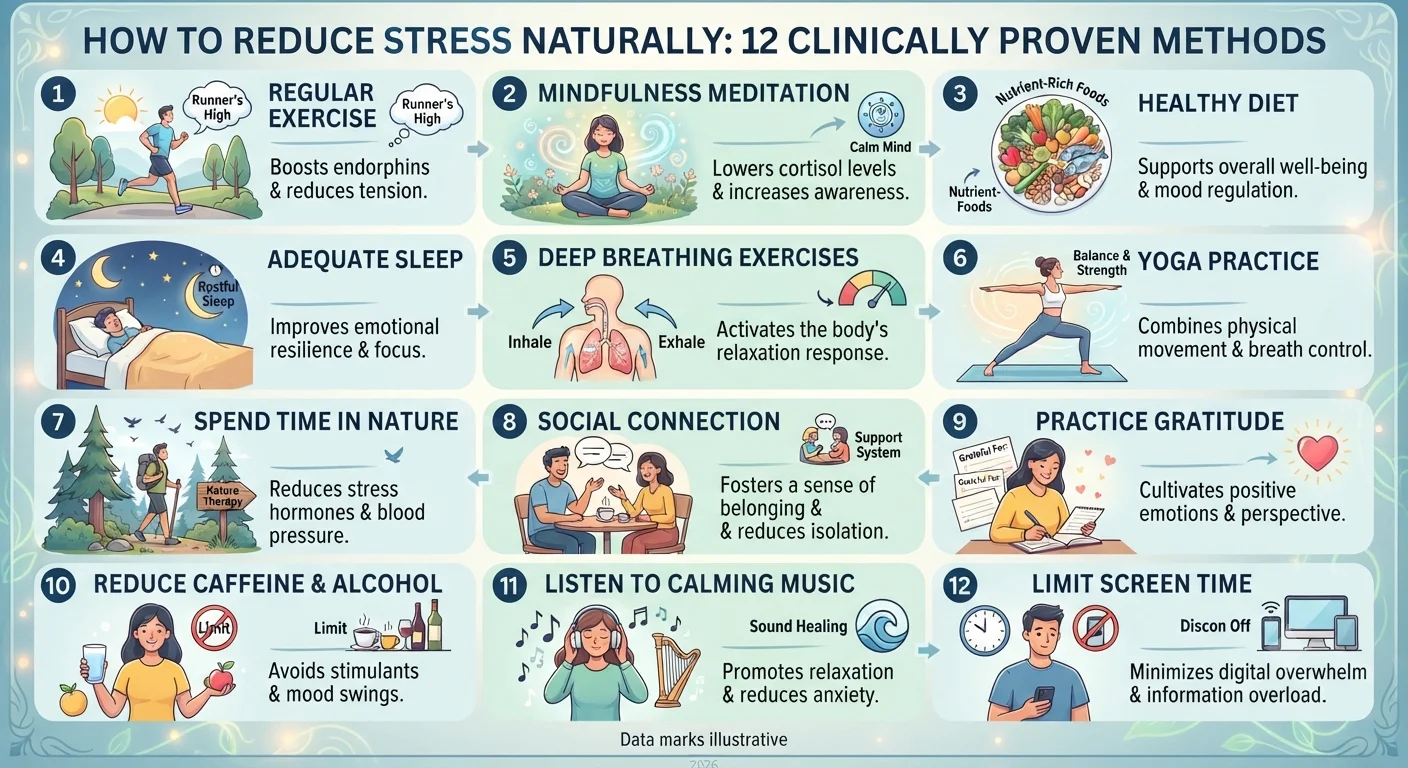
Mental health is maintained through consistent investment in behavioral factors that support psychological resilience and wellbeing. Research across positive psychology, clinical psychology, and neuroscience points to several practices with strong evidence for supporting everyday mental health.
Regular aerobic exercise has the most consistently robust evidence for improving mood, reducing anxiety, and building psychological resilience. A 2023 British Journal of Sports Medicine meta-analysis of 97 systematic reviews covering over 1,000 randomized controlled trials found that physical activity was 1.5 times more effective than medication or cognitive behavioral therapy for reducing depression and anxiety symptoms across multiple populations.
Adequate sleep, as discussed throughout this article, is foundational to emotional regulation, stress tolerance, and mood stability. The prefrontal cortex, which governs impulse control, emotional regulation, and rational thinking, is among the most sensitive brain regions to sleep deprivation.
Social connection, whether with family, friends, colleagues, or community groups, consistently predicts psychological wellbeing and resilience across cultures, age groups, and socioeconomic backgrounds. A 2023 meta-analysis of 38 studies found that social isolation increased risk of depression by 29 percent and anxiety by 21 percent.
Mindfulness practice, including both formal meditation and informal mindful awareness during daily activities, has a well-established evidence base for reducing psychological distress and improving wellbeing in both clinical and non-clinical populations.
Meaningful engagement with valued activities, a concept central to both Viktor Frankl's logotherapy and acceptance and commitment therapy (ACT), appears to buffer against psychological distress even under conditions of significant external stress.
Limiting heavy alcohol and substance use is critical, as the relationship between alcohol, drug use, and mental health conditions is bidirectional: substance use worsens mental health conditions, and poor mental health increases the risk of substance use as a coping mechanism.
When to Seek Professional Help
Determining when self-care strategies are sufficient and when professional support is warranted involves evaluating four dimensions: severity, duration, impairment, and trend.
Severity refers to how intense the psychological symptoms are. Significant distress, especially including thoughts of self-harm, suicide, or harming others, warrants immediate professional contact. Moderate distress that interferes with daily functioning warrants professional evaluation. Mild distress that remains manageable may respond to self-care.
Duration refers to how long symptoms have persisted. Symptoms lasting more than two weeks with no clear situational explanation, or symptoms that improve and return repeatedly, suggest the need for professional assessment.
Impairment refers to whether symptoms significantly interfere with work, relationships, self-care, or other important areas of functioning. Impairment that prevents normal daily activities strongly suggests professional evaluation.
Trend refers to whether symptoms are improving, stable, or worsening over time. Worsening symptoms despite self-care efforts indicate professional consultation is appropriate.
Mental health professionals include psychiatrists (medical doctors who can diagnose mental illness, prescribe medication, and provide psychotherapy), clinical psychologists (doctoral-level specialists in psychological assessment and psychotherapy), licensed clinical social workers, and licensed professional counselors. Primary care physicians are often the first point of contact and can provide screening, initial treatment, and referrals.
In crisis situations involving active suicidal ideation with intent or plan, severe psychotic symptoms, or inability to care for oneself or others, emergency services or crisis lines provide immediate support. In the United States, dialing 988 connects to the 988 Suicide and Crisis Lifeline, which launched in July 2022. In the United Kingdom, the Samaritans can be reached at 116 123. In Pakistan, the Umang helpline operates at 0317-4288665.
Breaking the Stigma Around Mental Illness
Stigma, defined by sociologist Erving Goffman as "a deeply discrediting attribute that reduces someone from a whole person to a tainted, discounted one," remains one of the most significant barriers to mental health treatment globally. Mental health stigma operates at three levels: public stigma (society's negative attitudes toward people with mental illness), self-stigma (internalized shame in the person with mental illness), and structural stigma (institutional policies and practices that disadvantage people with mental illness).
The consequences of stigma are concrete and measurable. A 2015 meta-analysis found that stigma was associated with significantly reduced help-seeking behavior, medication non-adherence, and social withdrawal among people with mental illness. Research consistently shows that public understanding of mental illness increases significantly through direct social contact with people who have mental illness, an approach called "contact-based education" that is more effective than information-only campaigns.
The global mental health advocacy community, led by organizations including the World Federation for Mental Health, Time to Change (UK), and the National Alliance on Mental Illness (NAMI) in the United States, has made measurable progress in reducing mental health stigma over the past decade. NAMI's 2024 annual survey found that 77 percent of Americans reported being comfortable talking to a friend about mental health, up from 62 percent in 2015.
Public figures including Prince Harry, Simone Biles, Michael Phelps, Naomi Osaka, Demi Lovato, and Ryan Reynolds have spoken publicly about their mental health experiences, contributing to normalization and reduced stigma particularly among younger demographics.
Frequently Asked Questions About Mental Health and Mental Illness
Can a person have poor mental health without a mental illness?
Yes. Poor mental health, meaning psychological distress, low wellbeing, and impaired functioning, can occur in the absence of any diagnosable mental illness. Burnout, grief, relationship difficulties, work stress, and life transitions can produce significant psychological suffering without meeting the diagnostic threshold for any clinical condition. These experiences are real, valid, and worthy of support and attention even when they do not constitute a diagnosable disorder.
Is mental illness permanent?
Most mental illnesses are not permanent. The majority of people who receive evidence-based treatment for depression, anxiety disorders, and other common conditions achieve full or significant remission. Some conditions, including schizophrenia and bipolar disorder, typically require long-term management rather than cure, but effective treatment enables most people to live meaningful, productive lives. Recovery-oriented mental health care focuses on building a full life rather than eliminating symptoms as the primary goal.
Is mental illness caused by chemical imbalance in the brain?
The "chemical imbalance" theory, which attributed mental illness primarily to low serotonin or dopamine levels, was an oversimplification that became popular in the 1990s alongside the marketing of SSRIs. Current neuroscience understanding recognizes mental illness as involving complex interactions between genetic factors, multiple neurochemical systems, brain circuitry, psychological factors, and social and environmental influences. Medications that affect neurotransmitter systems are effective treatments for many mental illnesses, but this does not necessarily mean the illness was caused by a simple deficit of that neurotransmitter.
What is the difference between a psychiatrist and a psychologist?
A psychiatrist is a medical doctor (MD or DO) who specializes in mental illness, completing medical school followed by a four-year psychiatry residency. Psychiatrists can diagnose mental illness, prescribe medications, and provide psychotherapy. A clinical psychologist typically holds a doctoral degree (PhD or PsyD) in psychology and specializes in psychological assessment and psychotherapy. Psychologists in most countries cannot prescribe medications, though prescribing rights for psychologists exist in some states in the United States.
How common is mental illness in children and adolescents?
Mental illness is significantly more common in young people than is often recognized. The CDC reports that approximately 17 percent of children and adolescents in the United States aged 2 to 17 had a diagnosed mental, behavioral, or developmental disorder in the most recent reporting period. Anxiety disorders are the most common, followed by ADHD, behavior problems, and depression. Approximately 50 percent of all lifetime mental illness begins by age 14, and 75 percent begins by age 24, making early identification and intervention critically important.