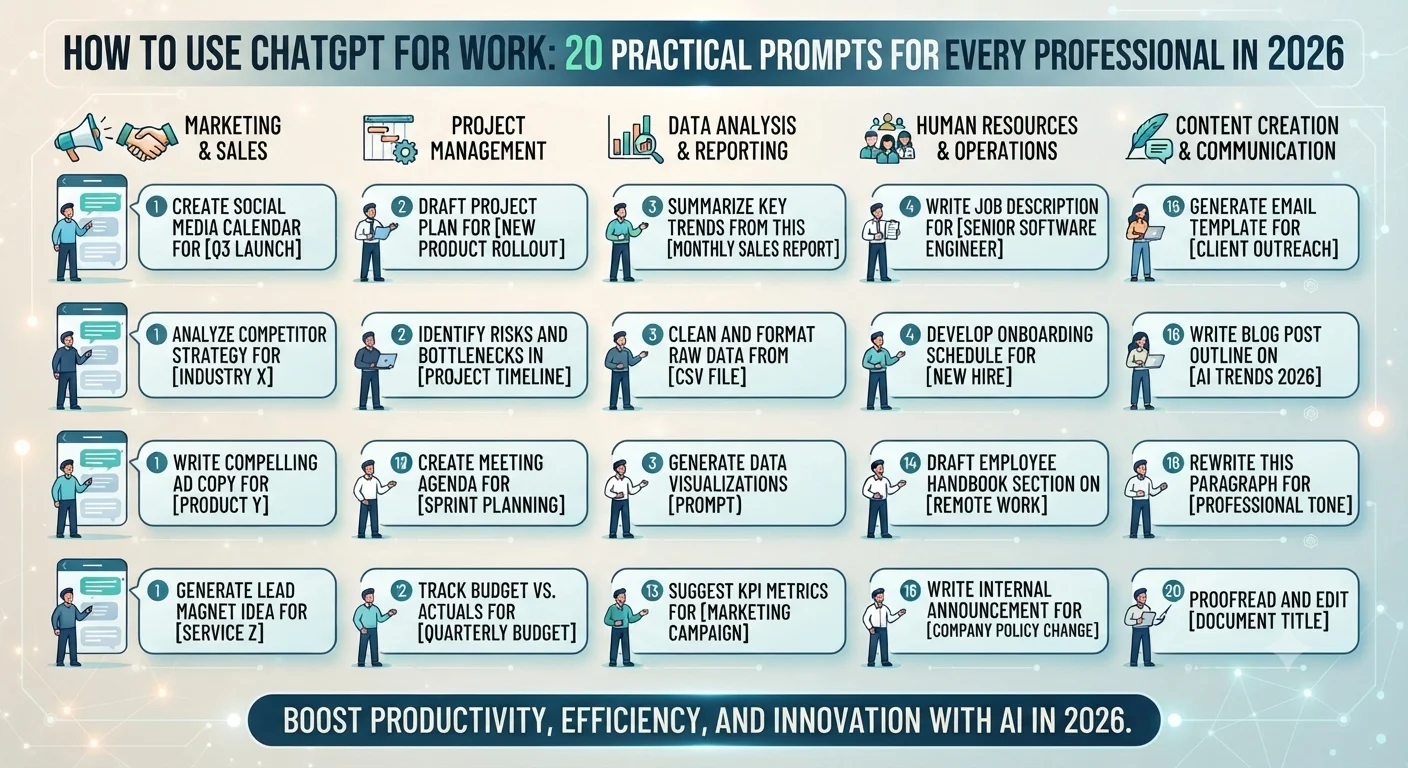
ChatGPT is most powerful at work when you treat it like a skilled colleague who needs clear context to help well. The best prompts specify your role, the task, the audience, the format, and any constraints. The 20 prompts below are organized by function (email, reports, brainstorming, research, presentations) and are ready to copy, customize, and use immediately.
Key Takeaways
- A 2024 Nielsen Norman Group study found that knowledge workers using AI writing assistants completed tasks 59 percent faster on average and produced outputs rated significantly higher in quality by blind evaluators.
- A 2025 McKinsey Global Survey found that 78 percent of respondents reported using generative AI tools at work at least weekly, up from 55 percent in 2023.
- Harvard Business School research by Fabrizio Dell'Acqua and colleagues found that consultants using ChatGPT completed 12.2 percent more tasks, completed tasks 25.1 percent faster, and produced work rated 40 percent higher in quality than control groups without AI assistance.
- The most important skill in using ChatGPT effectively is prompt quality. Vague prompts produce generic outputs. Specific, context-rich prompts produce professional-grade outputs.
- ChatGPT cannot access real-time information without web search enabled, cannot verify current facts reliably, and should never be the sole source for high-stakes decisions involving legal, medical, or financial advice.
Why ChatGPT Is the Professional Tool of 2026
- Key Takeaways
- Why ChatGPT Is the Professional Tool of 2026
- How to Write Better ChatGPT Prompts
- The CRISPE Framework for Professional Prompts
- The Most Common Prompt Mistakes to Avoid
- 20 Work-Ready ChatGPT Prompts by Function
- Email Writing Prompts
- Report and Summary Prompts
- Brainstorming and Ideation Prompts
- Research and Analysis Prompts
- Presentation and Slide Prompts
- ChatGPT for Different Professional Roles in 2026
- Human Resources Professionals
- Marketing and Communications Professionals
- Finance and Accounting Professionals
- Technology and Engineering Professionals
- What ChatGPT Cannot Do: Important Limitations
- Frequently Asked Questions About Using ChatGPT at Work
ChatGPT has moved from novelty to essential infrastructure in the professional world remarkably quickly. In November 2022, it was a curiosity. By 2025, a McKinsey survey found 78 percent of knowledge workers using it weekly. By 2026, it is embedded in the workflows of professionals across industries in ways that make treating it as optional increasingly costly.
The business case is straightforward. Knowledge work, the category of work involving information processing, communication, analysis, and decision-making, is fundamentally about generating useful outputs from available inputs. ChatGPT accelerates virtually every step of that process: finding relevant information faster, drafting communications more quickly, structuring analysis more clearly, and generating options for consideration more comprehensively than unaided human work.
The Harvard Business School study referenced above is particularly instructive because it used a rigorous randomized controlled trial design with actual McKinsey consultants. The consultants using ChatGPT did not merely feel more productive; their outputs were measurably better as evaluated by senior consultants who did not know which outputs were AI-assisted. This suggests ChatGPT is not simply a speed tool but a quality amplifier for professional work.
The gap between professionals who learn to use ChatGPT effectively and those who do not is widening. The following framework and prompts are designed to close that gap quickly.
How to Write Better ChatGPT Prompts
The quality of ChatGPT's output is almost entirely determined by the quality of the instructions you give it. Most users drastically underinvest in prompt quality and are disappointed by generic results. The following framework transforms average prompts into professional-grade instructions.
- What Is Blockchain Technology? How It Works and Why It Matters in 2026
- ChatGPT vs Gemini vs Claude: Which AI Chatbot Is Best in 2026?
- What Is Artificial Intelligence? A Complete Beginners Guide for 2026
The CRISPE Framework for Professional Prompts
CRISPE is a prompt engineering framework developed to systematically build high-quality prompts. Each letter represents a component that adds specificity and context to your request.
C is for Capacity and Role. Tell ChatGPT what role it should occupy for this task. "Act as a senior marketing strategist with 15 years of experience in B2B SaaS" produces fundamentally different outputs than "help me with marketing."
R is for Request. State the specific task you want completed with precise, unambiguous language. "Write a 300-word executive summary" is far more actionable than "summarize this."
I is for Input. Provide the relevant context, data, constraints, or background information ChatGPT needs to complete the task well. The more relevant context you provide, the more accurate and tailored the output.
S is for Style. Specify tone, format, length, and audience. "Write in a direct, confident tone suitable for a C-suite audience. Use bullet points for the key recommendations section. Keep the total length under 400 words."
P is for Purpose. State the goal this output will serve. Understanding purpose helps ChatGPT make appropriate choices when trade-offs exist.
E is for Examples. Where possible, provide an example of the type of output you want. "Here is an example of a subject line I liked: [example]. Write ten more in this style."
You do not need to use every component for every prompt. For simple tasks, a clear role and specific request are sufficient. For complex professional tasks, the full CRISPE structure produces markedly better results.
The Most Common Prompt Mistakes to Avoid
Being too vague: "Help me with my email" produces unhelpful generic output. "Write a follow-up email to a potential client who attended our product demo three days ago but has not responded, in a warm but professionally persistent tone, referencing the specific feature they showed most interest in (automated reporting)" produces useful output.
Not providing context: ChatGPT does not know your industry, your company, your audience, or your specific situation unless you tell it. Spending thirty seconds adding relevant context produces dramatically better output.
Not iterating: the first output from ChatGPT is rarely the final output. Use follow-up prompts to refine: "Make this more concise," "Adjust the tone to be less formal," "Rewrite the third paragraph to emphasize the cost savings more prominently."
Accepting outputs uncritically: ChatGPT can confidently produce factually incorrect information. Every output that includes specific facts, statistics, names, or citations should be independently verified before use in professional contexts.
20 Work-Ready ChatGPT Prompts by Function
Email Writing Prompts
Prompt 1: Professional follow-up after no response
"Act as an experienced business development professional. Write a follow-up email to [Name] at [Company] who attended our product demo on [date] but has not responded. The demo focused on our [product/service]. They showed particular interest in [specific feature]. The tone should be warm, non-pushy, and professionally persistent. Include a clear single call to action. Maximum 150 words."
Prompt 2: Declining a request diplomatically
"Act as a professional communicator. Write a polite but firm email declining [specific request] from [Name/colleague/client]. The reason for declining is [brief reason]. I want to preserve the relationship and leave the door open for future collaboration. Tone: respectful, direct, appreciative. Maximum 120 words."
Prompt 3: Requesting a meeting with a senior stakeholder
"Write a meeting request email to [Name], who is [their role] at [company]. I am [your role] and I want to discuss [specific topic]. The value to them of this meeting is [benefit]. I am requesting 20 to 30 minutes. Tone: confident, concise, respectful of their time. Subject line included."
Prompt 4: Delivering difficult feedback
"Help me write an email to a team member, [Name], who has been consistently missing project deadlines. The impact on the team has been [specific impact]. I want to address this directly, express confidence in their ability to improve, and outline what I need to see change. Tone: direct, constructive, supportive. The goal is behavior change, not blame. Maximum 200 words."
Report and Summary Prompts
Prompt 5: Executive summary of a long document
"You are a senior analyst. Here is a [length]-page report on [topic]: [paste report or key sections]. Write a 250 to 300 word executive summary for a C-suite audience who will use this to make [specific decision]. Include: the key finding, the main evidence supporting it, and the recommended action. No jargon. Direct language only."
Prompt 6: Turning meeting notes into action items
"Here are raw notes from a meeting on [date] about [topic]: [paste notes]. Convert these into a structured meeting summary with: 1) a three-bullet overview of what was decided, 2) a table of action items with owner, task, and deadline, 3) any open questions that need resolution. Professional format. Clear and scannable."
Prompt 7: Weekly status report
"Act as a project manager. Write a professional weekly status report for project [name] covering: overall status (on track, at risk, or off track), work completed this week, work planned for next week, risks or blockers, and help needed. Use this project update information: [paste your updates]. Format for a manager who wants the essential information in under two minutes of reading."
Prompt 8: Competitive analysis summary
"Act as a strategic analyst. Compare [Company A] and [Company B] in the [industry] market across these dimensions: target customer, key product features, pricing model, market position, and main competitive advantage. Present as a structured comparison that helps a senior decision-maker understand where the competitive differentiation lies. Use clear, objective language."
Brainstorming and Ideation Prompts
Prompt 9: Content ideas for a specific audience
"Act as a content strategist specializing in [industry]. Generate 20 blog article title ideas for a [website type] targeting [specific audience] who want to [primary goal]. Each title should: address a specific problem or question, be clear and specific (not vague), and have genuine informational value. Format as a numbered list with a one-sentence description of each article's angle."
Recommended Articles
 TECHNOLOGY AI
 TECHNOLOGY AI
 TECHNOLOGY AI
Prompt 10: Solving a specific business problem
"Act as a business strategy consultant. I am facing this challenge: [describe problem in 3 to 5 sentences]. My constraints are: [budget/time/team/regulatory constraints]. Generate 8 to 10 distinct approaches to this problem, ranging from conservative and low-cost to bold and innovative. For each approach, give: the core idea in one sentence, the main advantage, and the main risk."
Prompt 11: Naming and tagline generation
"Act as a brand naming specialist. I am launching [describe product or service] targeting [target audience]. The brand personality should feel [adjective, adjective, adjective]. Generate 15 name ideas in three groups: (1) descriptive names that explain what it does, (2) evocative names that communicate the feeling or benefit, (3) invented or abstract names. For the top 5, suggest a matching tagline."
Prompt 12: Workshop or training agenda design
"Act as an instructional designer. Create a detailed agenda for a [half-day or full-day] workshop on [topic] for [number] participants who are [describe their level and background]. Learning objectives: by the end of this workshop, participants will be able to [3 specific outcomes]. Include: session titles, timings, activities, materials needed, and facilitator notes. Practical, engaging, and achievable."
Research and Analysis Prompts
Prompt 13: SWOT analysis
"Act as a business analyst. Create a comprehensive SWOT analysis for [company name or describe company] in the [industry] market as of [year]. Draw on publicly available information about the company's market position, financial performance, competitive landscape, and industry trends. Format as a clear 2x2 matrix with 4 to 6 points per quadrant. Each point should be specific and evidence-based, not generic."
Prompt 14: Explaining a complex concept simply
"Explain [complex concept or technical term] in simple language that a [non-specialist audience type] could understand in one reading. Use an analogy to everyday experience to illustrate the core idea. Include: a one-sentence definition, the analogy, a real-world example of why it matters, and one common misconception about it. Maximum 300 words."
Prompt 15: Synthesizing multiple perspectives on a topic
"I am researching [topic]. Present a balanced synthesis of the major perspectives on this issue. For each of the main positions, explain: what the position argues, who typically holds this view, and the strongest evidence supporting it. Then identify where the genuine areas of uncertainty or disagreement lie. I need this to inform a decision about [context], so emphasize practical implications."
Prompt 16: Data interpretation
"Act as a data analyst. Here is a dataset summary: [paste key figures, table, or data]. Interpret what this data shows about [business question]. Identify: the most significant trend or finding, what is surprising or unexpected, what the data does not tell us but would be useful to know, and what action this data most plausibly supports. Be direct. Avoid hedging that dilutes actionable insight."
Presentation and Slide Prompts
Prompt 17: Presentation outline for executive audience
"Act as a management consultant preparing a board presentation. Create a detailed slide-by-slide outline for a 15-minute presentation to [audience type] about [topic]. For each slide include: slide title, key message (one sentence), three to four supporting points or data, and recommended visual type (chart, table, image, diagram). Opening slide should establish stakes. Closing slide should have a single clear recommendation."
Prompt 18: Storytelling narrative for a pitch
"Act as a pitch coach and storytelling expert. I am pitching [product or idea] to [investor/stakeholder type]. My core message is [one sentence]. Build a three to five minute verbal narrative using the Problem-Solution-Proof-Ask structure. The problem section should create genuine urgency. The solution section should be specific about differentiation. The proof section should reference [specific evidence I will provide]. End with a clear, specific ask."
Prompt 19: Slide title rewrites for impact
"Here are 8 slide titles from my presentation: [paste your titles]. Rewrite each one to follow best practice for executive presentations: make each title the key takeaway message (not just a topic label), use action language where appropriate, and keep each under 10 words. Provide the original and your rewrite side by side for comparison."
Prompt 20: Speaker notes for a specific slide
"Here is the content of one of my presentation slides: [paste slide content]. Write natural, conversational speaker notes for this slide that I can use during delivery. The notes should: expand on the points in a logical flow, include one engaging transition from the previous topic, suggest where to pause for emphasis, and include the key sentence I most need the audience to remember from this slide. Approximately 150 to 200 words."
ChatGPT for Different Professional Roles in 2026
Human Resources Professionals
HR professionals use ChatGPT to draft job descriptions with precise competency language, write structured interview question sets aligned to specific role requirements, create onboarding documentation and policy summaries, draft performance review templates and development plan frameworks, and generate candidate rejection and offer letter templates.
A practical HR prompt: "Act as an HR professional specializing in talent acquisition. Write a job description for a [role title] at a [company size and industry] company. The role reports to [manager title]. Key responsibilities are [list]. Required qualifications are [list]. Tone: professional, inclusive language, free of gender-coded terms. Include a compelling company mission statement section at the top using this information: [company info]."
Marketing and Communications Professionals
Marketing teams use ChatGPT for first-draft copywriting across formats (social media captions, email campaigns, landing page copy, blog posts), A/B testing variations of headlines and calls to action, repurposing long-form content into multiple shorter formats, and translating technical product features into customer-benefit language.
Finance and Accounting Professionals
Finance professionals use ChatGPT to explain complex financial concepts for non-finance stakeholders, draft commentary for financial reports, create presentation narratives around financial data, and model financial scenarios described in plain language before translating to spreadsheets.
Critical caveat: ChatGPT should never be used to generate actual financial calculations, tax advice, or regulatory compliance decisions. It lacks access to current tax law specifics and cannot perform reliable numerical calculations. Use it for communication and narrative, not calculation.
Technology and Engineering Professionals
Software engineers and developers use ChatGPT for code debugging (explaining why code is broken and suggesting fixes), generating boilerplate code structures, writing documentation and code comments, explaining technical concepts for product or business stakeholders, and drafting technical specifications.
What ChatGPT Cannot Do: Important Limitations
Using ChatGPT effectively requires honest awareness of what it cannot reliably do.
Real-time information: ChatGPT's training has a knowledge cutoff and cannot access current events, current market prices, current organizational data, or recent publications without web search enabled. When web search is not enabled, never use ChatGPT for current fact claims.
Accurate calculations: ChatGPT is a language model, not a calculator. While it can often produce correct arithmetic for simple calculations, it makes errors in complex calculations with meaningful frequency. Always verify quantitative outputs independently.
Legal, medical, and financial advice: ChatGPT's outputs should never be treated as professional legal, medical, or financial advice. Its training data does not reflect current law, and it lacks the contextual knowledge of your specific situation that professional advice requires.
Confidential information: Pasting sensitive client data, proprietary business information, or personal employee data into ChatGPT's standard consumer interface sends that data to OpenAI's servers, where it may be used for model training depending on your account settings. For genuinely sensitive information, use ChatGPT Enterprise (which offers data privacy agreements) or restrict prompts to describe situations in general terms without identifying details.
Frequently Asked Questions About Using ChatGPT at Work
Is it ethical to use ChatGPT for work tasks?
Using AI tools at work is ethically equivalent to using any other productivity tool (a spreadsheet, a grammar checker, a search engine) as long as you are transparent when required, responsible for the quality and accuracy of AI-assisted outputs, and in compliance with your employer's policies and any applicable professional regulations. Some regulated industries and professions have specific rules about AI tool use; verify compliance in your specific context.
Should I tell people if I used ChatGPT to write something?
Context determines disclosure norms. Internal drafts and working documents generally require no disclosure. Client-facing communications may require disclosure depending on client agreements or professional standards in your industry. Academic work typically requires explicit disclosure or prohibits AI use per institutional policy. Legal, medical, and financial communications may have specific disclosure requirements. When uncertain, err toward transparency.
How do I keep my company's data safe when using ChatGPT?
Use ChatGPT Enterprise for business use involving any proprietary or sensitive data: it provides contractual data privacy protections ensuring your conversations are not used for model training. Alternatively, describe situations in general terms without including identifying details, confidential financial figures, or personal employee information in standard consumer ChatGPT.
What is the best ChatGPT model to use for professional work in 2026?
GPT-4o is the standard model for most professional tasks including writing, analysis, and communication. The o3 reasoning model is specifically advantageous for complex analytical and logical reasoning tasks, multi-step problem solving, and technical subjects. For most professionals, GPT-4o within ChatGPT Plus provides sufficient capability for everyday work use.