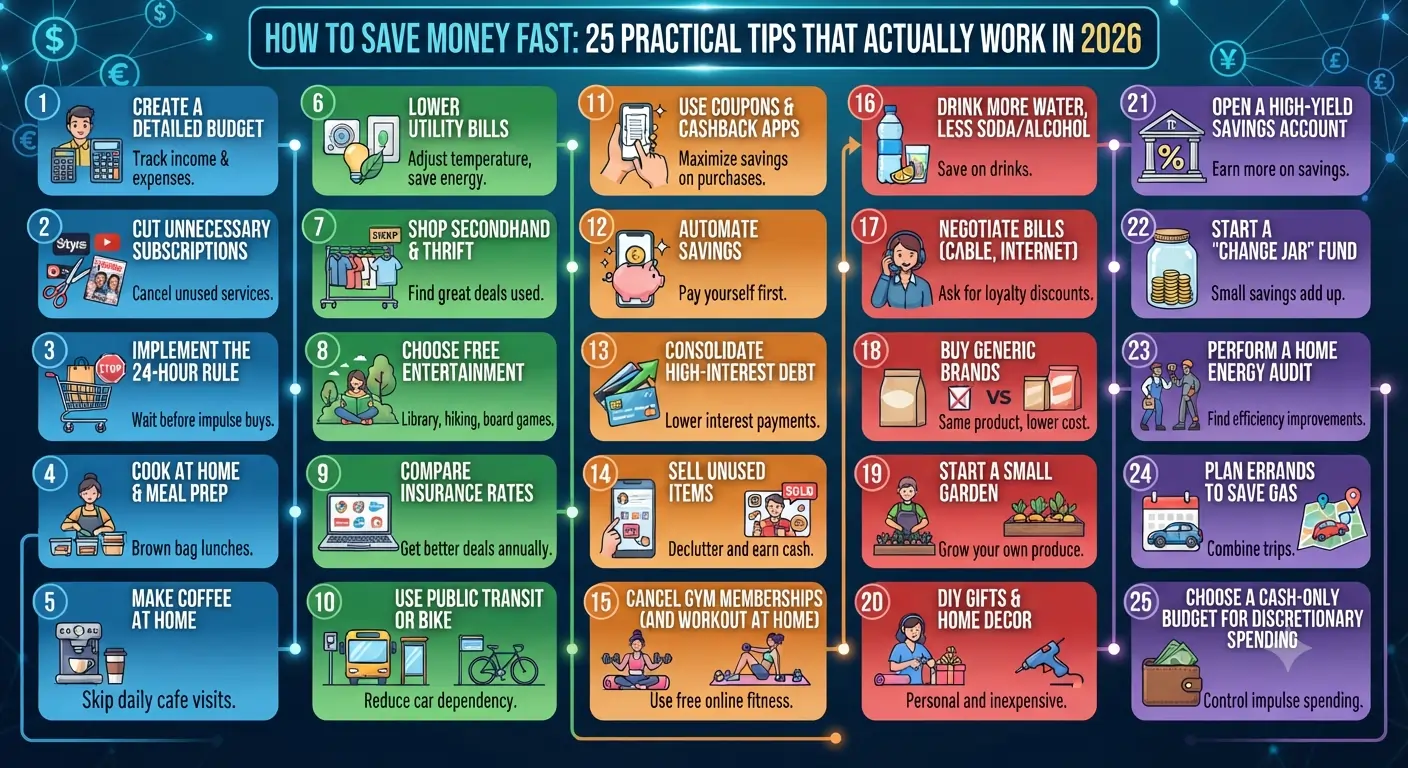
Saving money fast requires three simultaneous actions: reducing fixed expenses, cutting variable spending, and automating savings before the money can be spent. The most impactful single action most people can take immediately is setting up an automatic transfer of 10 to 20 percent of every paycheck to a separate high-yield savings account on payday, before discretionary spending occurs.
Key Takeaways
- The personal savings rate in the United States dropped to 3.6 percent in early 2026, near historic lows, according to the Federal Reserve Bank of St. Louis, meaning most Americans are saving almost nothing.
- A Bankrate survey conducted in January 2026 found that 56 percent of American adults could not cover a $1,000 emergency expense from savings alone.
- The average American household spends $18,000 per year on non-essential discretionary categories including dining out, subscriptions, entertainment, and impulse purchases, according to the Bureau of Labor Statistics Consumer Expenditure Survey 2025.
- Automating savings is the single behavioral change with the highest success rate for building savings, because it removes the decision from the equation entirely.
- High-yield savings accounts offered by online banks such as Marcus by Goldman Sachs, Ally Bank, and SoFi paid annual percentage yields (APY) of 4.5 to 5.1 percent in mid-2026, compared to the national average of 0.46 percent at traditional banks.
Why Most People Fail at Saving Money
- Key Takeaways
- Why Most People Fail at Saving Money
- The 50/30/20 Budgeting Rule: Your Foundation
- 25 Proven Ways to Save Money Quickly in 2026
- Tips 1 Through 5: Cut Fixed Expenses
- Tips 6 Through 10: Reduce Variable Spending
- Tips 11 Through 15: Increase Your Income
- Tips 16 Through 20: Automate Your Savings
- Tips 21 Through 25: Lifestyle and Mindset Shifts
- Free Apps and Tools to Track Your Savings in 2026
- How Much Should You Have Saved by Age? (2026 Benchmarks)
- Frequently Asked Questions About Saving Money in 2026
The primary reason people fail to save money is not a lack of desire or intention. It is a lack of system. Behavioral economists call the underlying problem "present bias," the well-documented human tendency to overweight immediate rewards and underweight future benefits. In practical terms, this means that the pleasure of spending today consistently feels more real and immediate than the abstract future benefit of having savings.
A 2024 study published in the journal "Behavioural Public Policy" found that people who relied purely on willpower to save money saved an average of 3.1 percent of income, while those who used automatic savings systems saved an average of 12.4 percent, four times as much, with no reported difference in perceived financial sacrifice or quality of life.
The second reason is the absence of a concrete savings goal with a deadline. Research by Professor Hal Hershfield at UCLA found that people save significantly more money when they have vivid, specific, emotionally connected goals (a house down payment by December 2027, a fully funded emergency fund by March 2027) compared to vague intentions to "save more."
The third reason is that most people track income but not spending. A 2025 survey by Personal Capital found that only 32 percent of Americans tracked their monthly spending in any systematic way. Without knowing where money currently goes, identifying and eliminating waste is essentially impossible.
The 25 tips below address all three root causes: system design, goal clarity, and spending awareness.
The 50/30/20 Budgeting Rule: Your Foundation
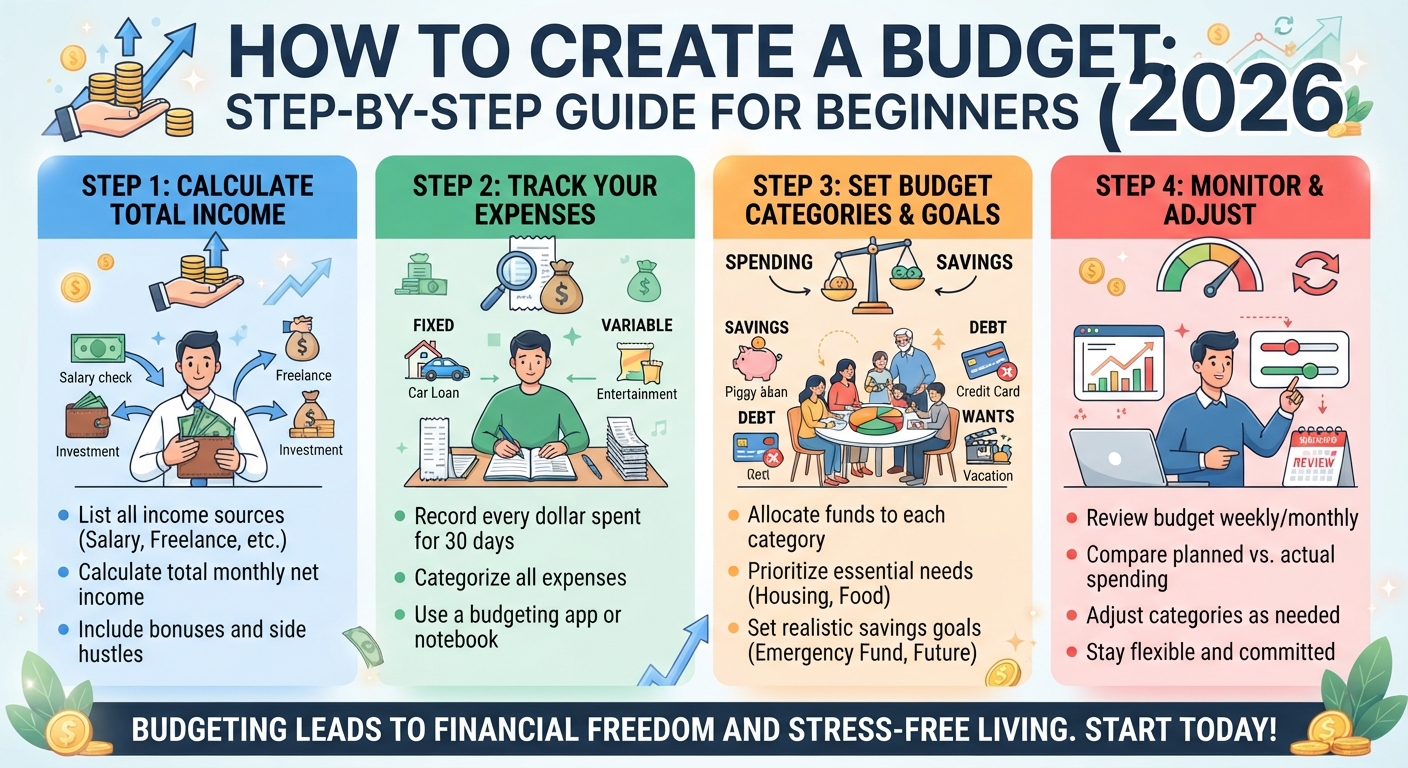
Before applying specific money-saving tactics, establishing a budgeting framework creates the structure within which all savings efforts operate. The 50/30/20 rule, popularized by U.S. Senator Elizabeth Warren and her daughter Amelia Warren Tyagi in their 2005 book "All Your Worth," divides after-tax income into three categories.
Fifty percent of after-tax income goes to needs: housing, utilities, groceries, transportation, insurance, and minimum debt payments. These are non-negotiable baseline expenses.
Thirty percent goes to wants: dining out, entertainment, hobbies, travel, subscriptions, and personal spending. These are discretionary and provide quality of life.
Twenty percent goes to financial goals: savings, emergency fund contributions, retirement contributions, and additional debt payments above the minimum.
If your current financial allocation differs significantly from 50/30/20, the 25 tips below will help you move toward it. The most common problem for people struggling to save is that wants and debt payments have crept into what should be the savings allocation.
25 Proven Ways to Save Money Quickly in 2026
Tips 1 Through 5: Cut Fixed Expenses
Fixed expenses are costs that recur at the same amount each month. Because they are predictable and often paid automatically, they are frequently forgotten and allowed to accumulate unchecked. Auditing and reducing fixed expenses produces ongoing monthly savings without requiring daily behavioral change.
Tip 1: Audit and cancel unused subscriptions. The average American household pays for 4.5 streaming services simultaneously, according to a 2025 Parks Associates report. Combined with fitness apps, software subscriptions, news subscriptions, and other recurring charges, the average person has subscription costs of $219 per month, and many are unaware of more than half of them. Use a subscription tracking service such as Rocket Money, Trim, or simply your bank statement to identify every recurring charge. Cancel anything you have not actively used in the past 30 days. Potential savings: $50 to $150 per month.
Tip 2: Negotiate your internet and phone bills. Cable and telecom companies have significant margin in their pricing and routinely offer promotional rates to customers who call to cancel or negotiate. A 2024 BillShark study found that 80 percent of customers who called to negotiate their internet or phone bill received a reduction, with average savings of $27 per month per service. Call your provider, reference a competitor's current rate, and ask for their best retention offer. Potential savings: $30 to $80 per month.
Tip 3: Shop your insurance annually. Car insurance, renters insurance, and homeowners insurance premiums vary dramatically between providers for identical coverage. The National Association of Insurance Commissioners reports that shopping your insurance at annual renewal consistently yields savings of 15 to 30 percent. Use comparison platforms including The Zebra, Policygenius, or NerdWallet to obtain multiple quotes in minutes. Potential savings: $50 to $200 per month depending on coverage type.
Tip 4: Refinance or consolidate high-interest debt. If you carry balances on credit cards charging 20 to 29 percent annual percentage rate (APR), refinancing to a personal loan at 8 to 14 percent APR can dramatically reduce monthly interest costs. A $5,000 credit card balance at 24 percent APR costs approximately $100 per month in interest charges. The same balance at a 10 percent personal loan rate costs approximately $42 per month. The difference is $58 per month that can be redirected to savings. Lenders including SoFi, LightStream, and Marcus by Goldman Sachs offer competitive personal loan rates in 2026. Potential savings: $30 to $200 per month depending on debt amounts.
Tip 5: Consider downsizing your housing or getting a roommate. Housing is the single largest expense for most households, typically representing 25 to 35 percent of income. Moving to a smaller space, relocating to a lower-cost area, or adding a roommate can produce the largest single-category savings of any action on this list. The average monthly rent in the United States reached $2,020 in 2025, according to Apartment List. Adding one roommate in an average two-bedroom apartment splits this cost and saves approximately $1,010 per month, or $12,120 per year. Potential savings: $300 to $1,200 per month.
Tips 6 Through 10: Reduce Variable Spending
Variable expenses fluctuate month to month and are the category where most discretionary savings opportunities exist. Unlike fixed expenses, variable spending requires ongoing behavioral awareness.
Tip 6: Apply the 24-hour rule for non-essential purchases. Impulse purchases are the largest single source of variable overspending. A 2024 Slickdeals survey found that Americans spend an average of $183 per month on impulse buys. The 24-hour rule is simple: any non-essential purchase above a chosen threshold (commonly $20 to $50) must wait 24 hours before being completed. During that period, the initial emotional impulse typically subsides. Research on impulse purchase regret found that 62 percent of impulse buyers reported regretting their purchase within one week. Potential savings: $50 to $180 per month.
Tip 7: Cook at home and meal plan weekly. The average American household spent $3,639 on food away from home in 2024, according to the Bureau of Labor Statistics. The average home-cooked meal costs approximately $4 per serving compared to $13 per serving at a restaurant and $16 per serving for food delivery with fees and tips. Cooking five of seven dinners at home instead of three of seven saves an average couple approximately $400 to $600 per month. Meal planning apps including Mealime, Plan to Eat, and Paprika reduce the planning friction that prevents home cooking. Potential savings: $200 to $600 per month.
Tip 8: Use cashback apps and grocery store loyalty programs. Apps including Ibotta, Rakuten, and Fetch Rewards provide cashback on purchases you were already going to make. Ibotta reported that its average active user earns $240 per year in cashback. Grocery store loyalty programs provide additional discounts on weekly purchases. The key is using these tools for planned purchases only, not as justification for buying things you would not otherwise purchase. Potential savings: $20 to $60 per month.
Tip 9: Reduce energy consumption at home. The U.S. Energy Information Administration reports that the average American household spends $1,856 per year on electricity. Practical reductions include setting your thermostat two to three degrees higher in summer and lower in winter, switching to LED lighting throughout the home, unplugging electronics that draw standby power, and using smart power strips. A programmable smart thermostat like the Nest or Ecobee pays for itself within six months through energy savings. Potential savings: $30 to $100 per month.
Tip 10: Use the envelope method for discretionary categories. The envelope method involves withdrawing cash at the start of each month for discretionary categories (groceries, entertainment, dining out, personal spending) and placing physical cash into labeled envelopes. When an envelope is empty, spending in that category stops for the month. Research on payment psychology shows that people spend 12 to 18 percent less when paying with cash compared to cards, because the physical loss of cash triggers the brain's loss-aversion response more powerfully than card transactions. Digital alternatives to physical envelopes include the YNAB (You Need a Budget) app and the Goodbudget app. Potential savings: $80 to $250 per month.
Tips 11 Through 15: Increase Your Income
Saving more money does not require only spending less. Increasing income while maintaining spending creates an even faster path to financial goals.
Tip 11: Sell items you no longer use. The average American home contains an estimated $3,100 worth of unused items, according to a 2024 Decluttr survey. Platforms including eBay, Facebook Marketplace, Poshmark, Depop, and OfferUp make selling secondhand items straightforward. Electronics, clothing, sports equipment, furniture, and collectibles are the highest-demand categories. Selling a meaningful portion of household clutter can generate $500 to $2,000 in a single month. Potential savings or income: $100 to $500 per month ongoing from periodic decluttering.
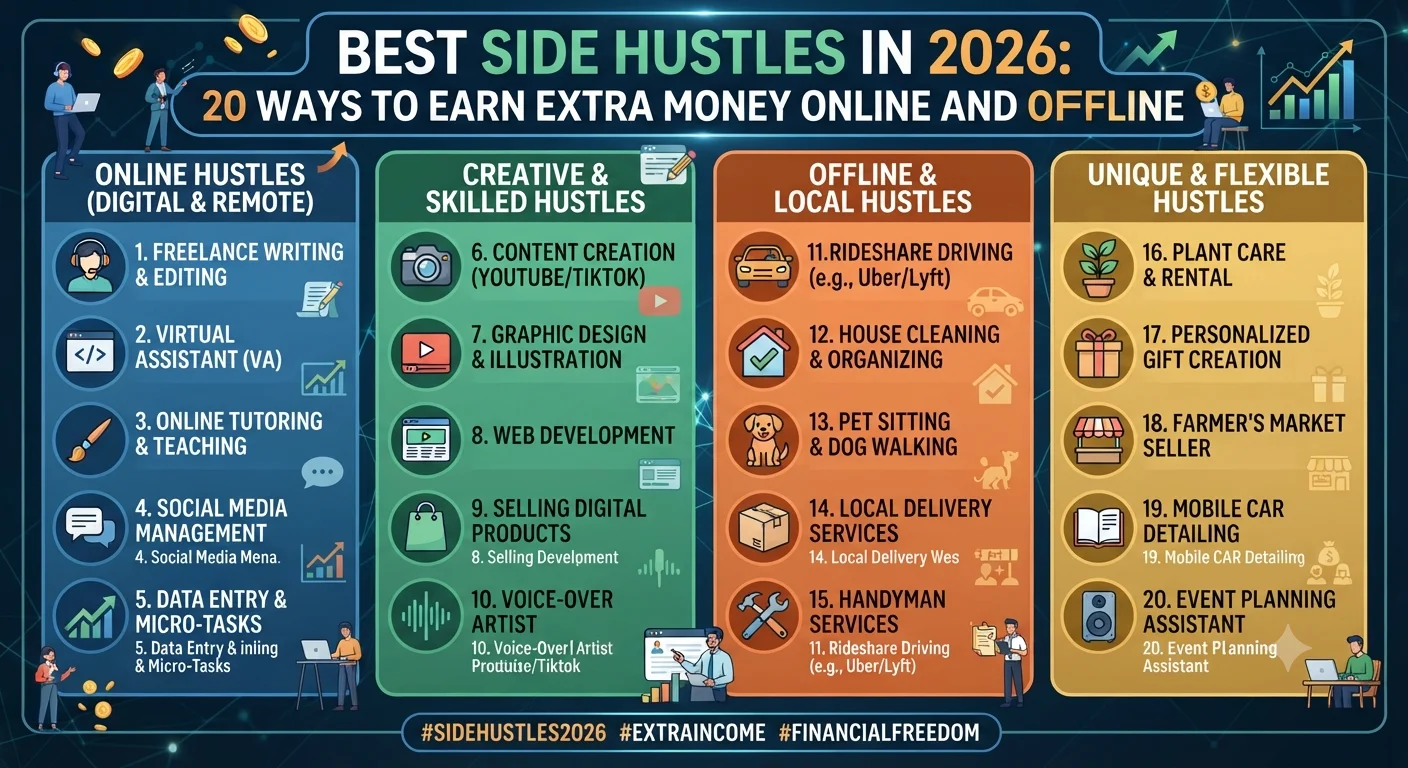
Tip 12: Monetize a skill with a weekend side hustle. A 2025 Bankrate survey found that 45 percent of American adults report having a side hustle. Common monetizable skills include writing, graphic design, tutoring, photography, handyman services, dog walking, and coding. Platforms including Fiverr, Upwork, TaskRabbit, Rover, and Wyzant connect service providers with paying clients. Even five hours per week at a $25 hourly rate generates $500 per month in additional income. Potential additional income: $200 to $2,000 per month.
Tip 13: Ask for a raise using market data. The largest single income increase most salaried employees can achieve requires no second job. It requires one conversation with their employer. The key is preparation: use salary data from Glassdoor, LinkedIn Salary Insights, Levels.fyi (for technology roles), and the Bureau of Labor Statistics to establish your market value. Employees who negotiate compensation at review time receive raises averaging 7.4 percent compared to 3.1 percent for those who do not negotiate, according to a 2024 PayScale study. On a $60,000 salary, that difference is $2,580 in additional annual income. Potential income increase: $2,000 to $10,000 per year.
Recommended Articles
 PERSONAL FINANCE MONEY
 PERSONAL FINANCE MONEY
 PERSONAL FINANCE MONEY
 PERSONAL FINANCE MONEY
Tip 14: Rent out assets you own. If you own a car, a spare room, a parking space, or recreational equipment, these assets can generate income during periods when you are not using them. Platforms including Airbnb (spare rooms and full properties), Turo (personal vehicles), SpotHero (parking spaces), and Fat Llama (equipment and tools) connect asset owners with renters. A spare bedroom on Airbnb in a mid-sized city generates an average of $900 per month, according to Airbnb's 2025 economic report. Renting a personal vehicle on Turo generates an average of $706 per month when actively listed. Potential income: $200 to $1,500 per month.
Tip 15: Leverage employer benefits you are not using. Many employees leave significant compensation on the table by not fully using employer benefits. Common underused benefits include employer 401(k) matching (contributing enough to capture the full match is an immediate 50 to 100 percent return on that portion of your savings), flexible spending accounts (FSAs) and health savings accounts (HSAs) that reduce taxable income, employee discount programs, tuition reimbursement, and wellness stipends. The average value of fully utilized employer benefits beyond salary exceeds $14,000 per year, according to a 2024 Bureau of Labor Statistics compensation report.
Tips 16 Through 20: Automate Your Savings
Automation eliminates the willpower requirement from saving and uses behavioral inertia (the human tendency to continue whatever default behavior is in place) in your favor rather than against you.
Tip 16: Set up automatic paycheck splitting. Most employers and payroll systems allow you to split your direct deposit between multiple bank accounts. Direct a fixed amount or percentage of each paycheck automatically to a separate savings account before it reaches your checking account. The money you never see in your checking account is money you will not spend. This is the principle behind the "pay yourself first" philosophy, advocated by personal finance authors including David Bach in his book "The Automatic Millionaire."
Tip 17: Use a high-yield savings account and automate monthly transfers. As noted above, high-yield savings accounts at online banks paid 4.5 to 5.1 percent APY in mid-2026, compared to 0.46 percent at traditional banks. On a $10,000 balance, this difference generates $404 to $464 more per year in interest income at zero additional effort. Set up automatic monthly transfers from checking to your high-yield savings account on the day after payday.
Tip 18: Automate retirement contributions to the employer match minimum. If your employer offers 401(k) matching (for example, matching 50 percent of contributions up to 6 percent of salary), contributing at least the minimum to capture the full match is mathematically one of the best financial moves available. A 50 percent match is a guaranteed 50 percent return on that portion of your investment before any market growth. Set contributions to automatic and increase them by one percentage point each year using your plan's "auto-escalation" feature, which most 401(k) plans now offer.
Tip 19: Round-up savings applications. Apps including Acorns and Qapital automatically round every debit card purchase up to the nearest dollar and invest or save the difference. While individual round-ups are small (averages of $0.50 per transaction), the accumulated effect across all daily transactions can generate $30 to $60 per month in effortless savings. More importantly, these apps build the psychological habit of saving on every transaction.
Tip 20: Set annual savings rate increases. Each time you receive a raise, immediately increase your automatic savings contribution by half the raise amount. If you receive a 5 percent salary increase, increase your savings rate by 2.5 percent. This approach allows your lifestyle to improve slightly while simultaneously growing your savings rate, without the sacrifice that comes from directing an entire raise to savings.
Tips 21 Through 25: Lifestyle and Mindset Shifts
Sustainable long-term saving requires addressing the psychological and social drivers of spending, not just the mechanical ones.
Tip 21: Practice a no-spend week or month. A no-spend challenge involves committing to zero discretionary spending for a defined period, typically one week or one month. Essential expenses (rent, utilities, groceries, transportation) continue as normal. All optional spending stops entirely. These challenges serve two purposes: they generate immediate savings, and they reveal which spending habits are genuinely fulfilling versus habitual and unconscious. Many participants report that they discover which expenses they genuinely missed and which they did not, providing clarity for permanent spending decisions. Reported average savings from a 30-day no-spend challenge are $500 to $1,500.
Tip 22: Delay lifestyle inflation after income increases. Lifestyle inflation, also called "lifestyle creep," is the nearly universal tendency to increase spending proportionally as income increases, preventing wealth accumulation regardless of how high income grows. The solution is a commitment to maintain current living standards for six to twelve months after any income increase, directing the additional income entirely to savings and debt reduction before allowing discretionary spending to rise. This single habit, consistently applied across a career, is the primary differentiator between high-income people who build wealth and high-income people who remain paycheck to paycheck.
Tip 23: Build a specific, emotionally vivid savings goal. Saving toward something concrete and personally meaningful is dramatically more sustainable than saving abstractly. Research by UCLA behavioral finance professor Hal Hershfield found that people save significantly more when they can vividly imagine their future selves benefiting from the savings. Create a visual representation of your goal (a photo of the house you want to buy, the travel destination you want to visit, or your retirement lifestyle) and associate it concretely with your savings account. Assign your savings account a name in your banking app that reflects the goal ("House Down Payment Fund," "Freedom Fund," "Emergency Safety Net").
Tip 24: Change your social context around spending. Social comparison and peer spending norms powerfully influence individual spending behavior. Research by Jonah Berger at the Wharton School of Business shows that people reliably adjust their spending upward to match the perceived norms of their social group. If your social circle regularly dines at expensive restaurants, takes luxury vacations, and buys new cars, maintaining frugal habits requires constant counter-cultural effort. Strategies to manage this include suggesting lower-cost social activities (cooking at home together, free community events, outdoor activities), being honest with trusted friends about your financial goals, and seeking community in personal finance spaces such as the r/personalfinance subreddit (which has over 20 million members as of 2026) or local personal finance meetup groups.
Tip 25: Measure your savings rate, not just your savings balance. Tracking your savings rate (savings as a percentage of income) rather than your absolute savings balance provides a more psychologically motivating and financially meaningful metric. A savings rate of 20 percent on a $40,000 salary is objectively stronger than a savings rate of 5 percent on an $80,000 salary, yet the absolute numbers might mislead. Financial independence research, including the foundational "Your Money or Your Life" framework by Vicki Robin and Joe Dominguez, demonstrates that savings rate is the primary determinant of time to financial independence, regardless of absolute income level.
Free Apps and Tools to Track Your Savings in 2026
Copilot Money (iOS only, $13/month) is widely regarded as the most sophisticated personal finance tracking app in 2026, using AI to automatically categorize transactions, identify spending patterns, and flag unusual charges.
YNAB (You Need a Budget, $14.99/month) uses a zero-based budgeting philosophy and has a strong track record of behavior change. YNAB reports that new users save an average of $600 in their first two months and over $6,000 in their first year.
Mint, which was shut down by Intuit in December 2023, has been replaced by alternatives including NerdWallet's free budgeting tool and the relaunched Monarch Money platform as the leading free option.
Personal Capital (now Empower) offers free financial dashboard features including net worth tracking and investment fee analysis, with optional paid wealth management services.
Google Sheets or Microsoft Excel remain the most customizable and entirely free budgeting tools for those willing to build their own system. Dozens of free personal finance templates are available from sources including NerdWallet, Vertex42, and Reddit's personal finance community.
How Much Should You Have Saved by Age? (2026 Benchmarks)
Financial planning benchmarks provide useful reference points, though individual circumstances vary substantially.
Fidelity Investments, one of the largest retirement plan administrators in the world, recommends the following retirement savings benchmarks measured as multiples of annual salary: one times salary saved by age 30, three times by age 40, six times by age 50, eight times by age 60, and ten times by age 67.
For emergency funds, the conventional standard is three to six months of essential living expenses held in a liquid, accessible savings account. A 2024 Federal Reserve report found that households with emergency funds covering at least three months of expenses were 60 percent less likely to take on high-interest debt after an unexpected financial shock compared to households with no emergency savings.
For wealth benchmarks beyond retirement savings, a useful reference is the "Millionaire Next Door" research by Thomas Stanley and William Danko, who defined expected net worth as age multiplied by pre-tax annual income divided by ten. If you are 40 years old with a $70,000 income, your expected net worth by this formula is $280,000.
Frequently Asked Questions About Saving Money in 2026
How much money should I save per month?
The standard personal finance recommendation is to save at least 20 percent of net (after-tax) income, split between emergency savings, retirement contributions, and other financial goals. If 20 percent is not immediately achievable, start with whatever amount is possible, even $25 per week, and increase by one percentage point every three months.
What is the fastest way to save $1,000?
Selling unused household items on Facebook Marketplace or eBay can generate $200 to $500 quickly. Eliminating subscriptions and dining out for 30 days while working extra hours or a brief side hustle can close the gap. With focused effort, most people can accumulate $1,000 in four to eight weeks.
Is it better to pay off debt or save money?
The mathematically optimal approach depends on interest rates. Pay off debt with interest rates above your savings account APY first. If your credit card charges 22 percent APR and your savings account earns 5 percent APY, every dollar applied to the credit card generates a guaranteed 22 percent return (in avoided interest). Always maintain a small emergency fund (at least $500 to $1,000) even while aggressively paying down debt, to prevent new debt accumulation when unexpected expenses arise.
How can I save money when I live paycheck to paycheck?
Start with the smallest possible automatic savings: even $10 per paycheck establishes the habit and account. Then systematically audit expenses using your bank statement to identify the single easiest cut. Many people discover subscription charges they had forgotten. Reducing one expense category meaningfully (dining out, streaming services, one subscription) often frees $50 to $100 per month immediately.
What is a high-yield savings account and is it safe?
A high-yield savings account (HYSA) is a savings account, typically offered by online banks, that pays a substantially higher interest rate than traditional bank savings accounts. HYSAs at FDIC-insured institutions (Marcus by Goldman Sachs, Ally Bank, SoFi, Discover Bank, American Express National Bank) carry the same federal deposit insurance protection as traditional banks, covering up to $250,000 per depositor per institution. They are as safe as any FDIC-insured bank account.
Can I save money on a low income?
Yes, though it requires more effort and precision. The key principles remain identical regardless of income: track spending to identify waste, automate even small savings amounts, reduce the highest-cost variable expenses first (food and transportation typically offer the most room on tight budgets), and aggressively pursue income increases through negotiation, job changes, or supplemental income. Community resources including food banks, utility assistance programs (LIHEAP), and healthcare subsidies (the Affordable Care Act marketplace) can meaningfully reduce essential expenses for low-income households.