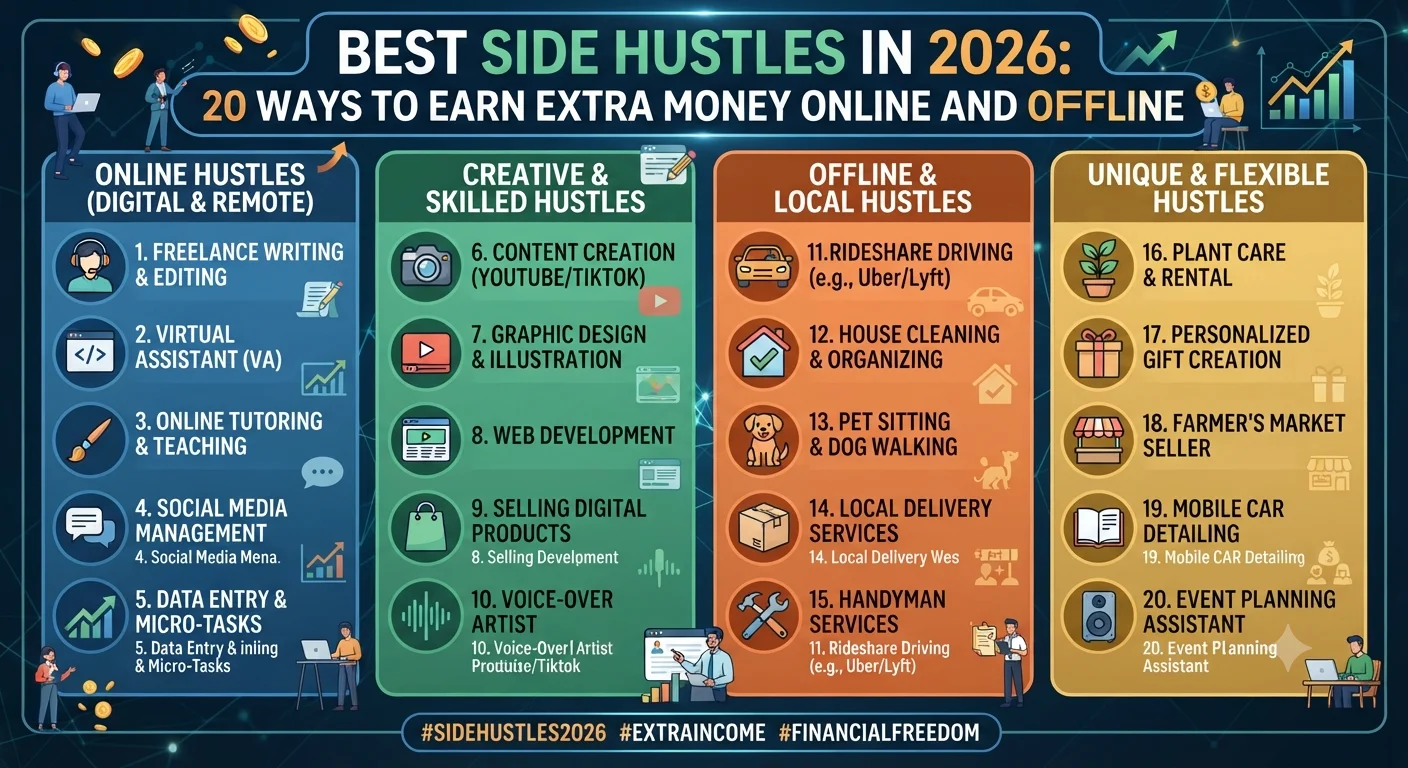
The best side hustles in 2026 combine low startup costs with scalable income potential. Freelance services (writing, design, coding), AI-assisted content creation, online tutoring, and selling digital products represent the highest return opportunities for most people. Offline side hustles including local service businesses and asset rental also remain strong. The right choice depends on your existing skills, available time, and income goals.
Key Takeaways
- A 2025 Bankrate survey found that 45 percent of American adults have a side hustle, up from 34 percent in 2021.
- The median monthly income from side hustles is $473, according to Bankrate's 2025 Side Hustles Report, though top earners in high-demand skills earn $3,000 to $10,000 per month.
- AI tools have dramatically lowered the skill threshold for many digital side hustles, while simultaneously increasing competition in content-based categories.
- The IRS defines side hustle income as self-employment income, meaning you pay self-employment tax of 15.3 percent on net earnings above $400. Setting aside 25 to 30 percent of side hustle income for taxes is advisable.
- The most successful side hustles in 2026 are those that build on existing skills, serve a specific audience, and have a clear path to increased rates or passive income over time.
Why Side Hustles Are Essential in 2026
- Key Takeaways
- Why Side Hustles Are Essential in 2026
- Top 20 Side Hustles in 2026 Ranked by Earning Potential
- 1. Freelance Writing and Content Creation
- 2. AI Prompt Engineering and Consulting
- 3. Online Tutoring and Teaching
- 4. Dropshipping and Print-on-Demand
- 5. YouTube Channel Monetization
- 6. Affiliate Marketing
- 7. Virtual Assistant Services
- 8. Social Media Management
- 9. Selling Digital Products
- 10. Freelance Graphic Design
- 11. Delivery and Rideshare Driving
- 12. Photography and Videography Services
- 13. Reselling and Flipping
- 14. Bookkeeping and Accounting Services
- 15. Podcast Editing and Production
- 16. Web Development and Design
- 17. Transcription and Closed Captioning
- 18. Language Translation Services
- 19. Resume Writing and Career Coaching
- 20. AI-Assisted Content Repurposing Services
- How to Choose the Right Side Hustle for You
- How Much Can You Realistically Earn? Income Ranges by Category
- Frequently Asked Questions About Starting a Side Hustle in 2026
The economic case for developing supplemental income has strengthened considerably over the past five years. Inflation between 2021 and 2024 reduced the purchasing power of stagnant wages, and while wage growth has improved since then, many workers found that a single income stream provides insufficient financial resilience.
A 2025 Federal Reserve report on household economic wellbeing found that 36 percent of American adults experienced income volatility significant enough to affect their ability to pay monthly bills. Side hustle income acts as a buffer against this volatility, providing security that a single employer-dependent income cannot.
Beyond financial security, side hustles in 2026 offer two additional strategic benefits. First, many side hustles develop skills (digital marketing, project management, client communication, financial literacy) that increase long-term career value regardless of whether the side hustle becomes a primary business. Second, side hustle income, when directed entirely toward savings and investment, dramatically accelerates timelines to financial goals including emergency funds, down payments, and retirement.
The following 20 side hustles are ranked roughly by their combination of accessibility, income potential, and scalability, though individual results vary significantly based on skill level, effort, and market positioning.
Top 20 Side Hustles in 2026 Ranked by Earning Potential
1. Freelance Writing and Content Creation
Freelance writing remains one of the most accessible and scalable side hustles for people with strong writing ability. The demand for high-quality written content continues to grow despite (and in some ways because of) AI writing tools, as businesses increasingly need human writers to produce credible, expert, nuanced content that AI struggles to replicate authentically.
Specialization is the key to earning above-average rates. Generalist writers on platforms like Fiverr and Upwork often compete at $0.03 to $0.07 per word. Specialists in technical writing, financial services content, medical writing, SaaS product content, or legal writing command $0.15 to $0.50 per word. A technical writer producing 4,000 words per week at $0.25 per word earns $1,000 per week, or $52,000 per year, as a side income.
Platforms to find clients include Upwork, Clearscope Marketplace, ProBlogger Jobs Board, LinkedIn, and direct outreach to businesses in your specialty area.
Typical monthly earnings range from $300 to $500 for beginners with generalist skills to $2,000 to $8,000 per month for experienced specialists with a client roster.
2. AI Prompt Engineering and Consulting
AI prompt engineering is one of the genuinely new and fast-growing side hustle categories of 2026. As businesses in every industry adopt AI tools including ChatGPT, Claude, Gemini, and industry-specific AI platforms, they need professionals who understand how to design effective prompts, build AI workflows, evaluate AI output quality, and train staff on AI tool usage.
AI consultants and prompt engineers working independently charge $75 to $250 per hour, with project rates for building custom GPT workflows, AI automation systems, or AI content pipelines ranging from $1,000 to $15,000.
Entry into this field requires genuine expertise with major AI platforms, understanding of prompt engineering principles (chain-of-thought prompting, few-shot learning, system prompt design), and familiarity with at least one specific industry domain. Certifications from platforms including Coursera (DeepLearning.AI courses), Anthropic's documentation, and OpenAI's API documentation provide structured learning paths.
Typical monthly earnings range from $500 to $3,000 for part-time consulting.
3. Online Tutoring and Teaching
Online tutoring is experiencing sustained demand growth driven by the permanent shift to remote learning infrastructure established during the COVID-19 pandemic and the ongoing academic pressure felt by students at all levels.
High-demand tutoring subjects in 2026 include mathematics (especially statistics and calculus for university students), test preparation (SAT, ACT, GRE, GMAT, LSAT), English as a Second Language (ESL) for non-native speakers, computer science and programming, and AP-level high school subjects.
Platforms including Wyzant, Tutor.com, Preply, and Cambly connect tutors with students. Wyzant tutors in high-demand subjects set their own rates, with experienced tutors in math, science, and test prep charging $60 to $150 per hour. Preply ESL tutors average $15 to $25 per hour at the platform rate.
Independent tutors who build their own client base through word of mouth, local community platforms, and social media can charge premium rates ($80 to $200 per hour for specialized subjects) without platform fees.
Typical monthly earnings range from $400 to $1,200 on platforms, and $800 to $4,000 for independent tutors with a full client schedule.
4. Dropshipping and Print-on-Demand
Dropshipping allows you to operate an online store selling physical products without holding inventory. When a customer places an order, you forward it to a supplier who ships directly to the customer, and you keep the margin between your retail price and the wholesale cost.
Print-on-demand (POD) is a variation where custom designs (t-shirts, mugs, phone cases, wall art, tote bags) are printed and shipped on demand by a fulfillment partner such as Printful, Printify, or SPOD. You design the products and set prices; the partner handles production and shipping.
The primary challenge of both models is marketing. Finding winning products through market research (tools including Jungle Scout, Helium 10, and the Minea platform for ad analysis), targeting the right audience through Facebook and Instagram advertising or organic social media, and maintaining sufficient margins after advertising costs is the core skill set required.
Successful dropshipping and POD stores in 2026 focus on specific niches (pet products, hobby communities, cultural affinity items) rather than competing in broad categories where Amazon dominates.
Typical monthly earnings range from $0 to $500 in the first three months (high learning curve) to $1,500 to $8,000 per month for established stores with proven products and traffic.
5. YouTube Channel Monetization
YouTube content creation requires the longest time investment before income materializes but offers one of the most scalable passive income ceilings of any side hustle. YouTube requires a channel to reach 1,000 subscribers and 4,000 watch hours in the past twelve months to qualify for the YouTube Partner Program and begin earning from advertising.
The average YouTube CPM (cost per thousand views, paid to the creator) ranges from $1 to $7 for most niches, with personal finance, business, technology, and health channels consistently earning $5 to $15 CPM due to high advertiser demand in those categories.
Beyond ad revenue, successful YouTube channels generate income through brand sponsorships (typically paying $500 to $50,000 per video depending on subscriber count and engagement), channel memberships, merchandise, and affiliate link commissions from product recommendations.
Niche selection is the most important early decision. Channels covering specific subjects (AI tools reviews, personal finance for millennials, specific programming languages, fitness for a particular demographic) grow faster than broad interest channels and earn higher CPMs.
Typical monthly earnings range from $0 to $200 in the first year, growing to $1,000 to $15,000 or more per month for channels with 50,000 to 200,000 subscribers in high-CPM niches.
6. Affiliate Marketing
Affiliate marketing involves promoting other companies' products or services and earning a commission when someone purchases through your referral link. It is one of the most popular online business models because it requires no product creation, inventory, or customer service.
The most effective affiliate marketing approaches in 2026 combine content with strong SEO. A blog, YouTube channel, newsletter, or social media presence that provides genuinely useful information attracts an audience with purchase intent, and affiliate link placements within that content generate commissions.
High-paying affiliate programs include software-as-a-service (SaaS) products (commonly paying 20 to 40 percent recurring monthly commissions for every customer you refer), financial products (credit cards paying $100 to $300 per approved applicant, investment platforms, insurance), and online courses (typically paying 30 to 50 percent of sale price).
Amazon Associates, the largest affiliate program globally, pays 1 to 10 percent commissions depending on category, with physical products. High-value affiliate income typically comes from digital products and financial services rather than physical retail.
Typical monthly earnings range from $100 to $500 for new affiliate marketers with small audiences, growing to $2,000 to $20,000 or more per month for established content creators with substantial organic traffic.
7. Virtual Assistant Services
Virtual assistants (VAs) provide administrative, operational, or technical support to businesses and entrepreneurs remotely. As more businesses operate with lean teams and rely on remote talent, VA demand has expanded significantly.
General VAs handle tasks including email management, calendar scheduling, customer service, data entry, research, and social media scheduling. Specialized VAs with expertise in specific tools or domains (Amazon seller management, real estate transaction coordination, executive support for startup founders, podcast production assistance) command significantly higher rates.
General VA rates range from $15 to $35 per hour. Specialized VAs in high-demand areas including Amazon FBA store management, e-commerce operations, and executive assistance for fast-growing startups charge $40 to $75 per hour.
Platforms including Belay, Time Etc, 24/7 Virtual Assistant, and direct outreach via LinkedIn and virtual assistant Facebook groups are the primary channels for finding clients.
Typical monthly earnings range from $800 to $2,500 for 20 hours per week of general VA work.
8. Social Media Management
Businesses of all sizes need consistent, professional social media presence but frequently lack the time or expertise to manage it internally. Social media managers handle content creation, scheduling, community engagement, and performance reporting.
A social media manager serving five to eight small business clients, each paying $500 to $1,500 per month for management of two to three platforms, generates $2,500 to $12,000 per month in revenue for 20 to 30 hours of work per week.
Specialization increases rates substantially. Social media managers who specialize in specific industries (restaurants, real estate agencies, law firms, e-commerce brands) or specific platforms (TikTok strategy and growth, LinkedIn B2B lead generation, Instagram for product brands) command higher rates than generalists.
Essential skills include platform-specific content strategy, basic graphic design (Canva for most needs), copywriting, analytics interpretation, and familiarity with scheduling tools including Hootsuite, Buffer, Later, and Sprout Social.
Typical monthly earnings range from $1,500 to $8,000 per month for part-time social media management with 5 to 8 clients.
9. Selling Digital Products
Digital products, including e-books, templates, courses, presets, stock photos, music, and software tools, represent one of the highest-margin side hustle models because they require creation once and can sell repeatedly without additional production cost.
Platforms for selling digital products include Gumroad, Etsy (digital products are a significant Etsy category), Shopify, Lemon Squeezy, and Teachable or Kajabi for online courses.
Recommended Articles
 PERSONAL FINANCE MONEY
 PERSONAL FINANCE MONEY
 PERSONAL FINANCE MONEY
 PERSONAL FINANCE MONEY
The most successful digital product creators identify specific pain points their target audience experiences, create a product that solves those pain points concisely, and invest in marketing the product through content, email lists, and social media.
High-performing digital product categories in 2026 include Notion and Obsidian productivity templates ($10 to $50 each), Canva social media template packs ($15 to $45), financial planning spreadsheets ($20 to $100), online mini-courses on specific skills ($97 to $497), and AI prompt libraries for specific industries ($20 to $150).
Typical monthly earnings range from $100 to $500 for new sellers with small audiences to $2,000 to $15,000 or more per month for established creators with significant email lists or social followings.
10. Freelance Graphic Design
Graphic design services including logo creation, brand identity packages, marketing materials, social media graphics, and web design remain in sustained demand. Platforms including 99designs, DesignCrowd, Fiverr, and Dribbble connect designers with clients globally.
Entry-level designers charge $25 to $50 per hour. Experienced brand identity designers and UI/UX specialists command $75 to $200 per hour. A logo design project typically bills at $300 to $2,000 depending on complexity and client budget.
Tools including Adobe Creative Cloud, Figma (for UI/UX work), and Canva reduce the software investment required, though professional-tier work generally requires Illustrator and Photoshop proficiency.
Typical monthly earnings range from $500 to $2,000 for part-time freelance design work.
11. Delivery and Rideshare Driving
For those who prefer physical work and flexible hours, gig economy platforms offer immediate income with no special skills required. DoorDash, Uber Eats, Instacart, Shipt, and Amazon Flex are the leading food and package delivery platforms. Uber and Lyft dominate rideshare.
Delivery and rideshare earnings vary significantly by city, hours, and optimization of working hours around peak demand periods (weekend evenings, lunch hours, sporting events). The Bureau of Labor Statistics reports median hourly earnings of $15 to $22 for gig delivery workers before accounting for vehicle expenses.
Vehicle depreciation, fuel, insurance, and maintenance are significant costs that reduce net income. Tracking mileage with an app like Stride for tax deduction purposes is essential for managing this expense.
Typical monthly earnings (part-time, 15 to 20 hours per week): $600 to $1,400 after expenses.
12. Photography and Videography Services
Photography and video production for events, businesses, and content creators represent a creative side hustle with strong income potential for those with technical skills and equipment.
Wedding photography is the highest-paying photography niche, with entry-level photographers charging $1,200 to $2,500 per wedding and experienced photographers commanding $3,000 to $10,000 or more. A photographer booking ten weddings per year at an average of $2,500 earns $25,000 in supplemental income.
Business photography including headshots, product photography, real estate photography, and architectural photography provides steadier, less seasonal income at $100 to $500 per session.
Stock photography and videography on platforms including Shutterstock, Getty Images, and Adobe Stock generate passive income from existing assets, though earnings per download are modest ($0.25 to $5 typically) and require a substantial portfolio to produce meaningful monthly income.
Typical monthly earnings range from $500 to $4,000 for part-time event photographers depending on booking frequency.
13. Reselling and Flipping
Buying undervalued items and reselling them at a profit, commonly called "flipping," is a time-tested side hustle that has grown substantially with the mainstream adoption of online marketplaces.
Successful flippers focus on specific categories where they develop expertise in pricing and demand: vintage clothing and sneakers on Poshmark and StockX, used electronics on eBay and Back Market, furniture and home goods on Facebook Marketplace, and rare books and collectibles on eBay and AbeBooks.
Profit margins of 50 to 200 percent on purchased items are common for experienced flippers who source from thrift stores, estate sales, garage sales, and liquidation auctions.
Typical monthly earnings range from $300 to $2,000 for part-time flippers.
14. Bookkeeping and Accounting Services
Small businesses need accurate financial records but frequently cannot afford or do not need a full-time accountant. Freelance bookkeepers provide monthly bookkeeping services for $200 to $800 per month per client, depending on transaction volume.
Credentials help but are not legally required for bookkeeping (as opposed to public accounting). Many freelance bookkeepers are certified QuickBooks ProAdvisors (certification is free through Intuit) and market themselves to small business owners through LinkedIn, local business networking groups, and referrals.
A freelance bookkeeper serving eight to ten small business clients part-time can generate $2,000 to $6,000 per month working fifteen to twenty hours per week.
15. Podcast Editing and Production
Podcasting has grown into a major content medium, with over 4 million active podcasts as of 2026 according to Podcast Index data. Most podcast hosts lack the technical skills or time to edit and produce their audio professionally, creating consistent demand for freelance editors.
Podcast editors charge $50 to $300 per episode depending on length, complexity, and deliverables (audio editing only versus full production including show notes, chapter markers, audiogram clips, and transcripts). An editor processing four to six episodes per week at $150 each earns $2,400 to $3,600 per month.
Software tools including Adobe Audition, Descript (which allows text-based audio editing), and Hindenburg Journalist are industry standard. Descript's AI-powered editing features have significantly reduced the time required per episode for editors who learn the workflow.
16. Web Development and Design
Web development remains one of the highest-paying freelance skills available. The demand for websites, web applications, landing pages, and e-commerce stores consistently exceeds the supply of qualified developers.
Entry-level web developers (HTML, CSS, JavaScript, basic WordPress) charge $30 to $60 per hour. Mid-level developers with framework expertise (React, Vue, Node.js) command $75 to $150 per hour. Full-stack developers and those specializing in e-commerce (Shopify, WooCommerce) or complex web applications charge $100 to $200 per hour.
Website project rates typically range from $1,500 to $5,000 for simple business websites to $10,000 to $50,000 or more for complex custom applications.
Platforms including Toptal (highly curated, premium rates), Upwork, and Clutch, as well as direct client relationships built through LinkedIn and industry networks, are the primary channels for freelance web development work.
17. Transcription and Closed Captioning
Audio and video transcription services convert spoken content into written text for podcasts, videos, legal proceedings, medical records, and academic research. While AI transcription has improved substantially, human review and correction remains necessary for accuracy in many professional contexts.
Transcription platforms including Rev.com, TranscribeMe, and GoTranscript pay $0.45 to $1.25 per audio minute for general transcription, with legal and medical transcription paying $0.60 to $2.50 per minute due to specialized vocabulary requirements.
For a fast typist comfortable with audio work, transcribing three to four hours of audio per workday generates $150 to $400 per day of supplemental income.
18. Language Translation Services
Fluent speakers of languages in high professional demand (Spanish, Mandarin, French, German, Portuguese, Arabic, Japanese, Korean) can offer freelance translation services for documents, websites, legal contracts, marketing materials, and software interfaces.
Translation rates range from $0.05 to $0.20 per word for general content to $0.15 to $0.40 per word for technical, legal, or medical translation. A translator producing 2,000 words of financial translation per day at $0.15 per word generates $300 per day or $6,000 per month.
Platforms including ProZ.com, TranslatorsCafe, and Gengo connect translators with clients. Direct outreach to translation agencies and legal or medical practices that serve bilingual populations is also effective.
19. Resume Writing and Career Coaching
The job market volatility of the past five years has created sustained demand for professional resume writing, LinkedIn profile optimization, interview coaching, and career transition consulting.
Resume writers charge $150 to $600 for a professional resume package depending on career level (entry-level, mid-career, executive). LinkedIn profile optimization services charge $100 to $400. Interview coaching commands $100 to $300 per hour.
Career coaches working with professionals in corporate transitions, executive job searches, or career pivots charge $200 to $500 per coaching session and often work with clients on retainer contracts of $1,500 to $5,000 per month.
Certification through organizations including the Professional Association of Resume Writers (PARW) and the International Coaching Federation (ICF) adds credibility, though client results and testimonials are ultimately the most persuasive marketing asset.
20. AI-Assisted Content Repurposing Services
One of the genuinely new side hustle categories of 2026 is AI-assisted content repurposing. Businesses with existing content libraries (blog posts, webinars, podcast episodes, video content) need that content adapted and reformatted for different channels: a webinar becomes a blog series, a blog post becomes a LinkedIn newsletter, a podcast becomes YouTube shorts, and so on.
Content repurposing specialists use AI tools including ChatGPT, Claude, Descript, and OpusClip to dramatically accelerate the reformatting process, then apply human judgment, brand knowledge, and editing to produce polished output.
Rates range from $500 to $3,000 per month per client for ongoing repurposing packages, with project rates for one-time content library repurposing campaigns ranging from $1,000 to $10,000.
How to Choose the Right Side Hustle for You
Selecting the right side hustle requires honest assessment of four variables.
Your existing skills determine where you can add value without a prohibitive learning curve. A software developer should not start with photography as a side hustle when web development consulting could immediately earn ten times the hourly rate.
Your available time per week determines which models are viable. High-income-per-hour services (consulting, specialized freelancing) maximize hourly return when time is limited. Passive income models (digital products, affiliate marketing, YouTube) require large upfront time investments before generating income but have higher long-term ceilings.
Your income timeline determines how quickly you need results. Service-based side hustles (freelancing, tutoring, delivery) can generate income within weeks. Product-based and content-based models typically require months of investment before meaningful income arrives.
Your long-term goals determine whether you want a side hustle that remains a supplement to your career or one that could eventually become your primary income. Plan accordingly.
How Much Can You Realistically Earn? Income Ranges by Category
| Side Hustle | Monthly Earnings (Part-Time) | Time to First Income |
|---|---|---|
| Freelance Writing | $500 to $4,000 | 2 to 4 weeks |
| AI Consulting | $500 to $3,000 | 2 to 6 weeks |
| Online Tutoring | $400 to $2,500 | 1 to 3 weeks |
| Dropshipping | $0 to $5,000 | 2 to 6 months |
| YouTube | $0 to $3,000 | 6 to 18 months |
| Affiliate Marketing | $100 to $5,000 | 3 to 12 months |
| Virtual Assistant | $800 to $2,500 | 2 to 4 weeks |
| Social Media Management | $1,500 to $8,000 | 2 to 6 weeks |
| Digital Products | $100 to $5,000 | 1 to 6 months |
| Delivery/Rideshare | $600 to $1,400 | Immediate |
Frequently Asked Questions About Starting a Side Hustle in 2026
Do I need to pay taxes on side hustle income?
Yes. The IRS considers side hustle income self-employment income. You must report it on your tax return and pay self-employment tax of 15.3 percent on net income above $400. You may also owe federal and state income tax at your marginal rate. Set aside 25 to 30 percent of gross side hustle income for taxes. Side hustle expenses (equipment, software, advertising, a portion of home office costs) are tax-deductible, reducing your taxable net income.
What is the easiest side hustle to start with no money?
Service-based side hustles that use skills you already possess and find clients through free platforms require the least financial investment. Freelance writing, tutoring, virtual assistant work, and social media management can be started with a laptop, a free portfolio website, and free accounts on Upwork or LinkedIn.
How do I balance a side hustle with a full-time job?
The most successful approach is to treat your side hustle hours as non-negotiable appointments. Block specific hours (early mornings, evenings, weekends) dedicated to side hustle work. Start small with five to ten hours per week to prove the model before scaling. Many people find that their side hustle productivity during ten focused hours per week exceeds what they could accomplish in twenty unfocused hours.
Is it legal to have a side hustle while employed full-time?
In most cases, yes, though you should review your employment contract for non-compete clauses, intellectual property agreements, or moonlighting policies. Non-compete agreements typically apply to direct competitors of your employer, not unrelated side businesses. If your side hustle involves using employer resources, working in the same industry, or soliciting your employer's clients, consult an employment attorney before proceeding.