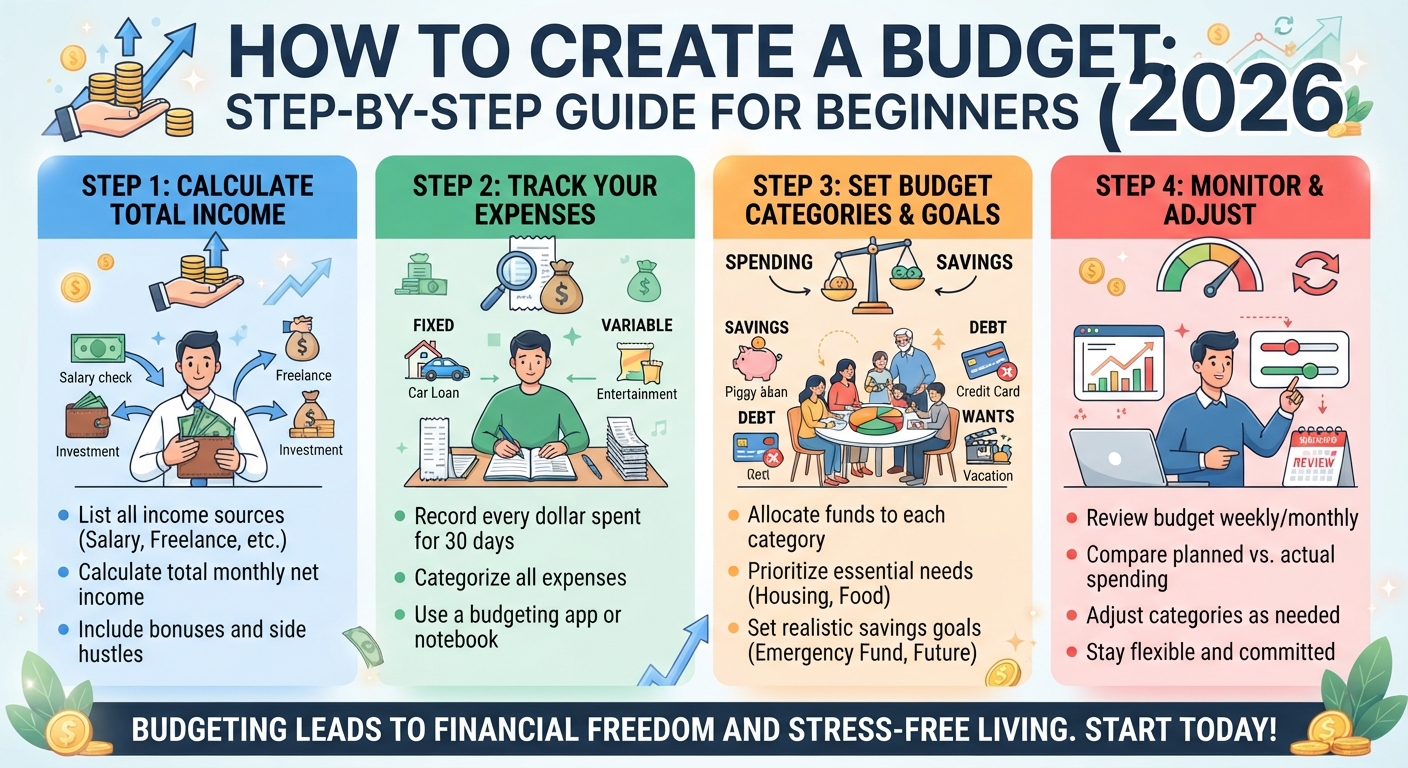
Creating a budget involves six steps: calculating your total after-tax monthly income, listing all fixed expenses, tracking variable expenses for 30 days, choosing a budgeting method, setting savings and debt goals, and reviewing and adjusting each month. The entire process takes less than two hours to set up and approximately 30 minutes per month to maintain. A budget is the foundation of every personal finance goal, from eliminating debt to building wealth.
Key Takeaways
- A 2026 Gallup poll found that only 32 percent of American adults maintain a detailed household budget, despite nearly all financial experts describing budgeting as the single most important financial habit.
- Research by U.S. Bank found that 76 percent of people who live paycheck to paycheck do not have a budget, while 80 percent of people who feel financially secure do have one.
- The average American household has 3.4 credit cards with combined balances, and 47 percent carry balances month to month, paying an average APR of 22.77 percent, according to the Federal Reserve 2026 Consumer Credit Report.
- YNAB (You Need a Budget) reported that new users save an average of $600 in their first two months and over $6,000 in their first year of budgeting.
- Budgeting does not mean restricting every pleasure. Done correctly, it means giving yourself deliberate permission to spend on things you value while eliminating unconscious spending on things you do not.
Why Budgeting Is the Foundation of Financial Health
- Key Takeaways
- Why Budgeting Is the Foundation of Financial Health
- Step-by-Step: How to Create Your First Budget
- Step 1: Calculate Your Total Monthly Income
- Step 2: List All Fixed Expenses
- Step 3: Track Variable Expenses for 30 Days
- Step 4: Choose a Budgeting Method
- The 4 Most Popular Budgeting Methods Compared
- The 50/30/20 Rule: Best for Beginners
- Zero-Based Budgeting: Best for Detail-Oriented Planners
- The Envelope Method: Best for Overspenders
- Pay Yourself First: Best for Savers
- Step 5: Set Savings and Debt Goals
- Step 6: Review and Adjust Monthly
- Best Free Budgeting Apps in 2026
- Common Budgeting Mistakes and How to Avoid Them
- Frequently Asked Questions About Creating a Budget
A budget is not a punishment. It is a plan. The word "budget" derives from the Old French "bougette," meaning a small leather bag or wallet. In its modern form, a budget is simply a plan that tells your money where to go before the month begins, rather than wondering where it went after the month ends.
Without a budget, spending follows the path of least resistance: habitual patterns, impulse decisions, and social influence rather than deliberate choice. Research by behavioral economists Shlomo Benartzi at UCLA and Richard Thaler at the University of Chicago (who won the 2017 Nobel Prize in Economics for his work on behavioral economics) demonstrates that the absence of explicit financial planning systematically leads to present-biased spending at the expense of future financial goals.
A budget is the concrete implementation of intentional financial decision-making. It operationalizes your values (what matters most to you) into specific spending allocations. A person who says they value travel and retirement security but spends heavily on dining out and impulse purchases and saves nothing is not living according to their stated values. A budget makes the alignment (or misalignment) between values and behavior visible and changeable.
The data on financial wellbeing consistently shows that budgeting predicts financial security more reliably than income level. A family earning $60,000 with a disciplined budget consistently builds more wealth than a family earning $100,000 without one. This relationship, documented in Thomas Stanley and William Danko's "The Millionaire Next Door" research and replicated in multiple financial wellness studies, makes budgeting the highest-leverage financial skill available.
Step-by-Step: How to Create Your First Budget
Step 1: Calculate Your Total Monthly Income
Begin with a precise, conservative picture of your total monthly take-home income. Use take-home pay (after taxes and mandatory deductions) rather than gross income, because you cannot budget money you will never receive.
Include all income sources: primary employment net pay (use your most recent pay stubs rather than estimates), any part-time employment, consistent freelance or side hustle income (use a conservative average from the past three months), alimony or child support received, government benefits, investment dividend income, and rental income.
For income that varies month to month (hourly workers, commission-based employees, freelancers, gig workers), use the average of your lowest three months from the past year as your budgeting baseline. This conservative approach prevents budgeting against income you may not actually receive, which is a common cause of budget failure for variable-income earners.
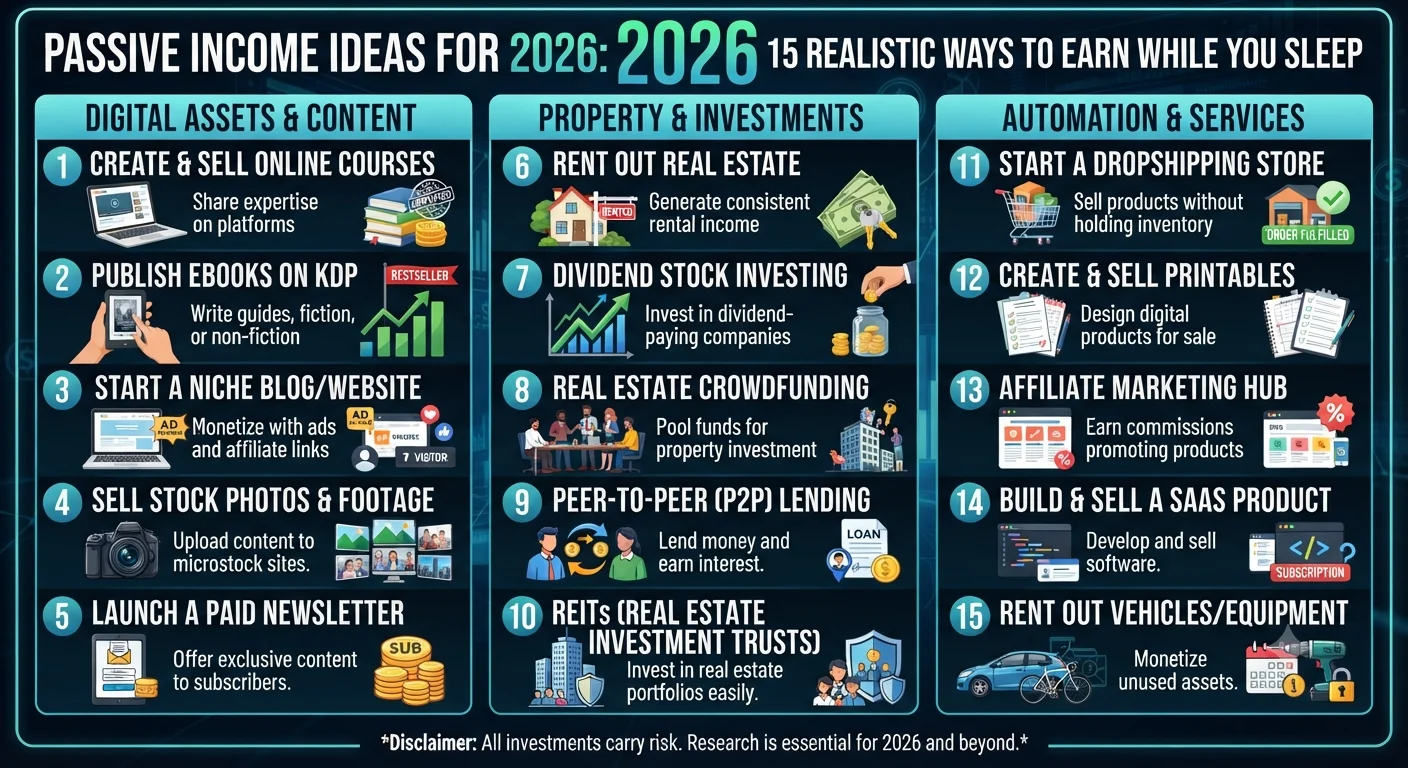
- Passive Income Ideas for 2026: 15 Realistic Ways to Earn While You Sleep
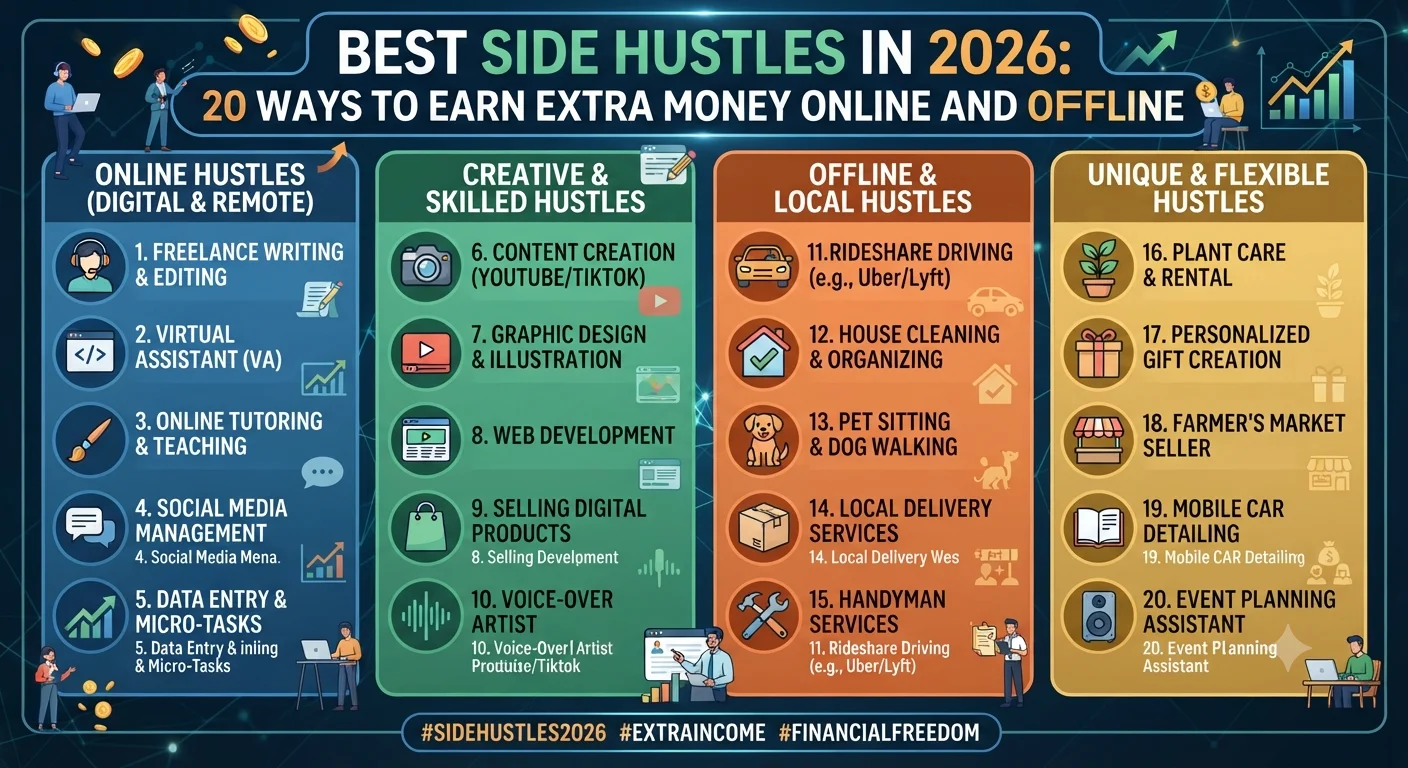
- Best Side Hustles in 2026: 20 Ways to Earn Extra Money Online and Offline
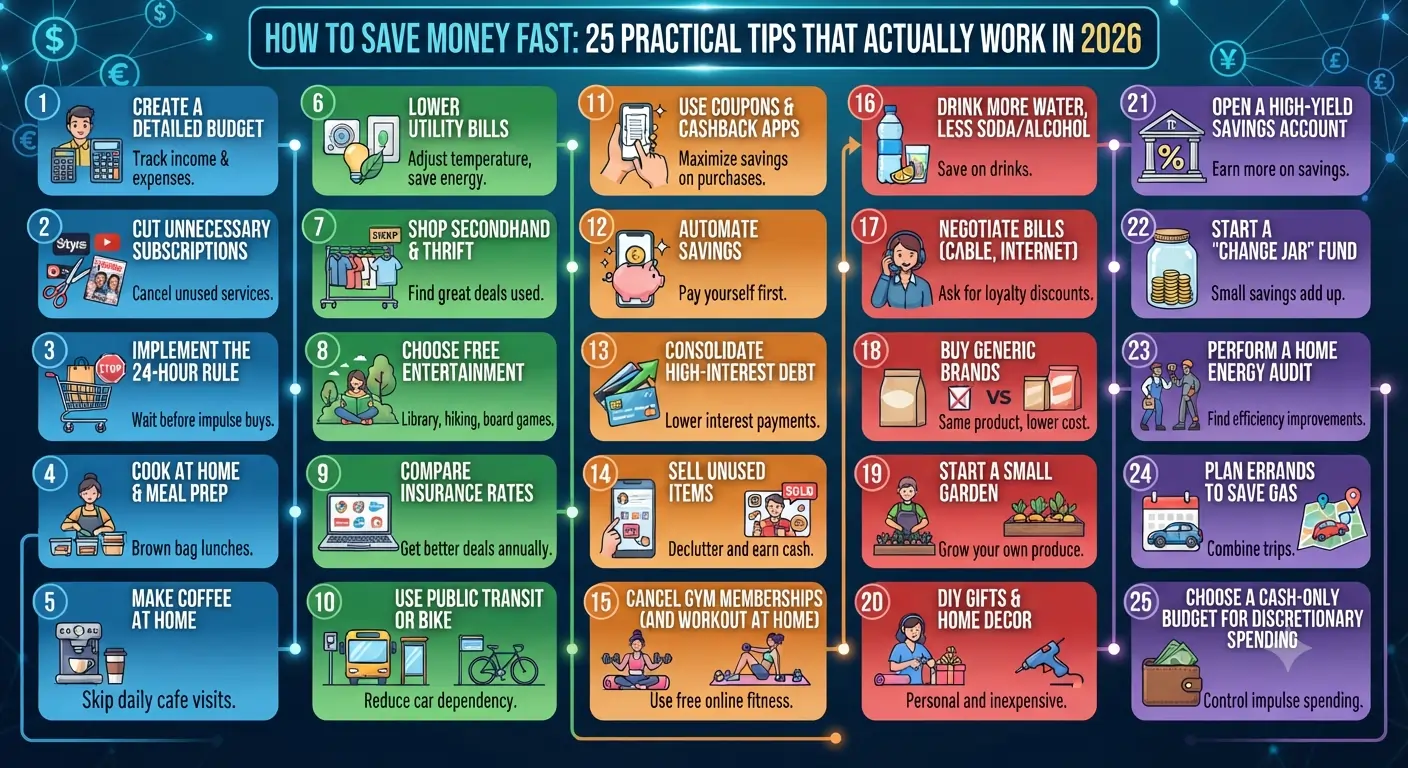
- How to Save Money Fast: 25 Practical Tips That Actually Work in 2026
Do not include potential bonuses, anticipated tax refunds, or hoped-for side hustle income that has not yet materialized. Build your budget on money you reliably have, not money you hope to have.
Step 2: List All Fixed Expenses
Fixed expenses are costs that recur at the same amount each month. They are the non-negotiable baseline of your budget: bills you must pay regardless of what else is happening financially.
Common fixed expenses include rent or mortgage payment, car payment, minimum loan payments (student loans, personal loans), insurance premiums (car, renters or homeowners, health, life), internet and phone bills, gym membership, subscription services (streaming, software, news), childcare, and any other recurring bills paid at a consistent monthly amount.
List each fixed expense with its exact monthly amount. If some bills are paid annually or quarterly (car insurance, domain renewals, some subscriptions), divide the annual amount by twelve and include that monthly equivalent in your budget as a "sinking fund" category. For example, if your car insurance is $1,200 per year, set aside $100 per month so you have the full amount ready when the bill arrives.
Add up your total fixed monthly expenses. This is the floor of your monthly spending: the minimum that goes out regardless of behavior.
Step 3: Track Variable Expenses for 30 Days
Variable expenses are the costs that fluctuate month to month based on your choices and behavior. They include groceries, dining out, gas and transportation costs beyond your car payment, clothing, entertainment, household supplies, personal care, and any other discretionary or irregular spending.
Before you can plan these expenses, you need to know what you are currently spending. Most people are significantly wrong about their variable spending when estimating from memory. The only accurate source is your actual transaction data.
Pull your bank and credit card statements from the past two to three months. Categorize every transaction into logical spending categories (groceries, dining out, entertainment, clothing, personal care, etc.). Use the average across three months for categories with meaningful variation.
If reviewing past statements feels overwhelming, use a budgeting app that connects to your bank accounts and auto-categorizes transactions. Apps including YNAB, Copilot, Monarch Money, and Empower Personal Finance automate this process and provide category spending summaries without manual transaction review.
This analysis almost always reveals spending patterns that surprise and motivate. Seeing that you spent $847 on dining out last month, when you estimated $300, is not a judgment. It is information you can use to make deliberate choices.
Step 4: Choose a Budgeting Method
Multiple effective budgeting methods exist. The right one depends on your personality, financial situation, and what motivates you to stay consistent. The four most widely used approaches are described below.
The 4 Most Popular Budgeting Methods Compared
The 50/30/20 Rule: Best for Beginners
The 50/30/20 rule, introduced by Senator Elizabeth Warren and Amelia Warren Tyagi in their 2005 book "All Your Worth," divides after-tax income into three categories.
Fifty percent to needs: housing, utilities, groceries, transportation, insurance, minimum debt payments, childcare, and other non-negotiable essential expenses.
Thirty percent to wants: dining out, entertainment, subscriptions, travel, hobbies, clothing beyond basics, and any spending on quality-of-life improvements that are not strictly necessary.
Twenty percent to financial goals: savings contributions (emergency fund, retirement, down payment savings), additional debt payments above minimums, and other financial goal funding.
The 50/30/20 rule is the most beginner-friendly method because it requires only three categories rather than twenty. It provides a clear diagnostic framework: if needs exceed 50 percent of income, housing or transportation costs are likely the primary culprit requiring attention. If less than 20 percent goes to financial goals, wants spending is the area requiring reduction.
The limitation of 50/30/20 is its lack of granularity. People who struggle with specific categories (dining out, online shopping, entertainment) need more detailed tracking to manage those categories effectively.
Zero-Based Budgeting: Best for Detail-Oriented Planners
Zero-based budgeting assigns every dollar of monthly income to a specific category, so that income minus all categorized allocations equals zero. The name does not mean you spend everything; savings, investment contributions, and debt payment are all budgeted categories that bring the total to zero.
Example: Monthly take-home income of $4,500 is allocated as follows: $1,200 rent, $400 groceries, $300 utilities and internet, $250 transportation, $200 insurance, $300 dining out and entertainment, $100 clothing, $100 personal care, $500 emergency fund savings, $500 retirement contribution, $200 debt extra payment, $150 travel savings, $300 miscellaneous. Total: $4,500. Every dollar has a job.
Zero-based budgeting is the most powerful method for people serious about maximizing financial progress because it eliminates all unconscious spending. YNAB is built around this philosophy and provides the best software implementation of it.
The limitation is the setup effort and ongoing discipline required. Zero-based budgeting works best for people who find detailed financial management satisfying rather than burdensome.
The Envelope Method: Best for Overspenders
The envelope method is the oldest and most behaviorally direct budgeting approach. Cash is withdrawn at the start of each month and physically divided into labeled envelopes corresponding to spending categories. When an envelope is empty, spending in that category stops for the month.
The behavioral power of envelopes comes from cash's psychological properties. Research on payment transparency consistently shows that paying with physical cash produces lower spending than paying with cards, because the act of handing over cash activates the brain's loss-aversion circuitry in a way that card swipes or digital payments do not.
Recommended Articles
 PERSONAL FINANCE MONEY
 PERSONAL FINANCE MONEY
 PERSONAL FINANCE MONEY
 PERSONAL FINANCE MONEY
The practical challenge of carrying and managing physical cash has made digital envelope systems more common in 2026. Apps including Goodbudget, EveryDollar, and YNAB implement digital envelope logic that preserves the spending limit discipline without requiring physical cash management.
The envelope method is particularly effective for people who consistently overspend in specific categories (groceries, dining out, entertainment) and need a hard behavioral stop rather than a flexible guideline.
Pay Yourself First: Best for Savers
The "pay yourself first" philosophy, popularized by David Bach in "The Automatic Millionaire" and earlier described by George Clason in "The Richest Man in Babylon" (1926), inverts the conventional budgeting sequence.
Rather than spending throughout the month and saving whatever remains (which typically means saving nothing), pay yourself first by automatically transferring your savings and investment contribution amounts on payday, before any discretionary spending occurs. Then live on what remains.
The behavioral advantage is that savings happen automatically and are never "available" to compete with discretionary spending temptations. The limitation is that this method provides less control over specific spending categories: if your remaining income after savings is insufficient for necessary expenses, the method requires adjustment of either savings amounts or fixed expenses.
Pay yourself first works best when combined with an emergency fund (preventing the need to reverse savings for unexpected expenses) and when discretionary spending is sufficiently low relative to remaining income.
Step 5: Set Savings and Debt Goals
A budget without goals is a system without purpose. Specific, concrete financial goals give your budget emotional meaning and directional clarity.
Common initial financial goals in priority order recommended by most certified financial planners include:
Starter emergency fund of $1,000 to cover minor emergencies without going into debt. This is the first priority because without any buffer, any unexpected expense becomes a debt event.
Employer 401(k) match contribution at a minimum. Contributing enough to capture the full employer match is an immediate 50 to 100 percent return on that contribution. No other investment reliably produces this.
High-interest debt elimination (all debt above 7 to 8 percent interest rate) using either the avalanche method (highest interest rate first, mathematically optimal) or the snowball method (smallest balance first, psychologically motivating for many people).
Full emergency fund of three to six months of essential expenses.
Retirement contributions increase and other long-term investment goals.
Write specific, time-bound savings goals with monthly contribution amounts: "Save $5,000 emergency fund by December 2026 by contributing $500 per month" is a concrete target that enables budget reverse-engineering. Divide the goal total by the number of months until the deadline to find the required monthly contribution, then confirm that contribution fits within your 20 percent financial goals allocation.
Step 6: Review and Adjust Monthly
A budget is not a one-time setup but a monthly practice. At the beginning of each month, review last month's actual spending against the plan: which categories were on target, which were over, which were under? Adjust next month's budget based on this information.
This monthly review typically takes 15 to 30 minutes with a budgeting app or 30 to 45 minutes with a manual spreadsheet. Over time, the review reveals patterns, motivates continued engagement through visible progress toward goals, and allows the budget to adapt to life changes (income changes, new expenses, completed debt goals).
The first three months of budgeting are the most difficult as new habits form and the system is calibrated to reflect actual spending patterns accurately. Most people who continue past month three find budgeting becomes significantly less effortful and noticeably more rewarding as progress becomes visible.
Best Free Budgeting Apps in 2026
YNAB (You Need a Budget) is widely regarded as the most effective budgeting app available. It implements zero-based budgeting philosophy with excellent user experience, real-time bank synchronization, and a substantial educational framework. Cost: $14.99 per month or $99 per year. A 34-day free trial is available. College students receive free access for the duration of enrollment. YNAB's reported average user savings of $6,000 in the first year makes the $99 annual cost exceptional value.
Copilot (iOS only) is regarded by many as the most aesthetically refined personal finance app available in 2026. Its AI-powered transaction categorization is highly accurate, and its spending trend visualizations are exceptional. Cost: $13 per month. Free trial available.
Monarch Money is the most popular alternative to YNAB for users who want comprehensive budgeting without YNAB's learning curve. It supports joint financial management for couples, offers goal tracking, investment monitoring, and clean spending reporting. Cost: $14.99 per month.
Empower Personal Finance (formerly Personal Capital) offers a free budgeting dashboard with particularly strong investment tracking and net worth monitoring. The free tier is genuinely capable for most users who want a combined spending and investment view. Optional paid wealth management services are available but not required.
Google Sheets and Microsoft Excel remain the most customizable budgeting tools for those willing to build their own system. Dozens of free templates are available from NerdWallet, Vertex42, and the Reddit r/personalfinance community. A well-designed spreadsheet budget is fully free and can be exactly as detailed as the user needs.
EveryDollar, developed by financial educator Dave Ramsey, implements zero-based budgeting with a simpler interface than YNAB. The free version requires manual transaction entry. The Plus version with bank synchronization costs $17.99 per month or $79.99 per year.
Common Budgeting Mistakes and How to Avoid Them
Being too restrictive in the first month causes most new budgeters to abandon the system when they inevitably overspend in a category. A better approach is to budget generously in the first month based on actual past spending, then gradually reduce discretionary allocations as behavior changes. The budget should fit your actual life before trying to change your actual life.
Forgetting irregular but predictable expenses is the most common mechanical budgeting error. Car registration, annual subscriptions, holiday gifts, back-to-school costs, and medical expenses are irregular but not unexpected. Creating sinking fund categories for these costs (allocating a monthly fraction of their annual total) prevents these expenses from becoming budget-busting emergencies.
Giving up after one bad month is the most expensive mistake in budgeting. No budget survives first contact with reality unchanged. An unexpected car repair, a medical expense, or a social occasion that cost more than planned does not mean budgeting failed. It means the emergency fund category needs more priority. Every month of budgeting, imperfect as it may be, produces more financial control than no budgeting at all.
Treating budget categories as independent rather than interconnected creates cascading failures. When one category goes over, consciously moving money from another less-essential category maintains overall financial integrity rather than abandoning the budget entirely. YNAB calls this "rolling with the punches": the budget is a dynamic tool, not a rigid set of rules that breaks on first deviation.
Not budgeting as a couple when sharing finances is a relationship risk as well as a financial one. Financial disagreements are the leading cause of relationship conflict and a major predictor of separation. Couples who budget together explicitly, with regular money meetings to align on spending decisions, report significantly higher relationship satisfaction and financial progress than those who manage finances independently or avoid financial conversations.
Frequently Asked Questions About Creating a Budget
How much of my income should go to housing?
The widely recommended guideline is that housing costs (rent or mortgage, including utilities) should not exceed 30 percent of gross income. Many financial advisors now use 25 to 28 percent of take-home (after-tax) income as a more conservative benchmark. In high-cost cities like New York, San Francisco, and London, housing costs frequently exceed this guideline, requiring greater restriction in other categories or income growth to maintain financial health.
What should I do if my expenses exceed my income?
If expenses exceed income, two levers are available: reduce expenses or increase income. For immediate relief, prioritize cutting non-essential variable expenses (dining out, subscriptions, entertainment) before addressing fixed expenses, which are harder to change quickly. For sustainable improvement, focusing simultaneously on income growth (asking for a raise, developing marketable skills, starting a side hustle) alongside expense reduction produces faster progress than expense reduction alone.
Should I include my partner's income in my budget?
For couples who share expenses and financial goals, a joint budget that includes both incomes and all shared expenses produces the most accurate picture and avoids the planning gaps that emerge from separate budgeting. A common approach is to pool income for shared expenses and financial goals while maintaining personal "fun money" allocations that each partner manages independently without accountability to the other.
How detailed does my budget need to be?
The right level of detail depends on your financial situation and personality. People with limited income margin need precise category-level tracking because every dollar matters. People with significant financial cushion may need only three to five broad categories to maintain oversight. Start with enough detail to identify where spending deviates from intention, and simplify or expand as experience reveals what level of detail supports your behavior change.
What is the best budgeting method for someone with irregular income?
For freelancers, commission earners, gig workers, and seasonal employees, the "baseline budget" approach works best: budget around your minimum expected monthly income (the worst recent month, not the average), and create a "buffer" or "income holding" account where above-average income months accumulate. Draw a consistent amount from this buffer to fund your budget each month, smoothing income variability into consistent budget execution.