Quick Answer
Cryptocurrency is a form of digital money secured by cryptography and recorded on a blockchain, a distributed ledger that no single entity controls. Bitcoin, created in 2009 by the pseudonymous Satoshi Nakamoto, was the first cryptocurrency and remains the largest by market capitalization. In 2026, over 10,000 cryptocurrencies exist, though the vast majority have little value or legitimate use. Understanding how crypto works, who the real players are, and what the genuine risks are is essential before putting any money into this asset class.
Key Takeaways
- Quick Answer
- Key Takeaways
- What Is Cryptocurrency? A Clear Definition
- How Bitcoin Actually Works
- The Bitcoin Network
- Bitcoin's Fixed Supply
- Bitcoin Wallets and Private Keys
- Types of Cryptocurrency: Beyond Bitcoin
- Ethereum and Smart Contract Platforms
- Stablecoins
- Altcoins, Memecoins, and Speculative Tokens
- How to Buy Cryptocurrency Safely in 2026
- Choosing a Reputable Exchange
- Bitcoin ETFs: The Simplest Access
- Cryptocurrency Security Best Practices
- Real Risks Every Beginner Must Understand
- Frequently Asked Questions About Cryptocurrency
- Bitcoin's total market capitalization reached approximately $1.3 trillion in mid-2026, making it comparable in size to some of the world's largest publicly traded companies, according to CoinMarketCap data.
- The global cryptocurrency market capitalization was approximately $2.4 trillion in mid-2026, down from its all-time high of approximately $3 trillion in November 2021.
- Bitcoin's supply is permanently capped at 21 million coins by its protocol. As of mid-2026, approximately 19.7 million have been mined, leaving fewer than 1.3 million remaining to be created.
- The U.S. Securities and Exchange Commission approved spot Bitcoin ETFs in January 2024, with BlackRock's iShares Bitcoin Trust (IBIT) accumulating over $20 billion in assets within its first year.
- Cryptocurrency remains one of the most volatile asset classes available to investors. Bitcoin has experienced multiple drawdowns exceeding 80 percent from peak to trough, including declines of 83 percent (2018), 77 percent (2022), and shorter-duration drawdowns since.
What Is Cryptocurrency? A Clear Definition
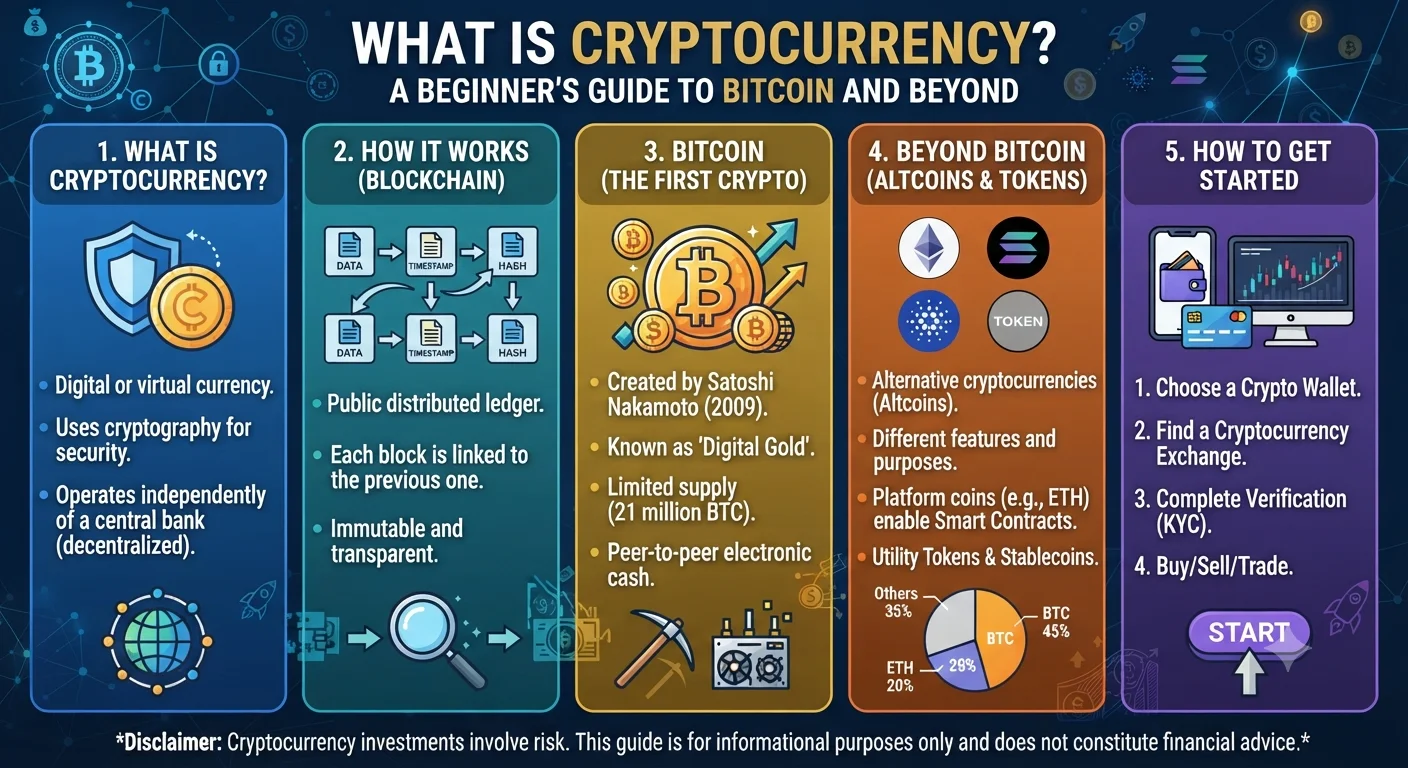
Cryptocurrency is a form of digital currency that uses cryptography to secure transactions, control the creation of new units, and verify the transfer of assets. Unlike traditional currencies (dollars, euros, yen) issued and controlled by central banks and governments, most cryptocurrencies operate on decentralized networks maintained collectively by participants rather than by any single authority.
The "crypto" in cryptocurrency refers to cryptographic techniques, specifically the mathematical algorithms that make it computationally infeasible to counterfeit transactions or create unauthorized new currency units. Every transaction on a cryptocurrency network is signed with a private cryptographic key held by the sender, proving their ownership and authorization of the transfer without requiring a trusted third party like a bank to verify it.
The revolutionary aspect of Bitcoin specifically was not digital money itself (digital payment systems existed long before Bitcoin) but the solution to what computer scientists called the "double-spend problem." In any digital system, a file can be copied infinitely. If digital money were simply a file, the same unit could be spent multiple times. Bitcoin's blockchain, by recording every transaction in a distributed, cryptographically linked ledger that all network participants can verify, solved this problem without requiring a central authority.
How Bitcoin Actually Works
The Bitcoin Network
Bitcoin operates on a peer-to-peer network of computers (nodes) that each maintain a complete copy of the Bitcoin blockchain, the full historical record of every Bitcoin transaction ever made, dating back to the genesis block on January 3, 2009.
When you send Bitcoin to another person, you broadcast a transaction to the network stating that a specific amount of Bitcoin is being transferred from your address to theirs, signed with your private key. Network nodes validate that your address has sufficient balance and that your signature is authentic, then propagate the valid transaction across the network.
Miners, which are specialized computers competing to add new blocks to the blockchain through Proof of Work computation, group pending transactions into blocks and compete to find a valid hash for each block. The winning miner adds the block to the chain and receives a block reward (newly created Bitcoin plus transaction fees). As of the fourth Bitcoin halving in April 2024, the block reward is 3.125 Bitcoin per block, roughly every ten minutes.
Bitcoin's Fixed Supply
One of Bitcoin's most distinctive economic properties is its predetermined maximum supply of 21 million coins. This cap is enforced by the protocol itself, not by any organization or individual. No authority, including Satoshi Nakamoto (assuming they are still alive), has the ability to create additional Bitcoin beyond the protocol's schedule.
The fixed supply is achieved through the halving mechanism: approximately every four years (every 210,000 blocks), the block reward paid to miners is halved. Starting at 50 Bitcoin per block in 2009, rewards have halved to 25, then 12.5, then 6.25, and most recently to 3.125 following the April 2024 halving. This schedule will continue until approximately 2140, when the last fraction of Bitcoin will be mined.
Bitcoin proponents argue that this fixed supply makes Bitcoin a form of "digital gold," with scarcity built into the protocol that cannot be inflated away by any authority. Critics argue that the value of Bitcoin depends entirely on continued demand and network adoption rather than any intrinsic utility or productivity.
Bitcoin Wallets and Private Keys
Owning Bitcoin means controlling a private key, a 256-bit number that proves ownership of a Bitcoin address (similar to an account number on the blockchain). Your private key mathematically generates your public key and Bitcoin address. Anyone can send Bitcoin to your address, but only the holder of the private key can authorize spending from it.
Losing your private key means permanently losing access to the Bitcoin associated with it. Approximately 3.7 to 5 million Bitcoin are estimated to be permanently lost due to forgotten passwords, discarded hardware, and other key loss scenarios, according to Chainalysis research. This represents 17 to 24 percent of all Bitcoin ever mined.
Bitcoin wallets are software or hardware tools that store your private keys and interface with the Bitcoin network. Hardware wallets including Ledger and Trezor store private keys offline, protecting them from internet-based attacks. Software wallets including Electrum, BlueWallet, and the wallets built into exchanges are more convenient but carry greater security risks.
Types of Cryptocurrency: Beyond Bitcoin
The cryptocurrency ecosystem in 2026 extends far beyond Bitcoin. Understanding the major categories helps distinguish potentially legitimate applications from speculative tokens with no clear use case.
Ethereum and Smart Contract Platforms
Ethereum, created by Vitalik Buterin and launched in 2015, extended the blockchain concept beyond currency to programmable smart contracts: self-executing code stored on the blockchain that automatically carries out predefined actions when conditions are met. Ethereum is the foundation for most decentralized finance (DeFi) applications, non-fungible tokens (NFTs), and the majority of new blockchain projects.
Ethereum's transition from Proof of Work to Proof of Stake in September 2022 (The Merge) reduced its energy consumption by approximately 99.95 percent and introduced a deflationary mechanism through fee burning that has made Ethereum's total supply gradually decrease rather than increase over time.
As of mid-2026, Ethereum's market capitalization was approximately $380 billion, making it the second-largest cryptocurrency by a significant margin. Competing "Layer 1" blockchain platforms including Solana, Avalanche, Cardano, and Polkadot offer alternative smart contract environments with different technical trade-offs regarding speed, cost, and decentralization.
Stablecoins
Stablecoins are cryptocurrencies designed to maintain a stable value relative to a reference asset, typically the U.S. dollar. They are the most practically useful category of cryptocurrency for everyday financial transactions because they eliminate the extreme volatility that makes other cryptocurrencies impractical as payment methods.
The major stablecoins in 2026 include Tether (USDT), USD Coin (USDC), and Dai. Together, they had a combined market capitalization exceeding $180 billion, reflecting their essential role in the cryptocurrency ecosystem as the primary medium of exchange between different cryptocurrencies and as a stable store of value within the crypto world.
The regulatory status of stablecoins has been actively contested. The U.S. Stablecoin GENIUS Act, which moved through Congress in 2025, established a federal regulatory framework for stablecoin issuance, requiring reserve transparency, redeemability guarantees, and banking-like oversight for major stablecoin issuers.
Altcoins, Memecoins, and Speculative Tokens
Beyond Bitcoin, Ethereum, and stablecoins exists an enormous category of "altcoins" (alternative coins) ranging from projects with genuine technical development and use cases to pure speculation vehicles with no underlying utility.
Recommended Articles
 PERSONAL FINANCE MONEY
 PERSONAL FINANCE MONEY
 PERSONAL FINANCE MONEY
 PERSONAL FINANCE MONEY
Memecoins, a category popularized by Dogecoin (originally created in 2013 as a joke) and expanded by Shiba Inu, Pepe, and countless others, are cryptocurrencies with no technical differentiation or inherent utility whose value derives entirely from community sentiment, celebrity promotion, and speculative trading. Dogecoin's market capitalization has oscillated between $5 billion and $90 billion since 2021, driven almost entirely by Elon Musk's social media commentary.
- How to Create a Budget: Step-by-Step Guide for Beginners (2026)
- Passive Income Ideas for 2026: 15 Realistic Ways to Earn While You Sleep
- Best Side Hustles in 2026: 20 Ways to Earn Extra Money Online and Offline
The most important fact about altcoins for beginners is the historical performance distribution: research by Dr. Amin Shams at Ohio State University found that the median altcoin loses more than 90 percent of its value within three years of launch. A small number of projects deliver extraordinary returns while the vast majority go to zero. This distribution resembles venture capital more than any conventional investment market and carries commensurate risk.
How to Buy Cryptocurrency Safely in 2026
Choosing a Reputable Exchange
Centralized cryptocurrency exchanges (CEXs) are platforms that allow you to purchase cryptocurrency with fiat currency (dollars, euros, etc.) and trade between cryptocurrencies. In 2026, the most established and regulated exchanges serving U.S. customers include Coinbase (publicly traded on Nasdaq since 2021), Kraken, Gemini, and Fidelity Crypto (for existing Fidelity customers).
The collapse of FTX in November 2022, which resulted in the loss of approximately $8 billion in customer funds and the criminal conviction of founder Sam Bankman-Fried, demonstrated the catastrophic risk of holding cryptocurrency on exchanges that co-mingle customer funds with company assets. The lesson is universally repeated by cryptocurrency security experts: "Not your keys, not your coins." Any cryptocurrency left on an exchange is at risk if the exchange fails, is hacked, or engages in fraud.
When selecting an exchange, verify that it is registered with relevant financial regulators (FinCEN in the United States, FCA in the United Kingdom, ASIC in Australia), that it maintains audited proof of reserves demonstrating that customer assets are fully backed, and that it carries cybersecurity insurance. Coinbase, Kraken, and Gemini are among the most regulated and transparent major exchanges as of 2026.
Bitcoin ETFs: The Simplest Access
For investors who want Bitcoin exposure without managing private keys, hardware wallets, or exchange accounts, the spot Bitcoin ETFs approved by the SEC in January 2024 provide the simplest and most regulated access. These ETFs hold actual Bitcoin on behalf of investors, with shares tradeable through any standard brokerage account.
The major Bitcoin ETFs available in 2026 include BlackRock's iShares Bitcoin Trust (IBIT), Fidelity Wise Origin Bitcoin Fund (FBTC), ARK 21Shares Bitcoin ETF (ARKB), and VanEck Bitcoin ETF (HODL). These funds charge annual management fees of 0.19 to 0.39 percent, significantly lower than early cryptocurrency funds.
The SEC approved spot Ethereum ETFs in May 2024, providing similar regulated access to the second-largest cryptocurrency.
Cryptocurrency Security Best Practices
Never share your private key or seed phrase with anyone. Your seed phrase (a series of 12 to 24 words that can regenerate your private key) is the master key to your cryptocurrency holdings. No legitimate exchange, wallet provider, or support service will ever ask for it. Anyone who requests it is attempting to steal your funds.
Use hardware wallets for any cryptocurrency holdings exceeding amounts you would be comfortable losing entirely if an exchange fails or is hacked. Ledger Nano X and Trezor Model T are the two most widely used and trusted hardware wallets in 2026.
Enable two-factor authentication (2FA) on all exchange accounts, using an authenticator app (Google Authenticator, Authy) rather than SMS-based 2FA, which is vulnerable to SIM-swapping attacks.
Be extremely skeptical of any investment opportunity promising guaranteed cryptocurrency returns, celebrity endorsements for specific tokens, or "recovery services" that claim to recover lost cryptocurrency. These are among the most common cryptocurrency scam formats.
The FBI's Internet Crime Complaint Center (IC3) reported that cryptocurrency investment fraud generated $3.96 billion in losses in 2023, making it the largest category of internet fraud by dollar value for the third consecutive year.
Real Risks Every Beginner Must Understand
Volatility is the defining risk characteristic of cryptocurrency. Bitcoin's price fell from approximately $69,000 in November 2021 to approximately $15,700 in November 2022, a decline of 77 percent in twelve months. Anyone who purchased near the peak and sold near the bottom experienced catastrophic losses. This is not an anomaly but a recurring pattern: Bitcoin has experienced multiple drawdowns exceeding 80 percent from peak to trough in its history.
Regulatory risk is a genuine and evolving concern. The regulatory treatment of cryptocurrencies varies dramatically between countries. China has banned cryptocurrency trading and mining entirely. The United States has taken a more permissive but uncertain regulatory stance, with ongoing enforcement actions and legislative debates. El Salvador adopted Bitcoin as legal tender in 2021. The European Union's Markets in Crypto-Assets (MiCA) regulation, implemented in 2024, provides the world's most comprehensive crypto regulatory framework. Adverse regulatory action in major markets can rapidly suppress cryptocurrency prices.
Security risk from exchange hacks, smart contract vulnerabilities, and personal security failures has resulted in billions of dollars in losses for cryptocurrency users. Unlike bank deposits, cryptocurrency losses from theft or fraud are generally irreversible and uninsured.
Scam risk is pervasive. The combination of irreversible transactions, pseudonymous participants, and regulatory gaps creates an environment where fraud is common. Rug pulls (where developers abandon a project after raising funds), pump-and-dump schemes (artificial price inflation followed by insider selling), and phishing attacks targeting wallet credentials are among the most common fraud patterns.
Frequently Asked Questions About Cryptocurrency
Is cryptocurrency a good investment in 2026?
Cryptocurrency is a high-risk, high-volatility asset class appropriate only as a small portion of a diversified portfolio for investors who fully understand and can absorb potential losses of 50 to 90 percent of invested value without it affecting their financial security. Bitcoin and Ethereum have the longest track records and the broadest institutional adoption. Most other cryptocurrencies carry substantially higher risk of permanent loss.
How is cryptocurrency taxed?
In the United States, the IRS classifies cryptocurrency as property rather than currency. Every sale, trade, or use of cryptocurrency to purchase goods or services is a taxable event subject to capital gains tax. Short-term gains (assets held less than one year) are taxed at ordinary income rates. Long-term gains (assets held more than one year) are taxed at preferential rates of 0, 15, or 20 percent depending on income level. Crypto tax software including Koinly, CoinTracker, and TaxBit automates the tracking and reporting of cryptocurrency transactions.
What is the difference between Bitcoin and Ethereum?
Bitcoin is primarily designed as a decentralized store of value and peer-to-peer payment network with deliberately limited programmability. Ethereum is a programmable blockchain platform designed to execute smart contracts and host decentralized applications. Bitcoin prioritizes security and simplicity; Ethereum prioritizes programmability and flexibility. Both are the most established and widely adopted cryptocurrencies in their respective categories.
Can cryptocurrency replace traditional money?
In its current form, no. Bitcoin processes approximately seven transactions per second globally. Visa processes approximately 24,000 per second. Bitcoin's price volatility makes it impractical as a unit of account for everyday commerce. Stablecoins represent the most practically functional cryptocurrency for actual payment use cases, and central bank digital currencies (CBDCs) being developed by over 130 countries may eventually represent the most widely used form of digital currency. Cryptocurrency as a store of value and speculative asset has achieved meaningful adoption; as a replacement for government-issued currency at scale, it has not.
What happened to FTX and why does it matter?
FTX was the world's second-largest cryptocurrency exchange, founded by Sam Bankman-Fried, which collapsed in November 2022 after it was revealed that customer funds had been misappropriated to fund risky investments through the company's affiliated trading firm, Alameda Research. Approximately $8 billion in customer funds were lost. Bankman-Fried was convicted of fraud and sentenced to 25 years in federal prison in March 2024. The collapse is significant because it demonstrated that even large, apparently reputable exchanges can engage in fraud, reinforcing the importance of self-custody for cryptocurrency holdings.