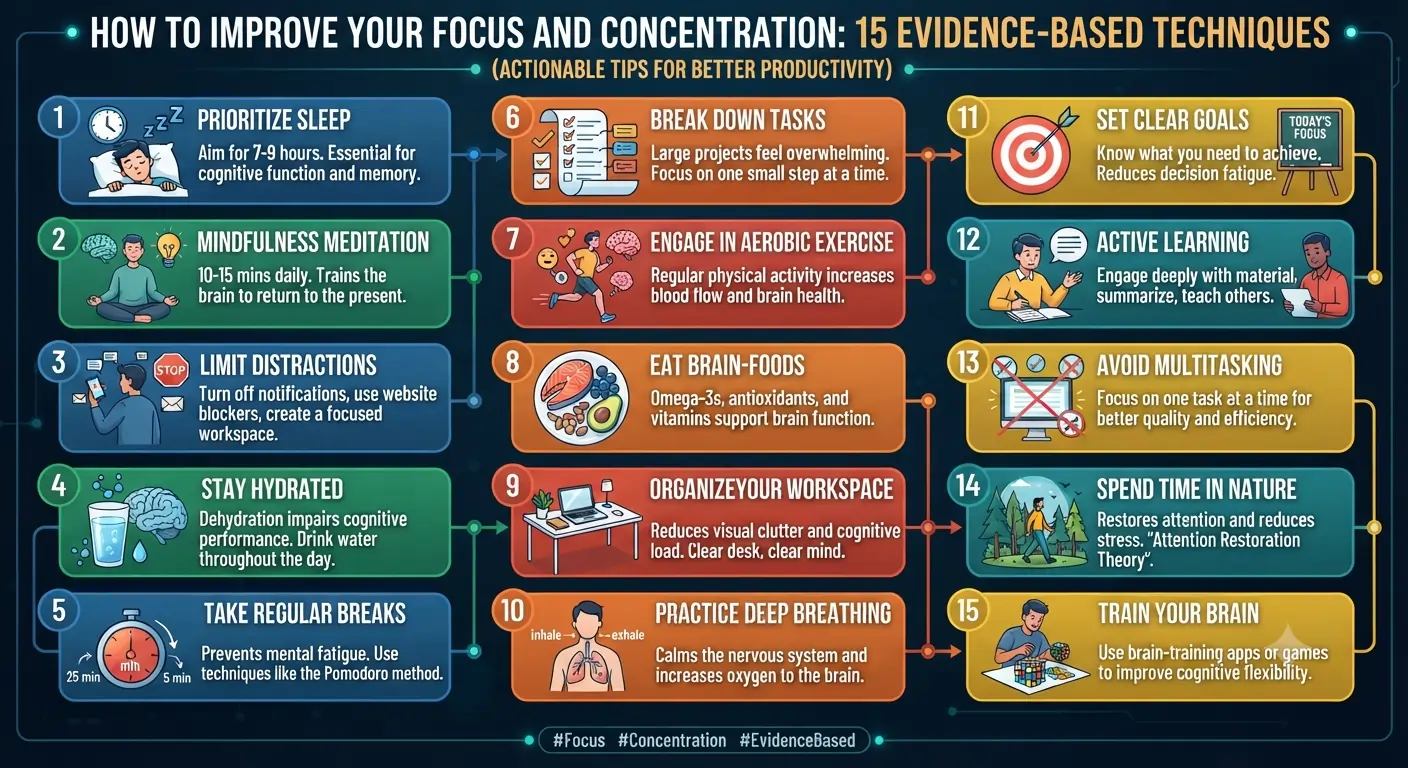
Improving focus and concentration is a trainable skill, not a fixed trait. The most effective techniques backed by neuroscience and behavioral psychology include structured work sessions using the Pomodoro Technique, deliberate practice of deep work, digital environment design, regular aerobic exercise, optimized sleep, and consistent mindfulness meditation. Combining several of these practices produces compounding benefits over weeks.
Key Takeaways
- The average adult attention span for a digital task before an interruption or distraction has fallen to approximately 47 seconds, according to a 2023 UC Irvine study by Dr. Gloria Mark.
- After being interrupted, it takes the average worker 23 minutes and 15 seconds to return to the original task at full focus depth, according to the same research.
- Aerobic exercise increases brain-derived neurotrophic factor (BDNF), a protein that promotes neural growth and dramatically improves cognitive performance for up to three hours after exercise.
- Smartphone notifications are the single most damaging common source of attention disruption in modern knowledge work environments.
- Consistent practice of focus techniques over 30 to 60 days produces measurable changes in prefrontal cortex gray matter density, according to neuroimaging research.
Why Most People Struggle to Focus in 2026
- Key Takeaways
- Why Most People Struggle to Focus in 2026
- The Neuroscience of Focus: How Your Brain Pays Attention
- 15 Science-Backed Methods to Improve Focus and Concentration
- 1. The Pomodoro Technique
- 2. Deep Work Blocks: Cal Newport's Framework
- 3. Digital Minimalism: Remove the Sources of Attention Theft
- 4. Exercise and BDNF Production
- 5. Sleep Optimization for Cognitive Function
- 6. Caffeine Timing Strategy
- 7. Mindfulness Meditation (MBSR)
- 8. Environment Design: Prime Your Space for Focus
- 9. Single-Tasking vs Multitasking
- 10. The Two-Minute Rule
- 11. Body Doubling Technique
- 12. Reduce Decision Fatigue Through Simplification
- 13. Music, Binaural Beats, and Cognitive Performance
- 14. Time Blocking Calendar Strategy
- 15. Reducing Digital Notification Load
- Focus Supplements: What the Research Actually Says
- Frequently Asked Questions About Improving Focus and Concentration
The focus crisis of the 2020s is not a failure of individual willpower. It is the predictable outcome of an information environment designed by some of the world's most sophisticated engineering teams to capture and hold human attention as efficiently as possible.
Social media platforms, messaging apps, news feeds, and video services all use variable reward mechanisms, the same psychological principle found in slot machines, to keep users engaged. Each notification, like, share, and reply provides a small unpredictable dopamine hit that trains the brain to anticipate and seek interruption rather than sustain attention.
Dr. Gloria Mark at the University of California, Irvine has conducted some of the most cited research on digital attention fragmentation. Her 2023 book "Attention Span" synthesized decades of research showing that average focused attention on a single screen task dropped from approximately 2.5 minutes in 2004 to 75 seconds in 2012 to 47 seconds by 2020. By 2026, this trend has continued, with some estimates placing the average digital attention span at under 40 seconds before a self-initiated interruption.
The practical consequence for productivity is severe. Knowledge work tasks, including writing, coding, analysis, creative problem-solving, and strategic thinking, require what neuroscientists call a "sustained attention state," characterized by theta and alpha wave brain activity and engagement of the prefrontal cortex's executive function network. Reaching this state requires approximately 15 to 20 minutes of uninterrupted engagement with a single task. If interruptions occur more frequently than every 15 minutes, which they do for most modern workers, the sustained attention state is never properly reached, and work quality suffers accordingly.
The good news is that attention is trainable. The neural circuits governing sustained concentration, housed primarily in the prefrontal cortex and anterior cingulate cortex, respond to deliberate practice just as muscles respond to physical training. The 15 techniques below constitute an evidence-based training program for exactly this purpose.
The Neuroscience of Focus: How Your Brain Pays Attention
Before examining techniques, understanding the neural architecture of attention helps clarify why specific interventions work.
The prefrontal cortex (PFC) is the brain's executive command center, governing attention allocation, working memory, decision-making, and impulse control. It is the region that allows you to maintain focus on a difficult task despite competing stimuli.
The default mode network (DMN) is a set of brain regions that activate when the mind is at rest or wandering rather than engaged in a specific task. Mind-wandering, daydreaming, and distraction are associated with DMN dominance. Effective focus involves suppressing DMN activity and activating the task-positive network (TPN) instead.
Dopamine, norepinephrine, and acetylcholine are the primary neurotransmitters governing focused attention. Exercise, cold exposure, caffeine (in appropriate doses), and certain types of mental challenge each influence these systems in ways that enhance focus. Poor sleep, chronic stress, and excessive smartphone use disrupt these neurotransmitter systems in ways that impair concentration.
15 Science-Backed Methods to Improve Focus and Concentration
1. The Pomodoro Technique
The Pomodoro Technique was developed by Italian productivity consultant Francesco Cirillo in the late 1980s and has since become one of the most widely practiced focus frameworks in the world, with dozens of apps and digital tools built around it.
The method is straightforward: choose a single task, set a timer for 25 minutes, work on that task without interruption until the timer sounds, take a five-minute break, and repeat. After four "pomodoros," take a longer break of 20 to 30 minutes.
The technique works for two interconnected reasons. First, the time constraint creates urgency, activating the prefrontal cortex's goal-pursuit circuits. Second, the scheduled breaks allow the default mode network to process and consolidate information, a phase critical for creativity and learning that constant unstructured work suppresses.
Research published in the journal "Procedia Computer Science" in 2020 found that knowledge workers using the Pomodoro Technique reported 36 percent higher task completion rates and significantly reduced end-of-day mental fatigue compared to those working without time structure.
Apps for implementing the Pomodoro Technique include Forest, Be Focused, Toggl Track, and the Focus@Will audio service, which pairs the method with music engineered for concentration.
2. Deep Work Blocks: Cal Newport's Framework
Cal Newport, professor of computer science at Georgetown University and author of the 2016 book "Deep Work: Rules for Focused Success in a Distracted World," defines deep work as "professional activity performed in a state of distraction-free concentration that pushes your cognitive capabilities to their limit." Newport argues that deep work produces the most valuable outputs in the knowledge economy, and that it is becoming simultaneously rarer and more valuable as distraction increases.
The deep work framework involves scheduling two to four hour blocks of completely uninterrupted, cognitively demanding work. During a deep work block: the internet is disconnected or restricted using tools like Freedom or Cold Turkey, the phone is in another room, all notifications are disabled, and a single complex task is engaged with sustained, effortful focus.
Newport's research on the habits of highly productive academics, programmers, writers, and executives found that the most exceptional outputs in cognitive fields are almost universally produced in deep work states. Shallow work, defined as non-cognitively demanding tasks performed while distracted (emails, meetings, administrative tasks), produces far less value per hour and rarely builds durable skills.
Starting with just one 90-minute deep work block per day and gradually extending duration and frequency is a practical approach for those new to this framework.
3. Digital Minimalism: Remove the Sources of Attention Theft
Newport's companion framework, digital minimalism, addresses the root cause of focus problems rather than just the symptoms. Digital minimalism is the practice of using technology intentionally and selectively, keeping only the digital tools that serve your deepest values and goals and removing or severely restricting those that do not.
In practice, digital minimalism for focus involves turning off all non-essential smartphone notifications permanently, not just muting them temporarily. A 2019 study published in the "Journal of Experimental Psychology" found that even the sound of a phone notification, without looking at it, caused a significant cognitive disruption equivalent to actually checking the phone. Merely knowing a notification had arrived was enough to redirect mental attention.
Additional digital minimalism practices include removing social media apps from your phone (using browser-only access if needed, since browser friction significantly reduces use), establishing specific times for email rather than checking it continuously, and using website-blocking software during focused work sessions.
The app Freedom, used by over 3 million people globally in 2026, allows users to block distracting websites and apps across all devices simultaneously for scheduled periods, supporting deep work sessions.
4. Exercise and BDNF Production
Physical exercise is among the most powerful and evidence-supported interventions for cognitive performance and specifically for the prefrontal cortex circuits governing sustained attention.
Aerobic exercise, defined as rhythmic physical activity that elevates heart rate to 50 to 80 percent of maximum for at least 20 minutes, triggers the release of brain-derived neurotrophic factor (BDNF). BDNF is a protein that promotes the growth and maintenance of neurons, strengthens synaptic connections, and supports learning and memory formation. Dr. John Ratey at Harvard Medical School, who coined the phrase "Miracle-Gro for the brain" to describe BDNF, has written extensively on the cognitive benefits of aerobic exercise in his book "Spark: The Revolutionary New Science of Exercise and the Brain."
A 2019 meta-analysis of 79 randomized controlled trials published in the "British Journal of Sports Medicine" found that acute aerobic exercise consistently improved attention, working memory, and cognitive flexibility, with the largest effect sizes observed in the 20 to 30 minutes immediately following exercise.
For improving focus specifically, a 20-minute morning aerobic session produces cognitive benefits that can persist for two to three hours afterward. Walking, running, cycling, swimming, or using an elliptical trainer all qualify. The key variable is sustained elevation of heart rate, not the specific activity.
5. Sleep Optimization for Cognitive Function
Sleep deprivation is perhaps the single most common and most underappreciated cause of poor concentration among modern adults. The prefrontal cortex, the brain's attention and executive function hub, is exquisitely sensitive to sleep loss.
A landmark study by Dr. Matthew Walker at the University of California, Berkeley, published in his 2017 book "Why We Sleep" and the underlying peer-reviewed research, showed that people sleeping six hours per night for two weeks perform equivalently to people who have been awake for 24 hours straight on cognitive assessments. Crucially, those sleeping six hours self-report feeling only slightly impaired, suggesting that chronic partial sleep deprivation impairs the very brain function needed to accurately perceive that impairment.
The National Sleep Foundation recommends seven to nine hours of sleep for adults aged 18 to 64. Among knowledge workers, a 2024 survey by McKinsey Global Institute found that 36 percent reported regularly sleeping fewer than seven hours per night, suggesting that a significant fraction of the workforce is chronically impaired in precisely the cognitive functions most critical for their work.
For improving sleep quality to support focus: maintain a consistent sleep and wake time, keep the bedroom dark and cool (18 to 19 degrees Celsius is optimal according to Walker's research), avoid screens for 30 to 60 minutes before bed (blue light suppresses melatonin), and limit caffeine after noon, as caffeine has a half-life of five to seven hours in the average adult.
6. Caffeine Timing Strategy
Caffeine is the world's most widely consumed psychoactive substance, consumed daily by approximately 90 percent of adults in North America, Europe, and much of Asia. It is also one of the most evidence-supported cognitive performance enhancers when used correctly.
Caffeine works by blocking adenosine receptors. Adenosine is a neurotransmitter that accumulates in the brain throughout the day and promotes sleepiness. By blocking adenosine receptors, caffeine reduces perceived fatigue and increases alertness, reaction time, and sustained attention.
However, the timing of caffeine consumption matters significantly for focus. Cortisol, your body's natural alertness hormone, peaks in the first 30 to 90 minutes after waking. Consuming caffeine during this window, when cortisol is already high, produces little additional alertness benefit and accelerates adenosine receptor downregulation, which means you will need more caffeine over time to achieve the same effect.
Dr. Andrew Huberman and neuropharmacologist Dr. Matthew Walker recommend delaying the first caffeine intake to 90 to 120 minutes after waking. This strategy preserves the cortisol-driven natural alertness of the morning, and caffeine then provides an additional alertness boost once cortisol begins declining in mid-morning.
A practical caffeine timing protocol: wake at 7:00 AM, hydrate immediately, complete morning habits, then have your first coffee at 8:30 to 9:00 AM. Stop caffeine intake by 1:00 to 2:00 PM to avoid sleep disruption.
7. Mindfulness Meditation (MBSR)
Mindfulness-Based Stress Reduction (MBSR), developed by Dr. Jon Kabat-Zinn at the University of Massachusetts Medical School in 1979, is one of the most studied behavioral interventions in the history of medicine, with over 1,000 peer-reviewed studies published as of 2026.
For cognitive performance and attention specifically, a 2010 study published in "Psychological Science" found that just two weeks of mindfulness training involving ten minutes of daily practice significantly improved reading comprehension, working memory capacity, and the ability to concentrate on a task while ignoring distracting stimuli.
A 2012 study from UC Santa Barbara found that mindfulness training reduced mind-wandering frequency and improved scores on a reading comprehension test even among participants with no prior meditation experience.
The mechanism is neurologically specific. Mindfulness meditation trains the anterior cingulate cortex (ACC), a brain region critical for detecting and resolving attentional conflicts. Regular meditation practice strengthens ACC-prefrontal cortex connectivity, improving the brain's ability to detect when attention has wandered and redirect it back to the intended focus object.
A basic mindfulness practice for focus improvement: sit comfortably, set a timer for 10 minutes, close your eyes, and focus all attention on the physical sensation of breathing. When you notice your attention has wandered to a thought, sensation, or distraction, simply notice this and return attention to the breath. Repeat for the full ten minutes. The moment of noticing and returning is the actual cognitive training. More frequent wandering in early practice simply means more training repetitions.
8. Environment Design: Prime Your Space for Focus
Your physical environment powerfully influences your ability to focus through mechanisms that operate largely below conscious awareness. Environmental psychology research consistently shows that clutter, visual noise, temperature, lighting, and background sound all affect cognitive performance.
Recommended Articles
 LIFESTYLE PRODUCTIVITY
 LIFESTYLE PRODUCTIVITY
 LIFESTYLE PRODUCTIVITY
A 2011 study published in "The Journal of Neuroscience" found that visual clutter in your field of view competes for neural representation in the visual cortex, reducing the processing resources available for the task at hand. A clean, minimally decorated workspace is not merely aesthetically pleasing; it is neurologically advantageous.
Optimal temperature for cognitive work: research from Cornell University found that productivity and accuracy on cognitive tasks were highest at approximately 22 to 25 degrees Celsius. Temperatures below 20 degrees or above 27 degrees significantly increased error rates.
Lighting: natural daylight is associated with better mood and higher alertness through its effect on circadian rhythm and serotonin production. A 2013 study from Northwestern University found that workers with windows slept 46 minutes more per night and reported higher quality of life than those without windows. If natural light is limited, a bright light box used in the morning (10,000 lux for 20 to 30 minutes) can support alertness and circadian alignment.
Background sound: many people find moderate levels of consistent ambient noise, such as white noise, brown noise, or lo-fi music, supportive of focus. A meta-analysis published in the "Journal of Consumer Research" in 2012 found that moderate ambient sound levels of approximately 70 decibels improved creative performance compared to silence or high noise levels. Apps including Brain.fm, Noisli, and Focus@Will are purpose-built for this function.
9. Single-Tasking vs Multitasking
The widespread cultural belief that multitasking is a productivity asset has been definitively disproved by cognitive science research. The human brain cannot perform two cognitively demanding tasks simultaneously. What multitasking actually involves is rapid task-switching, and each switch carries a cognitive cost.
A study by Dr. David Meyer at the University of Michigan found that task-switching between two demanding cognitive tasks reduces efficiency by as much as 40 percent. A separate study by researchers at the Institute of Psychiatry at King's College London found that habitual multitasking reduced effective IQ scores by an average of 10 points, comparable to the cognitive impairment produced by skipping a night of sleep.
The practice of single-tasking, working on one task with full attention until it is complete or a natural stopping point is reached before switching, is the behavioral antidote. This requires restructuring your work environment and workflow to prevent forced multitasking: closing unnecessary browser tabs, silencing all notifications, using one application at a time, and batching similar tasks together rather than interleaving them.
10. The Two-Minute Rule
Productivity author David Allen introduced the two-minute rule in his widely read book "Getting Things Done" (GTD). The rule states: if an incoming task can be completed in two minutes or less, do it immediately rather than adding it to your to-do list.
The focus benefit of this rule is indirect but significant. A cluttered task list filled with small, unresolved items generates what psychologist Bluma Zeigarnik termed the "Zeigarnik Effect": the tendency for unfinished tasks to intrude on conscious thought. Each pending small task represents an open loop in your mental workspace, consuming working memory capacity and fragmenting attention even when you are not actively working on it.
By clearing small tasks immediately (a quick email reply, a short task delegation, a brief administrative item), you reduce the number of open loops competing for your attention during deep work sessions. The result is less mental background noise and better sustained focus.
11. Body Doubling Technique
Body doubling is the practice of working in the physical or virtual presence of another person, not necessarily collaborating with them, but simply being in proximity while both parties work on their respective tasks.
First used as a therapeutic intervention for people with ADHD, body doubling has become widely adopted as a general productivity tool. Apps including Focusmate, which pairs users with accountability partners for virtual co-working sessions, have grown substantially in use. Focusmate reported over 1 million sessions completed per week in 2025.
The mechanism involves social accountability and the subtle social pressure of being observed. Research on ADHD specifically shows strong evidence for body doubling improving task initiation and task persistence. For neurotypical individuals, the evidence is more anecdotal but widespread in adoption, suggesting meaningful practical utility.
12. Reduce Decision Fatigue Through Simplification
Decision fatigue, first formally described by social psychologist Roy Baumeister in a 2008 paper published in "Journal of Personality and Social Psychology," refers to the deterioration of decision quality and willpower after a long period of decision-making. Every decision, however small, consumes finite cognitive resources.
For focus specifically, decision fatigue matters because the prefrontal cortex serves both executive decision-making and attentional control. When decision-making resources are depleted, attentional control suffers as a consequence.
Practical strategies to reduce decision fatigue include establishing a fixed wardrobe for workdays (reducing clothing decisions), planning weekly meals in advance (reducing daily food decisions), using template responses for common email types (reducing composition decisions), and batching all low-stakes decisions into a specific daily time window rather than making them throughout the day.
Steve Jobs famously wore a black turtleneck and jeans every day. Mark Zuckerberg has spoken about wearing a gray t-shirt daily for the same reason. While these are stylistic examples, the underlying neurological logic is sound.
13. Music, Binaural Beats, and Cognitive Performance
The effect of music on focus depends heavily on music type, lyrical content, and individual differences. Research on this topic has produced nuanced rather than universal conclusions.
Music with lyrics generally impairs performance on language-based tasks because the language processing centers used for reading and writing conflict with the processing of sung words. A 2012 study published in "Applied Cognitive Psychology" found that performance on reading comprehension and serial recall tasks was significantly worse with lyrical music than with no music or instrumental music.
Instrumental music without vocals, particularly music in the 60 to 80 beats per minute range (often described as Baroque classical music), appears neutral to mildly beneficial for many people on certain types of tasks. The "Mozart Effect," a popular idea that classical music enhances intelligence, was largely overstated based on a narrow 1993 study. However, the broader finding that appropriately selected instrumental music can support a positive and alert cognitive state for some individuals is reasonably well-supported.
Binaural beats, an auditory phenomenon where slightly different frequencies are played in each ear and the brain generates a perceived beat at the difference frequency, are claimed to alter brainwave states and improve focus. The evidence as of 2026 is mixed. A 2020 systematic review found modest evidence for binaural beats in the 40 Hz (gamma) range improving attention and working memory in some conditions, but effect sizes were small and study quality varied.
The practical recommendation: experiment with your personal response to silence, white noise, instrumental music, and binaural beats during focus sessions to identify what works best for your individual cognitive style.
14. Time Blocking Calendar Strategy
Time blocking is the practice of scheduling specific tasks into specific, pre-committed calendar blocks rather than working from an open-ended to-do list. It is the calendar-based implementation of the deep work principle.
Rather than beginning the day with a task list and working through it reactively, time blocking requires you to decide in advance exactly what you will work on and when. Each cognitive task type is assigned a specific block: two hours of deep analytical work from 9 to 11 AM, email and communication from 11 AM to noon, meetings from 1 to 3 PM, creative work from 3 to 5 PM.
Cal Newport, Elon Musk, and Benjamin Franklin have all described detailed time management systems that function on time-blocking principles. Research by Dr. Anders Ericsson on expert performers, summarized in the book "Peak" and the popular concept of "deliberate practice," found that elite performers in every domain, from musicians to chess players to athletes, structure their practice time with rigid block scheduling rather than open-ended practice.
Google Calendar, Notion, and the time-blocking app Structured are commonly used tools for implementing this system.
15. Reducing Digital Notification Load
Notifications are the most immediate, high-frequency, and practically addressable source of attention disruption for most modern workers. Each notification interrupts your current attentional state, triggers the orienting response (an automatic neural reflex that redirects attention to novel stimuli), and imposes the 23-minute recovery cost documented by UC Irvine researchers.
A full audit of notification sources on the average smartphone reveals dozens of apps competing for attention throughout the day. A systematic notification reduction protocol involves the following steps.
First, audit all apps with notification permissions. A typical smartphone in 2026 has 50 to 100 apps, many with notifications enabled by default. Second, disable all non-essential notifications completely, not just silencing them. Social media, news apps, games, and promotional apps generate notifications that provide no time-sensitive value. Third, restrict remaining essential notifications (calls, messages from key contacts) to specific delivery windows rather than real-time alerts.
The smartphone Focus modes on iOS (introduced in iOS 15) and Android's Digital Wellbeing features allow users to schedule notification silence windows aligned with deep work periods, while permitting urgent contacts to break through if needed.
Focus Supplements: What the Research Actually Says
Several supplements are widely marketed for improving focus and concentration. The evidence base for most is considerably weaker than marketing suggests. The following is a summary of the most honest assessment of the available research.
Caffeine is the most extensively researched and most evidence-supported focus-enhancing substance. Its mechanisms and optimal use are discussed in technique number six above.
L-theanine, an amino acid found in green tea, has modest evidence for reducing anxiety and improving attention when combined with caffeine. The 200mg L-theanine plus 100mg caffeine combination is the most studied and appears to improve attention switching and reduce the anxious side effects of caffeine in several small studies.
Omega-3 fatty acids (EPA and DHA from fish oil) are among the most studied nutrients for brain health. A 2022 review in "Nutrients" found that higher omega-3 intake is associated with better sustained attention and processing speed, particularly in children and older adults. Effects in healthy middle-aged adults are less clear.
Creatine monohydrate, primarily known as a sports supplement, has growing evidence for cognitive benefits at doses of 3 to 5 grams per day. A 2022 meta-analysis in "Nutritional Reviews" found significant improvements in working memory and information processing speed, particularly during conditions of mental fatigue or sleep deprivation.
Nootropic compounds including racetams, modafinil, and various herbal adaptogens are widely discussed in online communities but have limited high-quality evidence supporting their use for focus in healthy adults. Modafinil (a prescription wakefulness agent used for narcolepsy) does have evidence for reducing fatigue and improving attention under sleep-deprived conditions but is a prescription medication with potential side effects.
The honest conclusion on supplements: no supplement significantly compensates for poor sleep, inadequate exercise, or a chronically distracted work environment. The behavioral interventions described above produce larger and more reliable focus improvements than any supplement currently available.
Frequently Asked Questions About Improving Focus and Concentration
How long does it take to improve focus with these techniques?
Most people notice measurable improvements within two to four weeks of consistent practice. Neuroimaging studies show structural brain changes, specifically increased gray matter density in the prefrontal cortex and anterior cingulate cortex, after eight weeks of regular mindfulness meditation practice. Full behavioral habit formation for complex routines takes approximately 60 to 90 days of consistent practice.
Why can I focus easily on video games or social media but not on work?
Video games and social media are engineered to be intrinsically motivating using variable reward schedules, immediate feedback, clear progress signals, and social comparison. Work tasks typically lack these built-in motivational structures. The solution involves artificially adding structure, novelty, feedback, and meaning to work tasks rather than expecting your brain to focus with equal ease on unprofitable and profitable activities.
Does ADHD explain why some people cannot focus?
Attention-Deficit/Hyperactivity Disorder (ADHD) is a neurodevelopmental condition characterized by persistent patterns of inattention, hyperactivity, and impulsivity. ADHD affects approximately 5 to 7 percent of children and 2.5 to 4 percent of adults worldwide according to the American Psychiatric Association. If you suspect ADHD, a clinical assessment by a psychiatrist or psychologist is the appropriate first step. The behavioral techniques in this article can support focus for people with ADHD as part of a comprehensive management approach but do not replace clinical treatment when that is indicated.
Is it better to work in silence or with background noise?
Individual differences are substantial. Some people focus best in complete silence. Others benefit from moderate ambient noise at approximately 60 to 70 decibels. The consistent finding is that variable, unpredictable noise (conversations nearby, irregular notification sounds) consistently impairs concentration, while consistent, predictable ambient noise has neutral to mildly beneficial effects for many people.
How many hours of deep focus work is realistic per day?
Research on expert performers by Dr. Anders Ericsson found that most elite experts across domains peak at four to five hours of intense concentrated work per day, beyond which diminishing returns and quality degradation become significant. Most people can sustain two to three hours of genuine deep focus work per day as a starting point. The goal is not to work more hours but to ensure that your available focus hours are spent on the highest-value tasks.
Can children improve their concentration?
Yes. Focus and attentional control develop throughout childhood and adolescence as the prefrontal cortex matures (a process not complete until approximately age 25). Exercise, sufficient sleep, reduced screen time, and structured play activities all support healthy attentional development in children. The American Academy of Pediatrics recommends no screen time before 18 to 24 months (except video chat), one hour per day of high-quality programming for ages 2 to 5, and consistent limits with media-free time for ages 6 and older.
What is the fastest way to improve focus right now?
The single fastest intervention for immediate focus improvement is removing your smartphone from your workspace entirely, not silencing it or placing it face-down, but removing it from the room. A 2017 study published in the "Journal of the Association for Consumer Research" found that the mere presence of a smartphone on a desk reduced available working memory capacity, even when the phone was silent and face-down. Out of sight genuinely means out of mind in neurological terms.