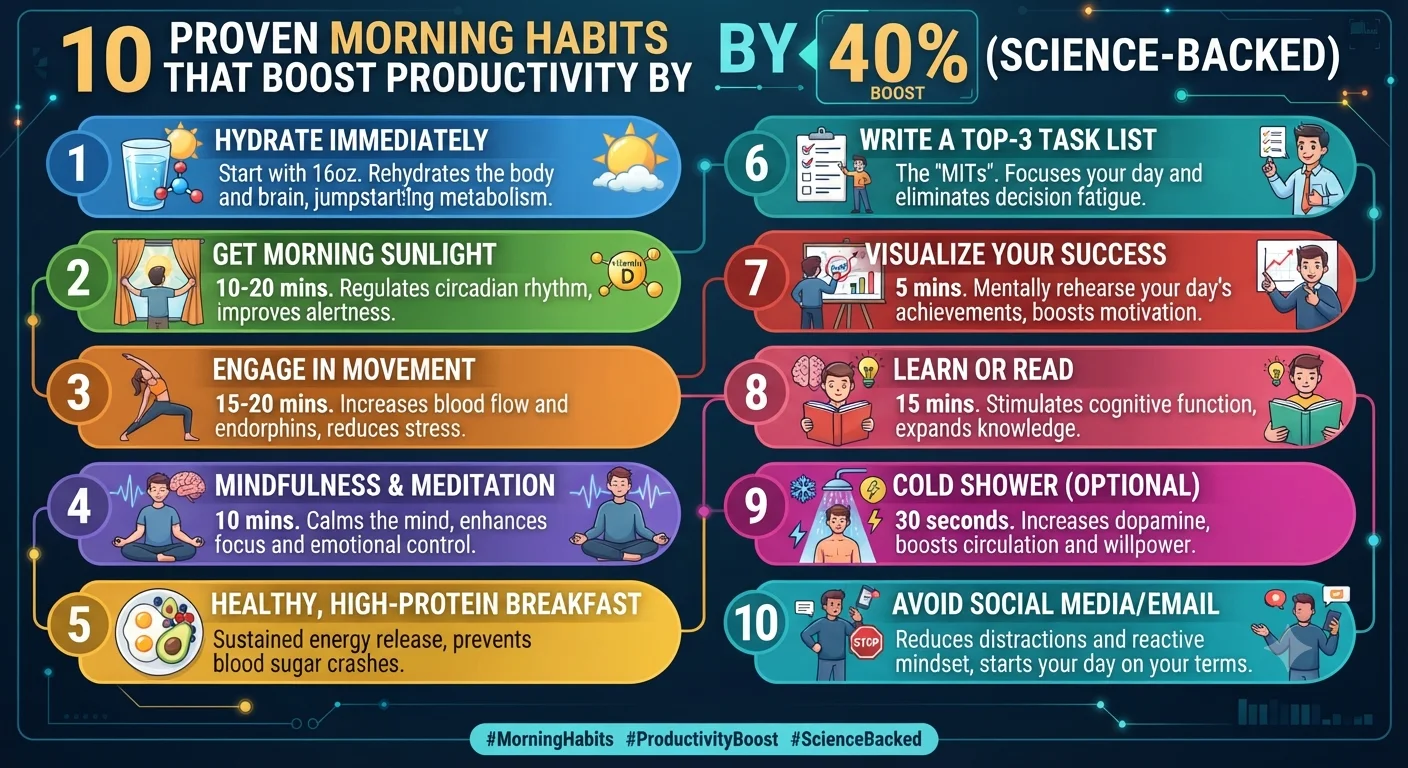
A structured morning routine that includes consistent wake times, hydration, exercise, and intentional planning can increase daily productivity by up to 40 percent, according to research published in the Journal of Applied Psychology. The ten habits below are backed by neuroscience, behavioral psychology, and the documented practices of high-performing individuals worldwide.
Key Takeaways
- Morning routines are not about waking up at 4 AM. They are about performing the right behaviors in the right order before the day demands your attention.
- Research from Harvard Business Review found that people who exercise in the morning report 23 percent higher energy levels and 15 percent better concentration throughout the day.
- Cortisol naturally peaks within 30 minutes of waking. Checking your phone immediately hijacks this energy window and redirects it toward reactive rather than intentional work.
- A 2024 study in the journal "Sleep Health" found that people with consistent wake times have higher cognitive performance than those who wake at varying times, even when total sleep hours are equal.
- The most productive morning routines in 2026 take between 60 and 90 minutes and combine physical, cognitive, and intentional elements.
Why Morning Routines Determine Your Entire Day
- Key Takeaways
- Why Morning Routines Determine Your Entire Day
- The 10 Best Morning Habits for Peak Productivity
- 1. Wake Up at a Consistent Time: The Circadian Advantage
- 2. Hydrate Immediately: Why 500ml of Water Changes Everything
- 3. No Screens for 30 Minutes: The Cortisol Connection
- 4. Exercise First: The Neurochemistry of Morning Movement
- 5. Cold Exposure: The Dopamine Boost Protocol
- 6. Meditation or Mindfulness: 10 Minutes That Compound
- 7. Journaling: Externalizing Your Cognitive Load
- 8. Eat a High-Protein Breakfast: Fuel for Focus
- 9. Set Three Daily Priorities: The MIT Method
- 10. Read or Learn for 20 Minutes: The 1% Growth Habit
- How Elon Musk, Tim Cook, and Oprah Winfrey Structure Their Mornings
- How to Build Your Own Morning Routine in 7 Days
- Frequently Asked Questions About Morning Habits and Productivity
The first 90 minutes after waking are among the most neurologically significant of the entire day. During this window, your brain transitions from the theta wave state of near-sleep into the alert beta wave state needed for focused work. Cortisol, often labeled a stress hormone but more accurately a readiness hormone, surges to its daily peak during this transition. How you use this cortisol surge determines much of your mental capacity for hours afterward.
Stanford neuroscientist Dr. Andrew Huberman, whose research on circadian biology has been widely cited in productivity literature, explains that the morning cortisol peak is essentially your body's natural performance enhancer. Using it for shallow activities like social media scrolling suppresses the focus-building effect. Using it for deliberate, structured activity compounds your cognitive output across the full workday.
A 2023 meta-analysis published in the journal "Frontiers in Psychology" analyzed 49 studies on morning routine behaviors and cognitive performance. The analysis found that individuals with structured morning routines demonstrated statistically significant advantages in task completion rates, decision-making quality, and self-reported wellbeing compared to those without routines.
The principle at work is momentum. Behavioral economists call this the "completion effect." Each small win early in the morning activates the brain's reward circuitry via dopamine release, creating a positive feedback loop that sustains motivation and focus into the afternoon.
The 10 Best Morning Habits for Peak Productivity
1. Wake Up at a Consistent Time: The Circadian Advantage
Your body runs on a 24-hour internal clock called the circadian rhythm, governed by the suprachiasmatic nucleus in the hypothalamus. This clock regulates sleep, hormone secretion, body temperature, metabolism, and mood. Consistency is its defining requirement.
A 2024 study published in "Sleep Health" that tracked 2,000 adults over six months found that those who woke within a 30-minute window each day (including weekends) had significantly better cognitive performance, mood stability, and physical energy than those with variable wake times, regardless of average total sleep duration.
In practical terms, this means waking at 6:30 AM every day is more beneficial than waking at 5:00 AM on weekdays and 9:00 AM on weekends. Weekend "sleep ins" that deviate more than 90 minutes from your weekday wake time create a phenomenon called social jet lag, which impairs cognitive function for 24 to 48 hours, much like crossing a time zone.
To set your consistent wake time, work backward from your required wake-up hour by seven to nine hours and establish that as your target bedtime.
2. Hydrate Immediately: Why 500ml of Water Changes Everything
After seven to nine hours of sleep, your body is in a mild state of dehydration. The brain is approximately 75 percent water by volume. Even mild dehydration of 1 to 2 percent of body weight has been shown in multiple studies to impair attention, short-term memory, and processing speed.
A 2022 study from the University of Connecticut's Human Performance Laboratory found that women who were just 1.36 percent dehydrated experienced significantly worse mood, increased fatigue, and reduced ability to concentrate on mental tasks.
Drinking 500ml (about two cups) of water immediately upon waking rehydrates tissues, supports kidney function, and activates the metabolism. Some practitioners of Ayurvedic medicine and Japanese culture drink warm water or water with a slice of lemon, which may additionally stimulate digestion, though the hydration benefit alone is the most strongly supported by Western research.
Coffee and caffeine, consumed before proper hydration, can further dehydrate the body and amplify cortisol-driven anxiety. Hydrating before your first cup of coffee optimizes both caffeine's performance-enhancing effects and your baseline hydration status.
3. No Screens for 30 Minutes: The Cortisol Connection
Reaching for your phone within minutes of waking is one of the most widely practiced and scientifically documented productivity-destroying habits of the modern era. As of 2025, a survey by the communications technology company Asurion found that 81 percent of Americans check their smartphone within the first ten minutes of waking.
Here is why this matters neurologically. Your morning cortisol peak, described above, is a window of heightened alertness and intrinsic motivation. Notifications, emails, and social media feeds are designed by software engineers to trigger reactive emotional responses: anxiety, curiosity, outrage, or pleasure. These stimuli effectively "spend" your cortisol budget on other people's agendas before you have allocated it to your own.
Dr. Cal Newport, Georgetown University computer scientist and author of "Deep Work," describes this pattern as training your brain for distraction before the workday even begins. A brain conditioned to seek novelty in the first 30 minutes of the day develops a lower threshold for boredom and a reduced capacity for sustained concentration later.
The practical solution is simple: leave your phone charging outside your bedroom, or place it face-down and silenced for the first 30 minutes after waking. Use an analog alarm clock to remove the excuse of needing your phone as an alarm.
4. Exercise First: The Neurochemistry of Morning Movement
Physical exercise in the morning has one of the strongest evidence bases of any productivity intervention. A 2019 study published in the British Journal of Sports Medicine tracked 4,755 adults and found that 20 minutes of moderate morning exercise improved attention, visual learning, and decision-making more than control conditions involving sitting or light stretching.
The neurochemical explanation lies in four key compounds released during exercise. Dopamine elevates mood and motivation. Norepinephrine enhances attention and working memory. Serotonin stabilizes mood and reduces anxiety. Brain-derived neurotrophic factor (BDNF), sometimes called "Miracle-Gro for the brain" by Harvard psychiatrist Dr. John Ratey, promotes the growth of new neural connections, which improves learning capacity for hours after exercise ends.
You do not need to run a marathon. Studies consistently show that 20 to 30 minutes of moderate-intensity exercise, defined as activity that raises your heart rate to 50 to 70 percent of its maximum, produces robust cognitive benefits. A brisk walk, a short resistance training session, a yoga flow, or a 20-minute run all qualify.
Nike Training Club, Peloton, and Apple Fitness Plus each reported significant increases in morning workout adoption between 2024 and 2026, suggesting that the cultural shift toward morning movement is already underway at scale.
5. Cold Exposure: The Dopamine Boost Protocol
Cold exposure, via cold showers or cold water immersion, has generated substantial scientific attention since neuroscientist Dr. Andrew Huberman popularized the research in 2022 and 2023. The evidence base, while still growing, is notable.
A 2021 study published in "PLOS One" found that cold water immersion at 14 degrees Celsius for one to two minutes increased dopamine levels by 250 percent. This dopamine elevation was gradual in onset and long in duration, very different from the rapid spike-and-crash pattern of dopamine produced by smartphones or sugar. This sustained dopamine increase translates to prolonged motivation, alertness, and emotional resilience.
Cold exposure also activates the sympathetic nervous system, releasing norepinephrine and causing a brief, controlled stress response. Regular cold exposure appears to train the body's stress response system, increasing tolerance for discomfort and reducing anxiety over time.
A practical starting point is ending your normal shower with 30 to 60 seconds of cold water. Dr. Huberman recommends building up to two to four minutes of cold exposure three times per week for optimal norepinephrine effects.
Cold exposure is not advisable for individuals with cardiovascular conditions, Raynaud's disease, or cold intolerance without medical guidance.
6. Meditation or Mindfulness: 10 Minutes That Compound
Mindfulness meditation has accumulated one of the most robust evidence bases of any behavioral intervention in the past two decades. A 2014 meta-analysis in "Psychological Medicine" analyzed 47 randomized controlled trials and found that mindfulness meditation programs produced moderate reductions in anxiety, depression, and pain.
For productivity specifically, a 2012 study from the University of Washington found that participants trained in mindfulness meditation showed better focus, lower stress, and improved task-switching ability compared to those who received no training or relaxation training. A follow-up study in 2018 demonstrated that even brief mindfulness practice of ten minutes per day for eight weeks produced measurable changes in prefrontal cortex activity, the brain region governing attention, working memory, and executive function.
Apps including Headspace, Calm, and Waking Up have made meditation accessible to millions of people globally. Headspace reported in its 2025 annual impact report that users who meditated with the app for at least 10 minutes per day reported a 36 percent improvement in perceived stress levels and a 22 percent improvement in focus within eight weeks.
Recommended Articles
 LIFESTYLE PRODUCTIVITY
 LIFESTYLE PRODUCTIVITY
 LIFESTYLE PRODUCTIVITY
For beginners, ten minutes of simple breath-focused attention meditation is sufficient. Sit comfortably, close your eyes, and focus on the sensation of each inhale and exhale. When your mind wanders (and it will), gently return attention to the breath. That redirection of attention is itself the practice.
7. Journaling: Externalizing Your Cognitive Load
Writing in a journal each morning serves two distinct and evidence-backed psychological functions. First, it externalizes cognitive load. Your working memory, the mental workspace where you actively process information, has a limited capacity. Carrying unresolved thoughts, worries, and to-do items in your head consumes working memory space and reduces effective cognitive capacity for other tasks.
Psychologist Dr. Sian Beilock at Dartmouth College demonstrated this effect in a 2011 study published in "Science," showing that students who wrote about their test anxieties for ten minutes before a high-stakes exam significantly outperformed students who did not write. The writing cleared the cognitive interference and freed up working memory for the test itself.
Second, journaling builds self-awareness and metacognitive clarity. Research by Dr. James Pennebaker at the University of Texas found that expressive writing about thoughts and feelings produced measurable improvements in immune function, reduced doctor visits, and improved psychological wellbeing over time.
A practical morning journaling practice can be as simple as writing three things you are grateful for (gratitude journaling), one page of unfiltered free-writing (as recommended by author Julia Cameron's "Morning Pages" framework), or a structured reflection covering yesterday's lessons and today's intentions.
8. Eat a High-Protein Breakfast: Fuel for Focus
Breakfast choices have measurable effects on cognitive performance across the morning. Research consistently shows that high-protein breakfasts produce superior cognitive outcomes compared to high-carbohydrate breakfasts or skipping breakfast entirely.
A 2020 study published in the "American Journal of Clinical Nutrition" found that adults who consumed a 30-gram protein breakfast reported greater satiety, more stable energy, and better concentration at a cognitive assessment three hours later compared to those who ate a carbohydrate-matched breakfast or skipped the meal.
Protein increases levels of tyrosine, an amino acid precursor to dopamine and norepinephrine, two neurotransmitters central to motivation and focus. Carbohydrate-heavy breakfasts, particularly those containing refined sugars and processed grains, produce a rapid glucose spike followed by a crash that many people experience as mid-morning fatigue, difficulty concentrating, and irritability.
High-protein breakfast options that require minimal preparation include eggs (any style), Greek yogurt with nuts, cottage cheese, a protein smoothie with protein powder and nut butter, or smoked salmon with whole grain bread. Aiming for 25 to 35 grams of protein before 9 AM is a practical and evidence-aligned target.
9. Set Three Daily Priorities: The MIT Method
The Most Important Tasks (MIT) method, popularized by productivity author Leo Babauta in his book "Zen to Done," is a deceptively simple framework with a strong track record. The principle is this: at the beginning of each day, before opening email or attending meetings, identify the three tasks that, if completed today, would make the day meaningfully successful.
The power of this framework lies in two psychological phenomena. First, decision fatigue, first described by social psychologist Roy Baumeister, refers to the finding that the quality of human decisions deteriorates with each successive decision made. By pre-committing to three priorities in the morning before the decision-heavy workday begins, you preserve your cognitive resources for executing those tasks rather than deciding what to work on.
Second, having a concrete, written daily intention activates what psychologist Peter Gollwitzer calls "implementation intentions," which are if-then mental plans that dramatically increase follow-through rates. A 2002 meta-analysis of 94 studies found that implementation intentions increased goal achievement rates by an average of 28 percent compared to simply setting goals without specifying when, where, and how they would be pursued.
Write your three MITs by hand in a notebook each morning. Sequence them by importance, not urgency. Work on the most important task first, before reactive work like emails and meetings consume your cognitive peak.
10. Read or Learn for 20 Minutes: The 1% Growth Habit
Reading 20 minutes each morning compounds into extraordinary intellectual growth over time. A person who reads 20 minutes per day reads approximately 18 to 20 books per year, based on an average adult reading speed of 200 to 300 words per minute and an average business or nonfiction book length of 60,000 words.
Naval Ravikant, the Silicon Valley investor and philosopher, attributes much of his business and intellectual development to a lifelong habit of reading widely and deeply every morning. Warren Buffett, Chairman of Berkshire Hathaway, has described spending 80 percent of his working day reading and thinking. While these are exceptional individuals, the underlying principle applies broadly: sustained, daily reading compounds into a significant knowledge advantage over time.
For productive morning reading, choose material that challenges your thinking or builds directly applicable knowledge. Categories that yield the highest career and intellectual returns include books on human psychology, strategy, science, biography, and history. Apps like Blinkist, which distill book insights into 15-minute summaries, offer an accessible starting point for those building the reading habit.
How Elon Musk, Tim Cook, and Oprah Winfrey Structure Their Mornings
Examining the morning routines of high-performing public figures reveals consistent patterns that align with the evidence-based habits above.
Tim Cook, CEO of Apple, reportedly wakes at 3:45 AM, reviews user feedback from Apple customers, exercises, and arrives at the office before most employees. The early wake time gives him several uninterrupted hours before the demands of leading one of the world's most valuable companies begin.
Oprah Winfrey has described a morning routine that includes meditation for 20 minutes, exercise, and journaling. She credits meditation specifically with the consistency and clarity she brings to her work.
Elon Musk, CEO of Tesla and SpaceX, has described a more compressed morning routine, driven by his characteristically demanding schedule. He has spoken about prioritizing "critical email review" and breakfast with his children over elaborately structured rituals, suggesting that even a modest, intentional morning beats an unstructured one.
The common thread among high performers is not any single specific ritual but the deliberate, consistent allocation of the early morning to activities that serve their long-term goals rather than the reactive demands of others.
How to Build Your Own Morning Routine in 7 Days
Building a morning routine requires a gradual, commitment-based approach rather than attempting all ten habits simultaneously on day one. The following seven-day framework introduces habits progressively to allow each to solidify before the next is added.
Day 1 and 2: Set and maintain a single consistent wake time. Do nothing else differently. Simply prove to yourself that you can wake at the same time two days in a row.
Day 3 and 4: Add morning hydration. Place a glass of water by your bed before sleep. Drink it before doing anything else.
Day 5: Add a no-phone rule for the first 20 minutes. Replace scrolling with sitting quietly, reading a physical book, or stepping outside.
Day 6: Add ten minutes of morning movement. A short walk, five minutes of stretching, and five minutes of bodyweight exercise are sufficient.
Day 7: Add a five-minute MIT planning session. Write your three most important tasks for the day in a notebook.
From this base, layer in the remaining habits one at a time, each week, allowing your nervous system and schedule to adapt before adding complexity.
Frequently Asked Questions About Morning Habits and Productivity
How long should a morning routine be?
Research suggests that 60 to 90 minutes provides enough time to include meaningful physical, cognitive, and intentional habits without requiring an unrealistically early wake time. However, even a 20-minute intentional routine is vastly more effective than no routine at all.
Does waking up early make you more productive?
Not inherently. A 2019 study in "Nature Communications" found that chronotype, your genetically influenced preference for morning or evening activity, significantly affects when your cognitive performance peaks. Evening chronotypes forced to wake early do not perform better and may perform worse. Consistency within your natural range is more important than waking at an extreme early hour.
What if I am not a morning person?
Work with your chronotype rather than against it. If you are naturally an evening person, shift your routine slightly later rather than emulating extreme early risers. A consistent 8:00 AM wake time with a structured 60-minute routine will outperform a 5:00 AM wake time you struggle to maintain.
Is it okay to skip my morning routine on weekends?
Modest flexibility is acceptable. Sleeping up to 60 to 90 minutes later than your weekday wake time on weekends and maintaining other habit elements will limit social jet lag while allowing appropriate rest. Sleeping more than 90 minutes later substantially disrupts your circadian rhythm and reduces the next week's productivity baseline.
How long does it take to form a morning routine habit?
A 2010 study by Phillippa Lally at University College London found that habit formation takes an average of 66 days, with a range of 18 to 254 days depending on the complexity of the behavior and individual differences. Simpler habits form faster. Complex multi-step routines may take several months to become fully automatic.
Which single morning habit has the most evidence behind it?
Exercise has arguably the most robust evidence base among all morning habits, given its documented effects on cognitive performance, mood, energy, and long-term brain health. If you adopt only one habit from this list, make it 20 to 30 minutes of morning physical movement.
Can morning routines help with anxiety and depression?
Yes. Exercise, mindfulness meditation, consistent sleep schedules, and journaling each have independent evidence of benefit for anxiety and depression symptoms. A structured morning routine that includes these elements can meaningfully support mental health as part of a comprehensive approach. It is not a replacement for professional mental health treatment when that is needed.