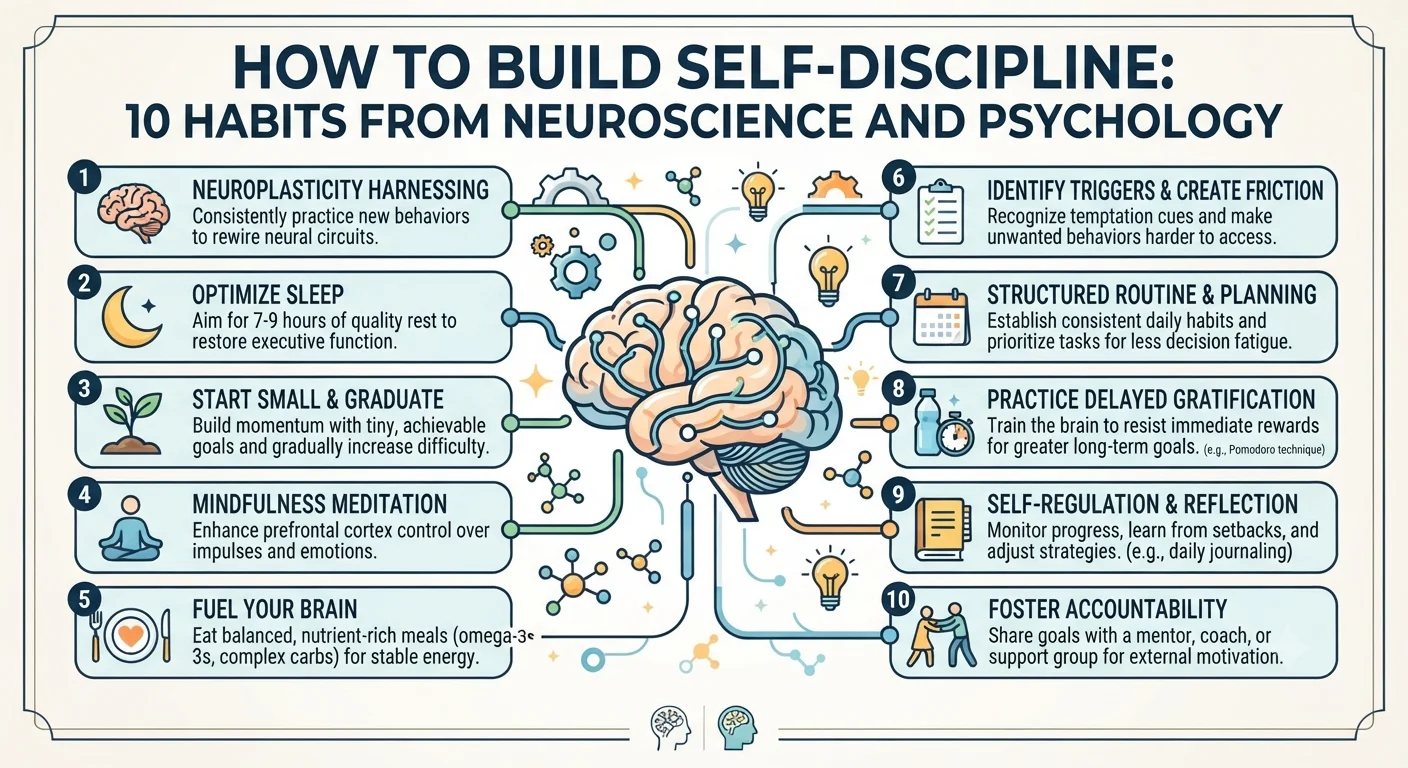
Self-discipline is not a fixed personality trait you either have or lack. It is a set of trainable skills rooted in environment design, identity, habit automation, and biological optimization. The most effective approach combines removing temptation from your environment, starting with impossibly small behaviors, building identity-based habits, and maintaining physical conditions (sleep, exercise, nutrition) that support prefrontal cortex function, the brain region governing self-control.
Key Takeaways
- A 2011 longitudinal study of over 1,000 children followed from birth to age 32, published in the Proceedings of the National Academy of Sciences, found that childhood self-control predicted adult health, wealth, and public safety outcomes more strongly than intelligence or socioeconomic status.
- Willpower is a poor strategy for building discipline because it depletes. Research by Roy Baumeister showed that self-control functions like a muscle that fatigues with use, a phenomenon called "ego depletion," making environment design and habit automation far more reliable than willpower.
- A 2019 study in "Psychological Science" found that people with the highest apparent self-discipline did not exert more willpower than others. They experienced fewer internal conflicts because their environments and habits reduced the frequency of temptation encounters.
- Sleep deprivation is one of the most potent inhibitors of self-discipline. Research shows that sleep-deprived individuals make significantly more impulsive choices and show reduced prefrontal cortex activity governing impulse control.
- The average person has approximately 200 food-related decisions per day according to Cornell University research by Brian Wansink, the vast majority of which occur below conscious awareness. Extending this finding to all behavioral domains suggests that most "discipline failures" occur in undesigned environments rather than through lack of character.
What Is Self-Discipline? A Scientific Definition
- Key Takeaways
- What Is Self-Discipline? A Scientific Definition
- Why Willpower Is a Myth and What Works Instead
- 10 Proven Ways to Build Self-Discipline
- 1. Remove Temptation from Your Environment
- 2. Start Impossibly Small: The Micro-Habit Strategy
- 3. Build Identity-Based Habits: The James Clear Framework
- 4. Use Implementation Intentions: The "If-Then" Plans
- 5. Track Your Behavior Publicly or Privately
- 6. Create Friction for Bad Habits
- 7. Reward Yourself Strategically
- 8. Sleep and Self-Control: The Research Link
- 9. Practice Stress Inoculation
- 10. Find Your Why: Purpose-Driven Discipline
- Self-Discipline vs Motivation: What Research Shows
- 30-Day Self-Discipline Challenge Plan
- Frequently Asked Questions About Building Self-Discipline
Self-discipline, formally studied in psychology as self-regulation or self-control, is the capacity to align behavior with intended goals despite the presence of competing impulses, distractions, emotions, or alternative behavioral options. It is the cognitive and behavioral mechanism that allows a person to choose to exercise when they want to rest, study when they want to play, eat a salad when they want pizza, and save money when they want to spend it.
Self-discipline operates primarily through the prefrontal cortex (PFC), the brain's executive control center located in the front of the frontal lobes. The PFC is responsible for inhibitory control (suppressing impulsive responses), working memory (holding goals and plans in mind while executing behavior), cognitive flexibility (adjusting behavior when initial approaches fail), and value-based decision-making (evaluating long-term versus short-term trade-offs).
This neurological basis explains several important practical facts about self-discipline. First, anything that impairs PFC function (sleep deprivation, alcohol, chronic stress, poor nutrition) directly reduces self-discipline capacity. Second, the PFC is among the last brain regions to fully mature, explaining why adolescents have less reliable impulse control than adults. Third, sustained PFC demands across a day can temporarily reduce its function, explaining why discipline failures tend to cluster in the evening when the day's self-regulation demands have been highest.
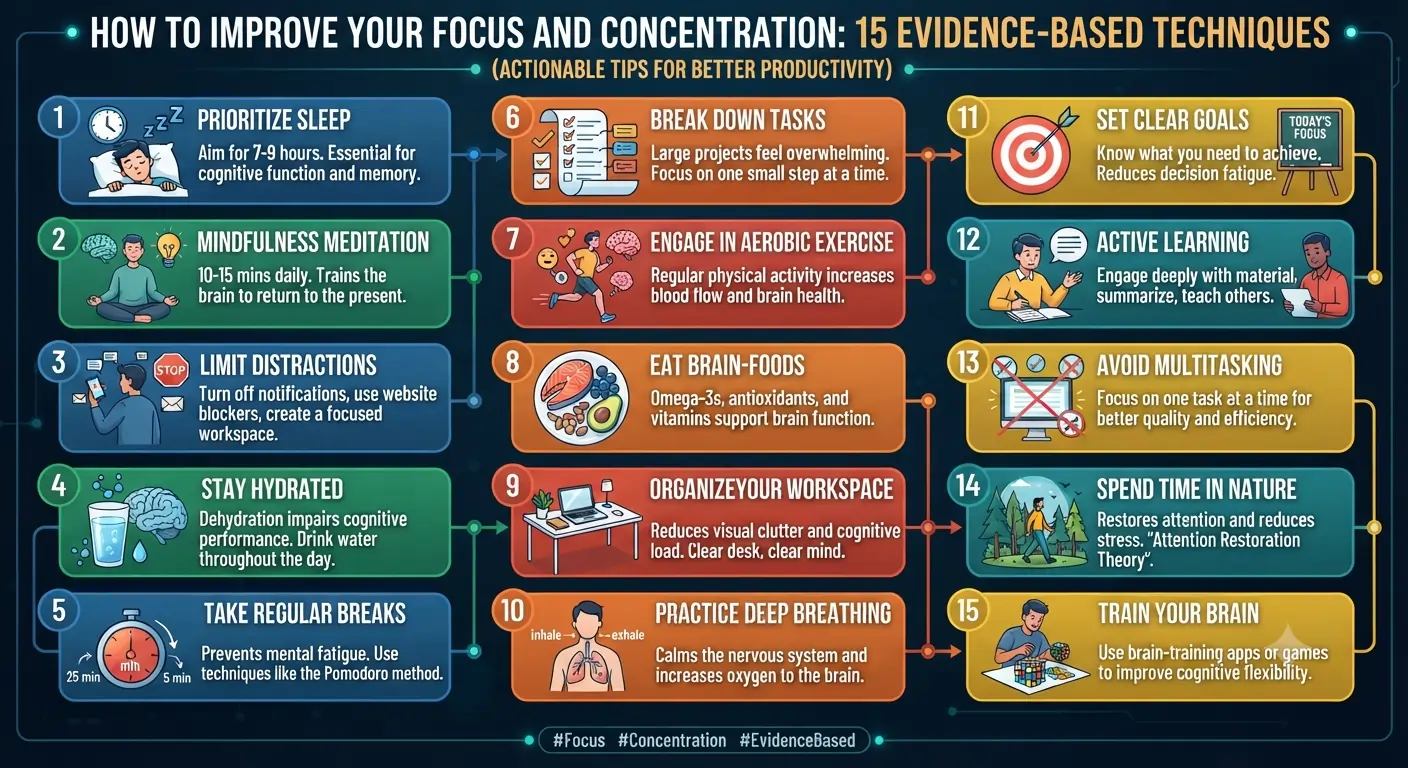
- How to Improve Your Focus and Concentration: 15 Evidence-Based Techniques
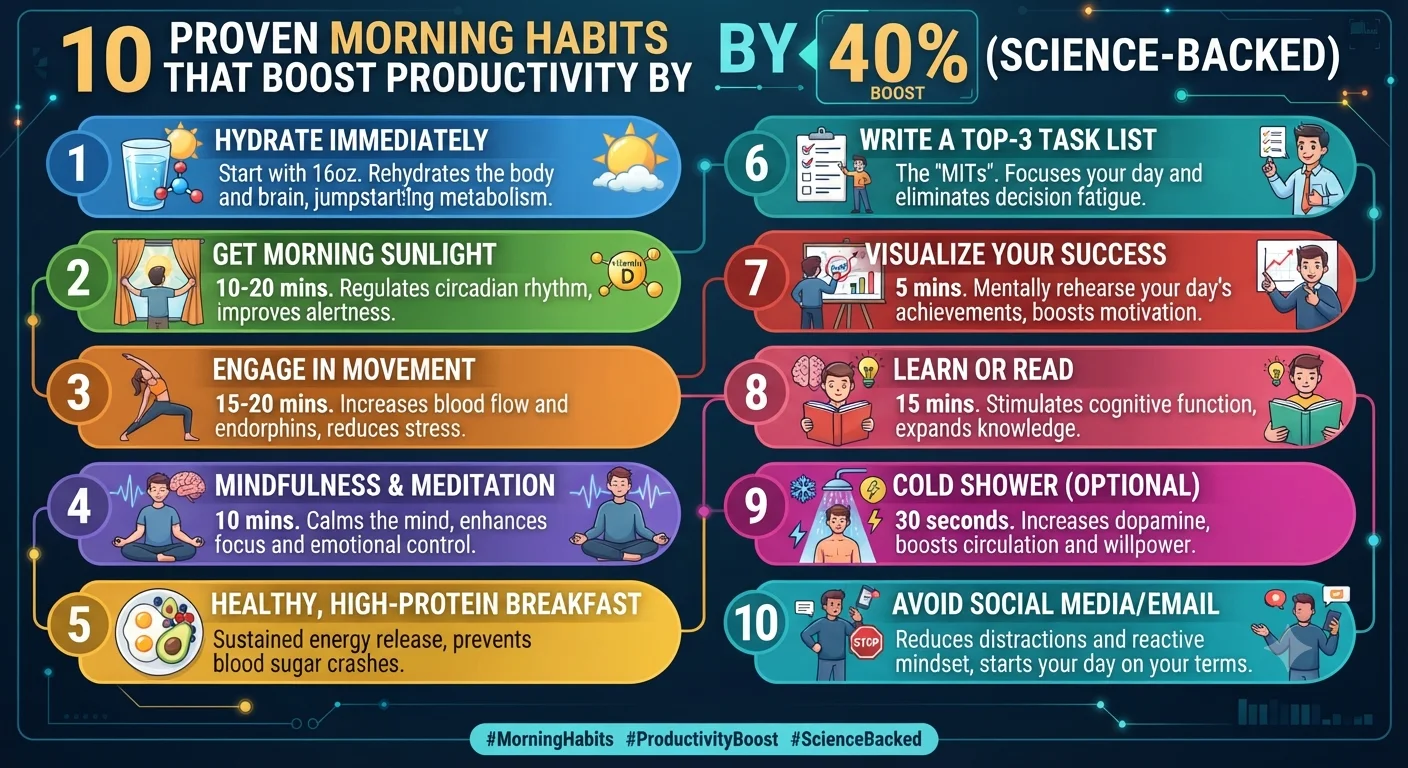
- 10 Proven Morning Habits That Boost Productivity by 40% (Science-Backed)
The distinction between self-discipline and motivation is important and frequently misunderstood. Motivation is the emotional state of wanting to pursue a goal. Self-discipline is the behavioral capacity to pursue a goal regardless of emotional state. Motivation fluctuates with mood, energy, and external circumstances. Self-discipline, properly developed, operates more consistently because it does not depend on emotional alignment. The phrase "I will do it when I feel motivated" describes a strategy that reliably fails. The phrase "I will do it because it is scheduled and my environment supports it" describes a strategy that reliably succeeds.
Why Willpower Is a Myth and What Works Instead
The concept of willpower as a fixed personal attribute, something you either have or lack, is one of the most damaging misconceptions in personal development. This framing leads people to attribute discipline failures to character deficiency rather than to the more accurate and actionable explanation: a poorly designed environment and system.
Research by psychologist Roy Baumeister and colleagues at Florida State University in the 1990s and 2000s introduced the concept of "ego depletion," the finding that self-control appears to draw on a limited resource that depletes with use throughout the day. Studies in the ego depletion framework found that participants who exerted self-control on an initial task showed reduced self-control capacity on subsequent tasks in the same session, suggesting a shared resource mechanism.
Subsequent research has complicated and partially challenged the original ego depletion model, with some replication failures raising questions about the specific "muscle" metaphor. However, the practical implication that sustained self-control demands throughout a day reduce behavioral discipline later in the day is consistently supported by both laboratory and real-world evidence. The famous Israeli parole board study found that judicial decisions favored parole (requiring the cognitive effort of a positive decision) significantly more frequently at the beginning of sessions than at the end, a finding interpreted as decision fatigue affecting judicial outcomes.
The solution implied by this research is not to try harder but to design smarter. Rather than relying on continuous willpower expenditure to resist temptation, the most effective self-discipline practitioners invest in environment design, habit automation, and biological optimization that reduce the frequency and intensity of self-control demands rather than continually meeting those demands through effort.
10 Proven Ways to Build Self-Discipline
1. Remove Temptation from Your Environment
Environment design is the highest-leverage self-discipline intervention because it operates before the willpower battle begins. Temptation that does not exist cannot be resisted, and resisting temptation costs self-control resources that would otherwise be available for productive work.
Research by Brian Wansink's food behavior laboratory (later replicated by independent groups despite controversies about specific studies) consistently found that the visibility and proximity of food dramatically affects consumption without conscious decision-making. People eat significantly more candy from a clear jar on their desk than from an opaque container in a drawer, without any difference in stated preferences or hunger.
The same principle extends to every behavioral domain. A person whose smartphone is in another room exercises more self-discipline in their work than a person whose phone is face-down on their desk. A person whose running shoes are visible by their bed exercises more than a person whose shoes are in a closet. A person whose kitchen contains primarily whole foods will eat more healthily than a person whose kitchen contains easily accessible processed snacks.
Practical environmental redesign requires auditing the specific environments where your discipline most frequently fails, then systematically removing the cues and triggers that activate unwanted behaviors, while increasing the visibility and accessibility of cues that prompt desired behaviors.
2. Start Impossibly Small: The Micro-Habit Strategy
One of the most counterintuitive findings in behavior change research is that starting with a behavior small enough to feel almost trivially easy produces better long-term habit formation than starting ambitiously. BJ Fogg, behavior scientist at Stanford University and author of "Tiny Habits" (2019), has studied this phenomenon across thousands of participants.
Fogg's research found that celebrating small behavioral wins immediately after performing them produces dopamine releases that reinforce the neural pathways associated with that behavior, making it progressively easier to perform. The size of the initial behavior matters less than the consistency of the celebration and the regularity of performance.
Practical micro-habits for building self-discipline: commit to two minutes of meditation (not twenty), one page of reading (not a chapter), one set of push-ups (not a workout), writing one sentence (not a full essay). The micro-version is not the permanent goal; it is the starting point that builds the behavioral groove through which larger behaviors can eventually flow.
James Clear's Two-Minute Rule, described in "Atomic Habits," operationalizes this principle: any new habit should take less than two minutes to begin. "Read self-development books" becomes "read one page." "Exercise regularly" becomes "put on workout clothes." The two-minute version begins the behavioral chain that momentum can extend.
3. Build Identity-Based Habits: The James Clear Framework
Behavior change researchers distinguish between three levels at which change can be attempted: outcomes (what you want to achieve), processes (what you do), and identity (who you believe you are). James Clear argues in "Atomic Habits" that identity-based change is the most durable because the evidence of consistency reinforces the identity, which reinforces the behavior, in a compounding feedback loop.
The distinction is concrete. A person trying to exercise more through outcome-based motivation thinks "I want to lose 10 kilograms." A person using identity-based motivation thinks "I am someone who exercises." When an identity-based exerciser misses a day, they feel a cognitive dissonance between their behavior and their identity that motivates return to exercise. When an outcome-based person misses a day, the outcome feels further away and the temptation to give up increases.
Building identity-based discipline involves accumulating evidence for the identity you want to embody: each small consistent action is a vote for the identity. "I read one page every day for thirty days" provides thirty evidence points for the identity "I am a reader." This identity then makes it easier to read on day thirty-one not through willpower but through consistency with self-concept.
4. Use Implementation Intentions: The "If-Then" Plans
Implementation intentions are a specific type of goal that specifies when, where, and how a behavior will be performed, in the form "If situation X occurs, then I will perform behavior Y." They were studied extensively by psychologist Peter Gollwitzer at New York University.
A 2002 meta-analysis of 94 studies by Gollwitzer and Sheeran published in "Advances in Experimental Social Psychology" found that implementation intentions increased goal achievement rates by an average of 28 percent compared to simply setting goals without specifying implementation details.
The mechanism is pre-decision: by planning exactly when and how you will perform a behavior in advance, you convert the need for a real-time willpower decision into an automatic response to a predetermined situational cue. The decision is made once during calm planning rather than repeatedly during moments of temptation or competing priorities.
Practical examples: "If it is 7:00 AM and I wake up, then I will immediately drink a glass of water before touching my phone." "If I complete my lunch, then I will take a ten-minute walk before returning to my desk." "If it is Sunday evening, then I will prepare my clothes and bag for Monday morning before watching television."
5. Track Your Behavior Publicly or Privately
Behavioral tracking serves two distinct self-discipline functions. First, it creates a visible record of consistency that activates what Jerry Seinfeld popularized as the "Don't Break the Chain" method: once a streak of consecutive days is visible, the desire to preserve the streak provides additional motivation beyond the behavior's intrinsic value.
Second, tracking creates accurate self-awareness about behavior. Research by John Norcross at the University of Scranton found that people who self-monitored their behavior during attempts at habit change were significantly more likely to succeed than those who relied on memory and general intention.
Behavioral tracking tools include habit tracking apps (Streaks, Habitica, Habit Tracker on iOS), physical paper trackers (a calendar with X marks for completed days), journaling systems (daily reflection noting whether key habits were completed), and public accountability (social media posts, accountability partner check-ins, or app-based accountability communities like Beachbody or Nerd Fitness).
Recommended Articles
 LIFESTYLE PRODUCTIVITY
 LIFESTYLE PRODUCTIVITY
 LIFESTYLE PRODUCTIVITY
Public tracking adds social accountability that research consistently shows amplifies behavior change effects, particularly for people who are motivated by social observation. A 2019 study found that publicly committing to a goal and reporting progress weekly to an accountability partner produced a 95 percent completion rate compared to 43 percent for goals set without external accountability.
6. Create Friction for Bad Habits
Just as reducing friction for desired behaviors makes them easier to perform, adding friction to unwanted behaviors reduces their frequency by increasing the effort cost of engaging in them. The friction does not need to eliminate the behavior, only to interrupt its automatic execution and introduce a decision point.
Website blocking during work hours using apps including Freedom, Cold Turkey, or the iOS Screen Time feature requires a conscious override to access distracting sites, converting an automatic impulse into a deliberate choice. Research on this approach consistently finds substantial reductions in time spent on distracting sites during work hours.
Removing apps from smartphone home screens requires navigating to a secondary folder or using the search function, adding seconds of friction that meaningfully reduce impulsive app-checking. Logging out of social media apps after each use so login is required each time further reduces the automatic opening that occurs during idle moments.
Placing unhealthy food at the back of kitchen shelves behind healthier options, or removing it from the home entirely, uses friction to support dietary discipline without requiring ongoing willpower to resist visible temptation.
7. Reward Yourself Strategically
Reward systems work because they activate the dopaminergic reward pathways that motivate behavior and encode memories of actions that led to positive outcomes. Strategically designed reward structures can build self-discipline by creating positive emotional associations with disciplined behavior.
The critical requirement is that rewards must be contingent on the specific behavior, not on the outcome. Rewarding yourself for completing a workout (the behavior) rather than for losing weight (the distant outcome) creates a shorter feedback loop that is neurologically more effective at reinforcing the behavior.
BJ Fogg's "Shine" technique involves creating a brief, genuine positive emotional state immediately after performing a desired behavior, through physical expression (a fist pump, saying "yes" aloud, smiling deliberately) that produces a real neurochemical response reinforcing the behavior's neural association with positive feeling.
Larger rewards scheduled after milestone achievements (completing 30 consecutive days of a habit, finishing a project, reaching a savings goal) provide motivational targets that sustain behavior over longer timeframes. The key is ensuring that the reward does not undermine the discipline goal: celebrating 30 days of healthy eating with an entire day of junk food undermines the identity being built.
8. Sleep and Self-Control: The Research Link
Sleep is not a passive recovery activity but an active biological process that specifically restores prefrontal cortex function, which governs self-control. The relationship between sleep quality and self-discipline is one of the most consistent and significant findings in behavioral neuroscience.
Matthew Walker's research at UC Berkeley demonstrated through fMRI imaging that a single night of insufficient sleep (less than six hours) reduces prefrontal cortex activity and increases amygdala reactivity (the brain's emotional alarm system) by 60 percent, producing a neurological profile resembling significant psychiatric disorders in terms of emotional reactivity and impulse control.
A 2007 study by Dr. Sian Beilock at the University of Chicago found that sleep-deprived students showed significantly worse performance on tasks requiring impulse control compared to adequately rested students, with no difference in performance on tasks that did not require self-regulation.
Protecting sleep duration and quality is therefore not a peripheral health concern but a direct investment in self-discipline capacity. The self-discipline failures that typically occur in the evening (late-night snacking, excessive screen time, impulsive decisions, reduced ability to maintain exercise or study commitments) are substantially explained by the progressive cognitive fatigue that accumulates when sleep is inadequate.
The practical implication: prioritize seven to nine hours of sleep before investing in other self-discipline strategies. A well-rested person with no other deliberate discipline training will outperform a poorly rested person using every other technique on this list.
9. Practice Stress Inoculation
Stress inoculation is a psychological technique originally developed for military and first responder training that involves deliberate, controlled exposure to mild stressors to build tolerance for stress, enhance stress-response regulation, and develop confidence in one's ability to function under pressure. In the context of self-discipline, it addresses the finding that discipline reliably deteriorates under stress conditions.
Controlled cold exposure (cold showers, cold water immersion) is the most accessible form of stress inoculation in everyday life. Each time you enter cold water, your sympathetic nervous system activates a strong stress response. Choosing to remain in the discomfort despite the powerful urge to exit practices exactly the same psychological mechanism as choosing to maintain discipline despite the urge to abandon a commitment. Research by Dr. Andrew Huberman documents that regular cold exposure trains the relationship between physical stress and behavioral response, building what he describes as the capacity to "override the reflexive desire to stop."
Physical exercise under controlled mild discomfort, including high-intensity intervals, challenging strength training sets, or endurance training, provides similar stress inoculation benefits. The deliberate choice to continue under discomfort during exercise directly practices the same override mechanism that constitutes self-discipline in other domains.
Mindfulness meditation, particularly in its more advanced forms that include deliberate exposure to uncomfortable body sensations without reactive movement, provides a specifically mental form of stress inoculation: practicing the observation of discomfort without acting on it is precisely the cognitive skill required for resisting impulses.
10. Find Your Why: Purpose-Driven Discipline
The most durable self-discipline has purpose at its foundation. Research on motivation and self-regulation by Edward Deci and Richard Ryan, whose Self-Determination Theory is among the most empirically supported frameworks in motivational psychology, consistently shows that behaviors aligned with intrinsic values (autonomy, competence, relationships) and genuine personal meaning require far less effortful self-regulation than behaviors pursued for external rewards or social pressure.
A person who exercises because they genuinely value being physically capable of active engagement with their children, their health, and their life experiences maintains exercise discipline far more durably than a person who exercises because they feel they should or to meet an external aesthetic standard.
Clarifying your "why" at the deepest level, connecting daily discipline practices to what you most genuinely value and what kind of person you most want to be, converts some of the cognitive labor of self-regulation into motivated action. The question "Why does this matter to me at the deepest level?" applied to each significant discipline goal reveals whether the goal is genuinely yours or borrowed from external expectations.
Viktor Frankl, the Austrian psychiatrist and Holocaust survivor whose "Man's Search for Meaning" documents the psychological conditions of Nazi concentration camp survivors, observed that those who maintained a sense of meaning and purpose endured conditions that destroyed those without it. His conclusion, "He who has a why to live can bear almost any how," has been empirically supported across contexts ranging from addiction recovery to workplace performance to athletic endurance.
Self-Discipline vs Motivation: What Research Shows
The popular wisdom to "stay motivated" misunderstands the relationship between motivation and discipline. Motivation is a state; discipline is a skill. States fluctuate. Skills endure.
Research by Alia Crum at Stanford University on mindset effects demonstrates that even the framing of a behavior in terms of its meaning and personal alignment affects how much willpower it requires to perform. Participants who framed their work as meaningful and personally chosen reported exercising more effective self-discipline than those who framed identical work as obligation.
The most durable performers in physically and intellectually demanding fields, documented across professional athletics, military service, medicine, academic research, and entrepreneurship, consistently report that motivation is unreliable and that they have built systems and habits that produce the required behavior regardless of momentary motivational state.
Jocko Willink, retired Navy SEAL officer and leadership author, expresses this concisely: "Discipline equals freedom." The investment in building disciplined habits and systems paradoxically produces more freedom (from decision fatigue, from the consequences of impulsive choices, from the anxiety of undefined direction) than the absence of structure that feels like freedom but actually produces chaos.
30-Day Self-Discipline Challenge Plan
A practical 30-day challenge for building foundational self-discipline draws on the evidence-based principles above.
Week one focuses on environment design: audit your home, workspace, and digital environment. Remove three specific temptation sources. Add three environmental cues for desired behaviors. Go to bed and wake at a consistent time every day.
Week two introduces one micro-habit in each of three domains: physical (two minutes of stretching or one set of exercise), cognitive (one page of reading or ten minutes of focused work), and behavioral (writing one sentence in a journal). Celebrate each completion immediately.
Week three adds implementation intentions: write three specific if-then plans for behaviors you consistently intend but fail to perform. Begin the process of identifying your deepest "why" for your most important discipline goals. Add public accountability for at least one habit.
Week four integrates all practices and adds weekly review: every Sunday evening, review the past week's consistency, identify what worked and what did not, and plan specific adjustments for the following week. Begin extending micro-habits toward their intended duration or frequency.
Frequently Asked Questions About Building Self-Discipline
How long does it take to build self-discipline?
Self-discipline builds progressively through consistent practice rather than arriving at a finished state. Meaningful improvements in specific behavioral patterns are typically noticeable within two to four weeks of consistent practice with environmental support. Phillippa Lally's research at University College London found that habit automaticity develops over an average of 66 days, with a range of 18 to 254 days depending on complexity and individual differences.
What is the relationship between self-discipline and ADHD?
Attention-Deficit/Hyperactivity Disorder (ADHD) involves neurological differences in prefrontal cortex function and dopaminergic regulation that produce genuine difficulties with impulse control, sustained attention, and executive function. People with ADHD experience the challenges of self-regulation more intensely than neurotypical individuals due to structural and functional differences rather than character or effort deficiency. The behavioral strategies in this article can support self-regulation for people with ADHD as part of a comprehensive approach, but they do not replace clinical evaluation and treatment (behavioral therapy, medication when appropriate) for those who meet diagnostic criteria.
Is self-discipline genetic or learned?
Both. Twin studies suggest that self-control has a heritable component of approximately 60 percent, meaning genetic factors account for about 60 percent of individual differences in self-regulation capacity. The remaining 40 percent reflects environmental influences, parenting, habits, and deliberate development. However, heritability does not imply immutability: even traits with high heritability can be significantly developed through the right environmental conditions and practices.
Does self-discipline work differently for morning people vs night owls?
Yes. Chronotype, the biological tendency toward morning or evening preference, affects when during the day prefrontal cortex function and self-control capacity are highest. Morning chronotypes (early birds) tend to have their highest self-discipline capacity in the morning and experience greater afternoon and evening depletion. Evening chronotypes (night owls) have their peak self-regulation in the late morning or afternoon. Aligning your highest-priority discipline demands with your individual chronotype's peak capacity significantly improves outcomes compared to fighting your biological timing.