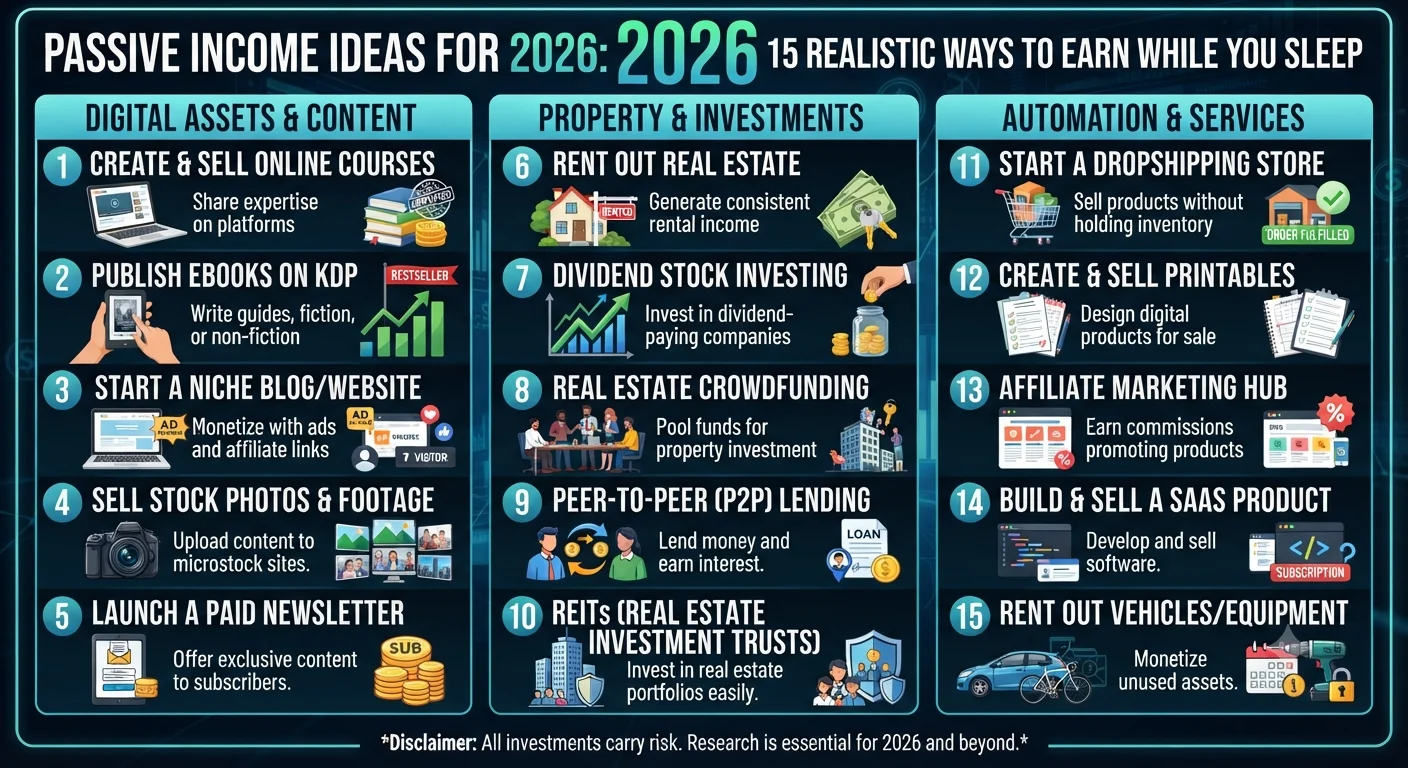
Passive income is real but it is not free. Every passive income stream requires either significant upfront capital, significant upfront time and skill investment, or both. The most accessible passive income streams for most people in 2026 are dividend investing, high-yield savings accounts, affiliate marketing through content, digital product sales, and print-on-demand merchandise. Truly passive income, requiring zero ongoing effort, is rare. Most "passive" income streams require periodic maintenance and content refreshing.
Key Takeaways
- Passive income is defined by the IRS as income from rental activity or a business in which the taxpayer does not materially participate. For tax purposes, most online passive income streams are treated as active self-employment income.
- The average dividend yield on S&P 500 index funds is approximately 1.3 to 1.5 percent as of mid-2026, meaning $100,000 invested generates $1,300 to $1,500 per year in dividends passively.
- High-yield savings accounts and certificates of deposit (CDs) at online banks paid 4.5 to 5.2 percent annual percentage yield (APY) in mid-2026, representing the highest risk-free passive return available since 2007.
- A 2025 Teachable survey found that online course creators who had been on the platform for three or more years earned an average of $47,000 per year from their courses, with the top 10 percent earning over $200,000 annually.
- The myth of purely passive income is the most expensive misconception in personal finance: most people who earn meaningful "passive" income spent hundreds or thousands of hours building the asset that generates it.
What Is Passive Income? (And What It Actually Requires)
- Key Takeaways
- What Is Passive Income? (And What It Actually Requires)
- The Passive Income Spectrum: Low Effort to High Setup
- 15 Legitimate Passive Income Ideas for 2026
- 1. Dividend Investing: The Classic Method
- 2. High-Yield Savings Accounts and CDs
- 3. Affiliate Marketing Through Content
- 4. YouTube Channel Income
- 5. Selling Online Courses
- 6. Print-on-Demand Merchandise
- 7. Rental Income from Property
- 8. Writing and Publishing eBooks
- 9. Licensing Photography or Music
- 10. Creating Mobile Apps or Software Tools
- 11. Peer-to-Peer Lending and Bonds
- 12. Dropshipping Store
- 13. Parking Space Rental
- 14. Investing in Index Funds for Capital Growth
- 15. Building a Niche Newsletter
- The Truth About Passive Income: Upfront Effort Required
- Frequently Asked Questions About Passive Income in 2026
Passive income is income earned with minimal ongoing active effort, in contrast to active income (wages, salary, freelance fees) which requires continuous work to sustain. The appeal is obvious: building income streams that continue generating money whether or not you show up to work on any given day provides financial resilience, time freedom, and an accelerated path to financial independence.
The honest framing is that passive income is a spectrum, not a binary. At one end are truly passive streams like interest income from savings accounts, which requires zero ongoing effort once the account is opened and funded. At the other end are streams that were called passive during their promotional phase (blogging, YouTube channels, online courses) but require substantial initial investment and ongoing maintenance to remain profitable.
The legendary investor Warren Buffett captured the realistic expectation well: "If you don't find a way to make money while you sleep, you will work until you die." The implication is not that passive income is easy or immediate, but that building assets that generate income is the path to financial independence.
Personal finance educator Robert Kiyosaki's "Rich Dad Poor Dad" framework distinguishes between assets (things that put money in your pocket) and liabilities (things that take money out). Passive income is the income generated by assets. Building passive income is, at its core, the practice of accumulating assets: financial assets (stocks, bonds, savings), productive assets (content that generates traffic, courses that generate sales, tools that solve problems), and physical assets (rental property).
The Passive Income Spectrum: Low Effort to High Setup
Understanding where each passive income stream falls on the effort-versus-reward spectrum helps set realistic expectations before investing time or money.
Truly passive (near-zero ongoing effort, capital required): interest from savings accounts, certificates of deposit, Treasury bills, and dividend income from index funds or individual dividend stocks. These require capital upfront but essentially no ongoing effort.
Mostly passive (periodic maintenance, some capital or time required): rental income from property, royalties from published books or music, licensing income from photographs or videos, affiliate income from established high-traffic content.
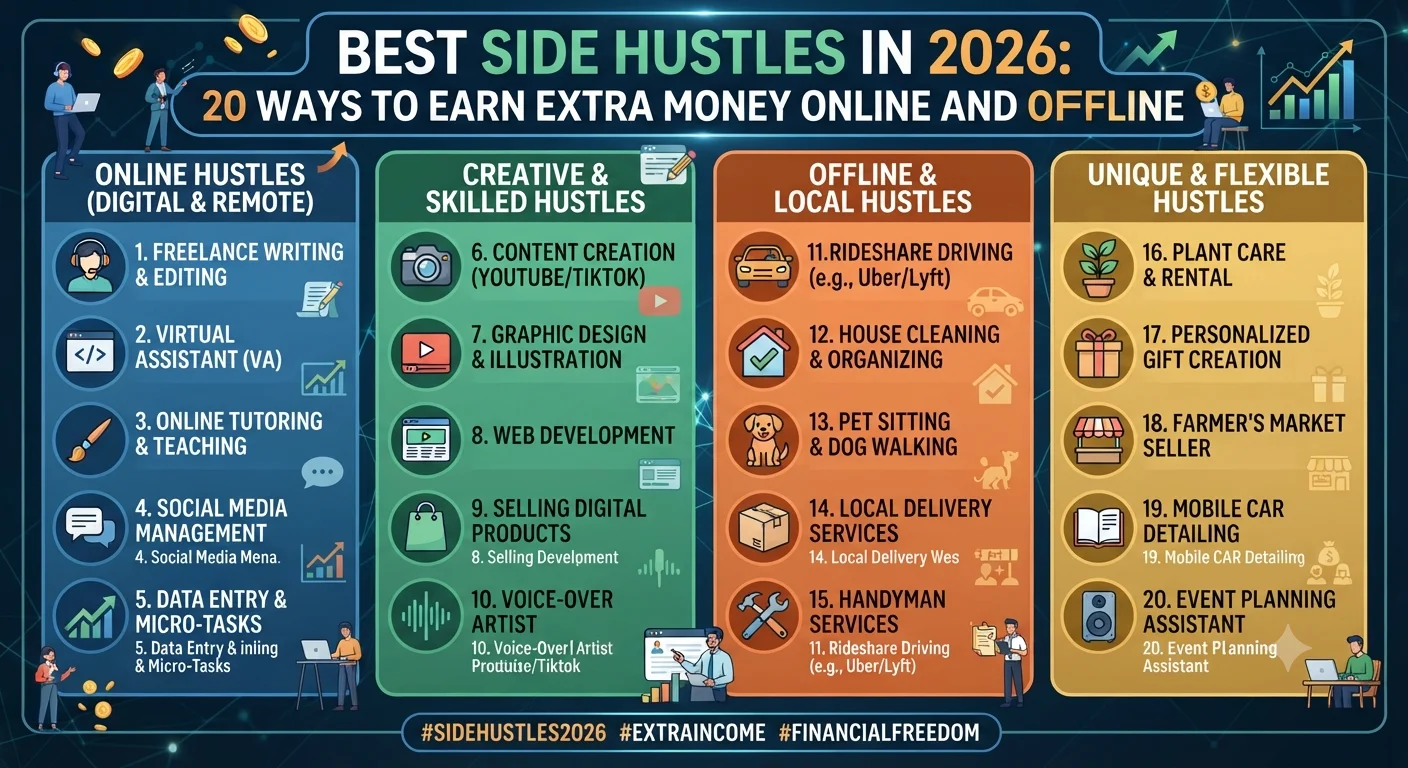
- Best Side Hustles in 2026: 20 Ways to Earn Extra Money Online and Offline
- How to Save Money Fast: 25 Practical Tips That Actually Work in 2026
Semi-passive (regular but limited ongoing work): income from online courses (requires periodic updating and student support), print-on-demand stores (requires occasional design refreshes and marketing), dropshipping stores (requires product and supplier management), YouTube channel income (requires ongoing content production or management).
Active with passive elements (ongoing work with scalable revenue): blogging with display advertising and affiliate marketing, newsletter monetization, software-as-a-service tools, and digital product businesses all have passive revenue mechanics but require significant ongoing work, especially in early stages.
15 Legitimate Passive Income Ideas for 2026
1. Dividend Investing: The Classic Method
Dividend investing involves purchasing shares in companies that distribute a portion of their earnings to shareholders as regular cash payments (dividends). This is the most time-tested passive income strategy and requires no ongoing effort beyond making the initial investment.
The S&P 500 index as a whole yields approximately 1.3 to 1.5 percent annually in dividends in mid-2026. Dividend-focused ETFs and individual dividend stocks in categories including consumer staples, utilities, real estate investment trusts (REITs), and financial services typically yield 2 to 6 percent annually.
The "Dividend Aristocrats" index, which tracks S&P 500 companies that have increased their dividends for 25 or more consecutive years, includes companies such as Johnson and Johnson, Coca-Cola, Procter and Gamble, and Chevron. These companies have demonstrated the ability to sustain and grow dividends through multiple economic cycles.
Realistic income: a $100,000 portfolio in dividend stocks yielding 3 percent generates $3,000 per year ($250 per month) in passive income. Building a $100,000 dividend portfolio requires either significant savings over time or an existing investment account.
Platforms: Fidelity, Schwab, Vanguard, and M1 Finance all support dividend investing with no trading commissions.
2. High-Yield Savings Accounts and CDs
High-yield savings accounts (HYSAs) at online banks and certificates of deposit (CDs) represent the lowest-risk passive income available, backed by FDIC insurance up to $250,000 per institution.
As of mid-2026, leading online banks including Marcus by Goldman Sachs, Ally Bank, SoFi, and Discover Bank offered HYSA rates of 4.5 to 5.1 percent APY. CDs with 12-month terms offered 5.0 to 5.4 percent APY at competitive banks. These rates represent a significant return to genuinely competitive savings rates after more than a decade of near-zero rates following the 2008 financial crisis.
On $50,000 in savings earning 5 percent APY, annual interest income is $2,500, completely passively. This represents a meaningful supplement to other income, especially for emergency funds or short-term savings that would otherwise sit in low-yield traditional bank accounts.
No action required beyond opening the account and transferring funds. Interest is calculated daily and credited monthly.
3. Affiliate Marketing Through Content
Affiliate marketing generates passive income when content you created (a blog article, YouTube video, or social media post) contains links to products or services, and readers who click those links make purchases. You earn a commission on each sale without any ongoing action required beyond the initial content creation.
The truly passive phase of affiliate marketing occurs after a content asset has accumulated organic search traffic or a large established audience. A blog article ranking on page one of Google for a high-intent keyword related to a product recommendation generates affiliate commissions continuously, sometimes for years, from a single piece of work.
Building to that passive phase requires substantial active investment: creating high-quality content that earns search rankings takes consistent effort over six to twelve months or more before meaningful organic traffic develops.
The highest-earning affiliate categories in 2026 by commission value are financial products (credit cards paying $100 to $400 per approved applicant, investment platforms, insurance), software and SaaS tools (typically 20 to 40 percent recurring monthly commissions), online education (30 to 50 percent of purchase price), and premium consumer products.
Realistic income (once established): an affiliate marketing blog with 50,000 monthly organic visitors in a financial or technology niche earns an average of $2,000 to $8,000 per month in affiliate commissions according to platform data from ShareASale and Commission Junction.
4. YouTube Channel Income
YouTube's Partner Program pays content creators a share of advertising revenue based on views, with CPM (cost per thousand views) varying by topic from approximately $1 to $20. Finance, technology, business, and health channels consistently earn the highest CPM rates.
A YouTube channel with 100,000 subscribers in a finance niche earning an average of $8 CPM and generating 200,000 monthly views would earn approximately $1,600 per month in AdSense income alone, supplemented by sponsorship deals (typically $500 to $3,000 per video at that subscriber level), affiliate commissions from video recommendations, and channel memberships.
YouTube income is semi-passive rather than fully passive: new content must be produced to maintain audience growth and algorithmic visibility. However, older videos continue generating views and income indefinitely. Top YouTubers report that a significant portion of their monthly income comes from videos published one to five years earlier.
Building a YouTube channel to meaningful income requires six to eighteen months of consistent content creation before the Partner Program threshold (1,000 subscribers, 4,000 watch hours) is reached, followed by continued growth before income becomes substantial.
5. Selling Online Courses
Online courses represent one of the highest-margin passive income streams available. A course created once and sold repeatedly through platforms including Teachable, Kajabi, Udemy, and Thinkific generates income from each sale with no additional production cost.
The most commercially successful online courses solve specific, high-value problems for well-defined audiences. Course topics that generate strong sales include professional skill development (Excel, data analysis, coding, digital marketing, accounting), personal improvement (fitness transformation, relationship skills, productivity systems), hobby skills (photography, music production, art), and business skills (freelancing, agency building, e-commerce).
Pricing varies enormously. Udemy courses are priced at $10 to $200 during frequent sales (Udemy itself controls pricing). Self-hosted courses on Teachable or Kajabi enable premium pricing of $197 to $2,000 or more for comprehensive programs.
The passive phase begins after the course is created and a reliable traffic or marketing system (email list, social media audience, search traffic) funnels buyers to it. Initial course creation typically requires 40 to 200 hours of work depending on depth and production quality.
Realistic income: the Teachable 2025 survey cited in the key takeaways found that course creators with three or more years on the platform averaged $47,000 annually, with top earners far exceeding this.
6. Print-on-Demand Merchandise
Print-on-demand (POD) allows you to sell custom-designed physical products (t-shirts, hoodies, mugs, phone cases, posters, tote bags, notebooks) without holding inventory. When a customer purchases, a fulfillment partner such as Printful, Printify, or SPOD prints the design on the product and ships it directly to the customer. You earn the margin between your retail price and the fulfillment cost.
POD income is semi-passive: designing products requires initial effort, and marketing (especially early on) requires ongoing attention. However, stores with proven products and established organic traffic (through Pinterest, Etsy search, or an existing social media audience) generate sales with minimal daily intervention.
Etsy is the primary marketplace for POD products, with over 90 million active buyers in 2025. Niches with consistent strong sales include pet-themed products, hobby communities (gaming, fishing, yoga, crafting), occupational designs (nurses, teachers, firefighters), cultural and regional pride themes, and humorous quotation designs.
Realistic income: established POD stores with a catalog of 50 or more designs and strong Etsy SEO generate $500 to $3,000 per month with minimal ongoing management time.
Recommended Articles
 PERSONAL FINANCE MONEY
 PERSONAL FINANCE MONEY
 PERSONAL FINANCE MONEY
 PERSONAL FINANCE MONEY
7. Rental Income from Property
Rental real estate is the classic passive income asset taught in personal finance education. A property purchased at the right price, financed appropriately, in a market with strong rental demand, generates monthly rental income exceeding mortgage, insurance, tax, and maintenance costs, creating positive cash flow.
The practical challenge of real estate passive income is the substantial capital required. Down payments on investment properties typically require 20 to 25 percent of the purchase price (lenders do not allow 3.5 percent FHA down payments on investment properties). On a $250,000 rental property, that is $50,000 to $62,500 upfront before closing costs and initial repairs.
Cap rates (the annual return on a property before financing costs) on single-family rentals in the United States averaged 4 to 7 percent in competitive markets in 2025 according to CoStar Group data. Real estate's true return advantage comes from combining rental income with property value appreciation over time, mortgage paydown (the tenant effectively pays down your loan), and tax benefits including depreciation deductions.
Real estate investment trusts (REITs), publicly traded companies that own income-producing real estate, provide exposure to real estate passive income without property management responsibilities. REITs are required by law to distribute at least 90 percent of taxable income to shareholders as dividends, making them a reliable income vehicle. REIT ETFs including VNQ (Vanguard Real Estate ETF) and SCHH (Schwab U.S. REIT ETF) are accessible, liquid, and diversified.
8. Writing and Publishing eBooks
Self-publishing eBooks through Amazon Kindle Direct Publishing (KDP) allows authors to earn royalties of 35 to 70 percent on each sale, depending on pricing tier, with no upfront publishing costs. A $9.99 Kindle eBook at 70 percent royalty earns $6.99 per sale.
Nonfiction eBooks in specific, high-demand niches generate the most reliable passive income. Topics including personal finance guides for specific situations, how-to guides for specific tools or skills, business frameworks, and health-related guides for specific demographics or conditions tend to sell consistently without requiring a famous author name.
A well-optimized KDP listing with good reviews, accurate category selection, and competitive pricing can generate ongoing sales from Amazon's search algorithm without additional marketing. Books optimized for Kindle Unlimited (Amazon's subscription service) earn per-page-read payments that can supplement direct sales revenue.
Realistic income: most self-published nonfiction eBooks earn $50 to $500 per month. Authors with multiple books in related niches, strong reviews, and effective keyword optimization report earning $1,000 to $5,000 per month from their combined catalog.
9. Licensing Photography or Music
If you create original photography, illustrations, or music, licensing these assets through stock platforms generates passive income from existing creative work.
Photography: Shutterstock, Getty Images (via iStock), and Adobe Stock pay contributors royalties each time their image is licensed. Rates range from $0.25 to $28 per download depending on the platform, license type, and contributor status. A portfolio of 500 to 1,000 in-demand stock images can generate $300 to $1,500 per month in passive royalty income. Top contributors with thousands of images and strong demand in commercial categories (business, technology, lifestyle, food) earn $3,000 to $10,000 per month.
Music: original music tracks licensed through platforms including AudioJungle (Envato Market), Pond5, Artlist, and Epidemic Sound earn royalties when filmmakers, YouTubers, and content creators license tracks for their productions. Music licensing income is typically modest for individual artists but can scale meaningfully with a substantial catalog.
10. Creating Mobile Apps or Software Tools
Developing a software application, mobile app, or browser extension that solves a specific user problem and charges a subscription fee or one-time purchase price generates passive income once the product achieves an initial user base.
"Micro-SaaS" businesses (small, focused software-as-a-service products solving specific niche problems) have become increasingly accessible to build in 2026, with AI coding tools dramatically reducing the development time required. Solo developers and small teams building focused tools for specific professional audiences (a scheduling tool for yoga studios, a proposal generator for freelance designers, an analytics dashboard for Etsy sellers) have achieved $1,000 to $10,000 monthly recurring revenue with minimal ongoing maintenance.
The passive income properties of software are strong: software replicates at zero marginal cost, the internet distributes it globally at near-zero cost, and subscription billing provides predictable recurring revenue. The active investment required is the initial development and ongoing maintenance (security updates, platform compatibility, customer support).
11. Peer-to-Peer Lending and Bonds
Fixed income instruments including U.S. Treasury bonds, I-bonds, corporate bonds, and peer-to-peer lending platforms generate interest income passively from capital deployed.
U.S. Treasury bonds and Treasury Inflation-Protected Securities (TIPS) are among the safest passive income instruments available, backed by the full faith and credit of the U.S. government. TreasuryDirect.gov allows direct purchase. Ten-year Treasury yields in mid-2026 ranged from 4.2 to 4.8 percent, providing meaningful real returns above inflation for conservative income-seekers.
I-bonds (inflation-indexed savings bonds) are a particularly attractive instrument for passive income protection: they cannot lose nominal value and their interest rate adjusts with inflation. The annual purchase limit of $10,000 per person limits total exposure but provides a meaningful risk-free inflation-protected return on that allocation.
12. Dropshipping Store
Dropshipping, operating an e-commerce store where you market and sell products fulfilled directly by a supplier, can reach a semi-passive state once product validation, supplier relationships, and marketing systems are established.
The active phase of dropshipping involves product research (identifying items with demand and manageable competition), supplier vetting, store setup on Shopify or WooCommerce, and initial advertising campaign testing. Once profitable products and reliable suppliers are identified, advertising campaigns can run with limited daily management.
Shopify and apps including AutoDS and DSers have automated much of the order fulfillment process, reducing daily operational demands. However, customer service, returns management, and continuous advertising optimization require ongoing attention, making dropshipping more semi-passive than truly passive.
Realistic income: established dropshipping stores with proven products generate $1,000 to $8,000 per month net profit, with high variability based on product selection, advertising efficiency, and market competition.
13. Parking Space Rental
Renting a parking space in a high-demand urban area requires minimal ongoing effort and generates consistent passive income from a physical asset many people already own.
Apps including SpotHero and ParkWhiz allow space owners in urban areas to list parking spaces for daily, weekly, or monthly rental. Monthly parking contracts in major city centers generate $100 to $500 per month per space in cities including New York, Chicago, San Francisco, Boston, and Seattle, according to SpotHero market data.
The passive income is genuinely passive in this case: once listed and contracted, the income arrives with no further effort. The limitation is geographic: this strategy is only meaningful in areas with demonstrated parking demand, typically urban centers near transit hubs, sports venues, airports, or dense commercial districts.
14. Investing in Index Funds for Capital Growth
Broad market index funds like Vanguard's VTSAX (Total Stock Market Index Fund) and VOO (S&P 500 ETF) provide two forms of passive income: quarterly dividend distributions and long-term capital appreciation.
The S&P 500 has delivered an average annual total return of approximately 10.5 percent (including dividends reinvested) over the past 50 years, making it the most reliable long-term wealth building vehicle available to ordinary investors. This includes multiple bear markets, recessions, and crises.
The passive income argument for index funds is compounding: reinvesting dividends automatically through a dividend reinvestment plan (DRIP) exponentially accelerates portfolio growth. $500 per month invested in an S&P 500 index fund for 30 years at historical average returns grows to approximately $1.1 million, generating roughly $33,000 per year in dividends at a 3 percent yield.
Brokerages offering commission-free index fund investing include Fidelity, Vanguard, Schwab, and M1 Finance.
15. Building a Niche Newsletter
Email newsletters have experienced a significant commercial renaissance through platforms including Substack and Beehiiv, which allow writers to charge subscription fees directly from readers. A niche newsletter serving a specific professional audience with curated, high-quality information commands subscriber rates of $5 to $20 per month.
At 1,000 paid subscribers paying $10 per month, a newsletter generates $10,000 per month in subscription revenue. The Hustle newsletter (acquired by HubSpot in 2021) was valued at approximately $27 million. Morning Brew (acquired by Business Insider) was valued at $75 million. These represent the top end of outcomes, but thousands of smaller newsletters generate $2,000 to $20,000 per month with 200 to 2,000 paid subscribers.
The semi-passive reality is that newsletter income requires weekly or biweekly content creation to maintain subscribers. However, the advertising and sponsorship component of newsletter revenue (most established newsletters charge $500 to $5,000 per sponsored mention) can be secured months in advance with minimal ongoing effort once an audience is established.
The Truth About Passive Income: Upfront Effort Required
The most important thing to understand about passive income is the honest accounting of what it actually costs to build each stream.
Financial passive income (dividends, interest, rental income) requires capital. Building a $10,000 per year dividend portfolio requires approximately $300,000 to $700,000 invested at typical yields. Accumulating that capital requires either high active income, disciplined saving over many years, or both.
Content-based passive income (affiliate marketing, YouTube, digital products, newsletters) requires creative and intellectual labor upfront. The hours spent writing articles, filming videos, creating courses, and building audiences are real work. The passive phase rewards that earlier investment.
Product-based passive income (print-on-demand, dropshipping, software) requires business building: market research, product creation, customer acquisition systems, and operational management. These businesses have passive elements but require real entrepreneurial input to reach meaningful scale.
The accurate frame is not "income that requires no work" but "income not directly proportional to hours worked." The most successful passive income earners are those who invested heavily in building assets during active phases and now benefit from the compounding returns on those earlier investments.
Frequently Asked Questions About Passive Income in 2026
How much money do I need to start earning passive income?
It depends entirely on the method. High-yield savings accounts can be opened with $1. A meaningful dividend portfolio requires $50,000 to $100,000 for significant monthly income. Content-based passive income streams require time investment rather than capital but can be started with less than $100 in hosting and tools. The right approach depends on whether your resource is capital, time, or skills.
Is passive income taxed differently than regular income?
Qualified dividends and long-term capital gains are taxed at preferential rates (0, 15, or 20 percent depending on income) rather than ordinary income tax rates. Rental income and most online passive income streams are taxed as ordinary income. Interest income from savings accounts and bonds is taxed as ordinary income. Consulting a tax professional about your specific passive income sources ensures optimal tax efficiency.
How long does it take to build significant passive income?
Financial passive income from investments builds over years of consistent contribution. Content-based passive income typically requires six to eighteen months of consistent effort before generating meaningful revenue. The most common experience is that passive income feels impossibly slow for the first year and then accelerates as content compounds and audiences grow.
What is the most realistic passive income for someone starting from zero?
For someone with no capital and no existing audience, the most accessible path is content creation combined with affiliate marketing: starting a blog or YouTube channel in a specific niche, building it consistently over twelve to eighteen months, and monetizing through display advertising and affiliate commissions. This requires no upfront capital beyond hosting ($3 to $10 per month) and generates meaningful passive income once search traffic is established.