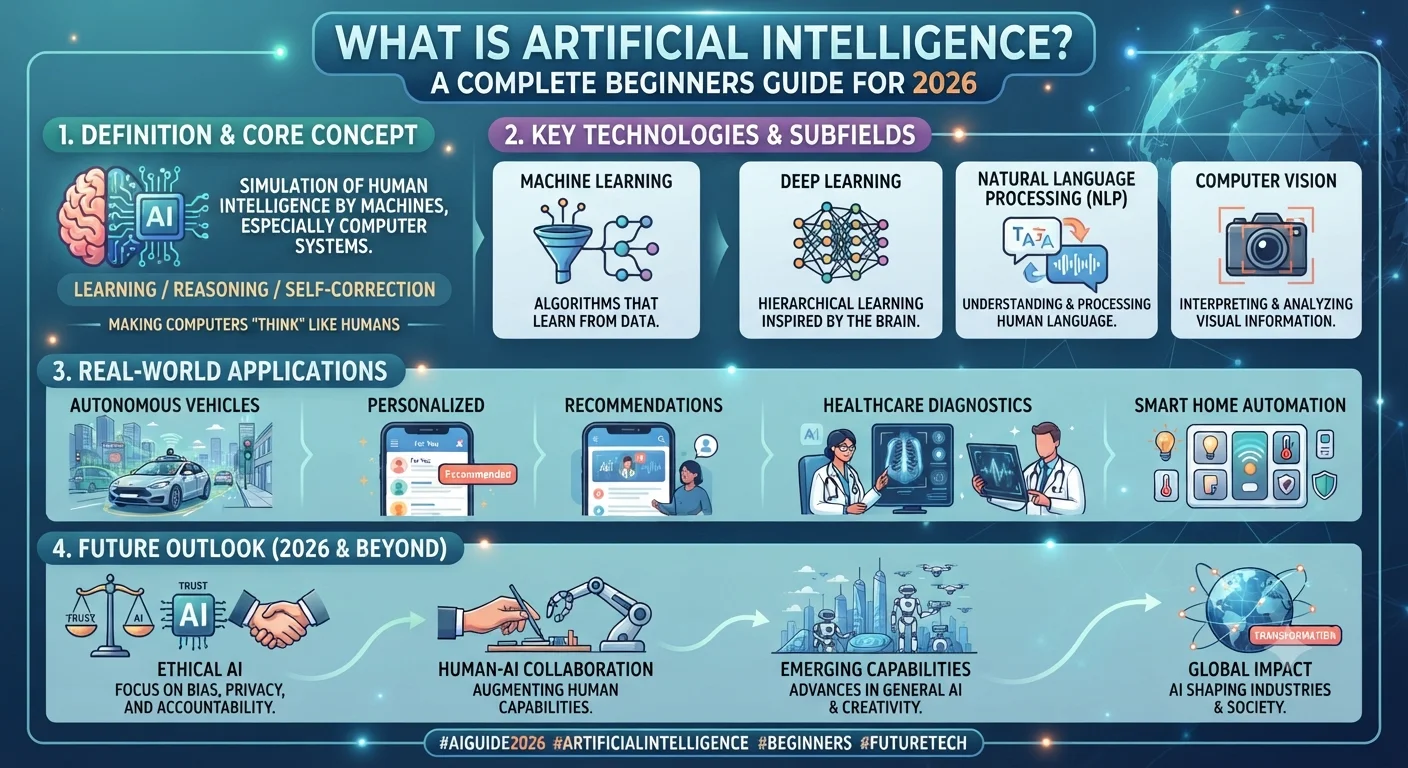
Artificial intelligence (AI) is the ability of computer systems to perform tasks that normally require human intelligence, such as understanding language, recognizing images, making decisions, and learning from experience. In 2026, AI powers everything from smartphone assistants to cancer diagnostics, financial trading systems, and autonomous vehicles.
Key Takeaways
- Artificial intelligence is a branch of computer science that enables machines to simulate human thinking and decision-making.
- The global AI market reached $621 billion in 2025 and is projected to exceed $1.8 trillion by 2030, according to Statista.
- Three main types of AI exist: narrow AI, general AI, and superintelligence. Only narrow AI exists in practical form today.
- Machine learning and deep learning are the core technologies that power modern AI systems.
- OpenAI, Google DeepMind, Anthropic, Meta AI, and Microsoft are the leading organizations shaping AI development in 2026.
The Simple Definition of Artificial Intelligence
- Key Takeaways
- The Simple Definition of Artificial Intelligence
- Types of Artificial Intelligence Explained
- Narrow AI (Weak AI) — What It Is and Examples
- General AI (Strong AI) — The Future Goal
- Superintelligence — Is It Possible?
- How Artificial Intelligence Actually Works
- Machine Learning: The Engine Behind AI
- Neural Networks and Deep Learning
- Real-World AI Applications in 2026
- AI in Healthcare and Medicine
- AI in Finance and Banking
- AI in Education
- Key AI Companies and Researchers to Know
- Is Artificial Intelligence Dangerous? Risks and Ethics
- Frequently Asked Questions About AI
Artificial intelligence is a field of computer science dedicated to building systems that can perform tasks typically requiring human intelligence. These tasks include understanding natural language, recognizing speech and images, solving problems, learning from data, and making predictions.
The term "artificial intelligence" was coined in 1956 by American computer scientist John McCarthy at the Dartmouth Conference, which is widely considered the founding moment of AI as an academic discipline. Since that conference, the field has gone through multiple periods of intense progress followed by slowdowns, now known as "AI winters." The current era, which began accelerating around 2012 with deep learning breakthroughs and exploded publicly with the launch of ChatGPT in November 2022, represents the most transformative period in AI history.
In 2026, artificial intelligence is no longer a futuristic concept. It is embedded in the products and services billions of people use every day, from Google Search and Netflix recommendations to medical imaging software and autonomous vehicle navigation.
Types of Artificial Intelligence Explained
Researchers and computer scientists classify AI into three broad categories based on capability and scope. Understanding these categories helps clarify what AI can and cannot do today.
Narrow AI (Weak AI) — What It Is and Examples
Narrow AI, also called weak AI or artificial narrow intelligence (ANI), refers to AI systems designed to perform one specific task or a limited set of related tasks. These systems cannot apply their intelligence to tasks outside their defined domain.
Every AI system that exists in practical use today is narrow AI. Examples include:
- ChatGPT by OpenAI, which generates text and answers questions
- AlphaFold by Google DeepMind, which predicts protein structures
- Tesla Autopilot, which handles specific driving tasks
- IBM Watson, which assists with medical diagnosis
- Spotify's recommendation algorithm, which suggests music
Narrow AI can outperform humans dramatically within its specialized domain. DeepMind's AlphaGo defeated world champion Go player Lee Sedol in 2016, and its successor AlphaZero became the world's strongest chess engine within four hours of training. But AlphaGo cannot write an email or recognize a face. That limitation defines narrow AI precisely.
General AI (Strong AI) — The Future Goal
Artificial general intelligence (AGI) refers to a hypothetical AI system capable of understanding, learning, and applying intelligence across any intellectual task that a human being can perform. An AGI system would be able to switch between domains freely, reason about novel problems, and transfer knowledge from one area to another.
No AGI system exists today. The timeline for achieving AGI remains one of the most debated questions in technology. Sam Altman, CEO of OpenAI, stated in early 2026 that AGI could be achieved within the next few years, while many academic researchers believe it remains decades away. The disagreement reflects genuine uncertainty about what AGI would require and how to measure it.
The development of AGI would represent one of the most significant technological events in human history, with profound implications for the economy, governance, and human identity.
Superintelligence — Is It Possible?
Artificial superintelligence (ASI) refers to a hypothetical AI system that surpasses human intelligence in every domain, including scientific creativity, social intelligence, and strategic planning. The concept was popularized by Oxford philosopher Nick Bostrom in his 2014 book "Superintelligence: Paths, Dangers, Strategies."
Superintelligence does not exist and is not imminent. However, organizations including Anthropic, the Machine Intelligence Research Institute (MIRI), and the Center for AI Safety are actively researching how to ensure that future powerful AI systems remain aligned with human values, a field known as AI safety or AI alignment.
How Artificial Intelligence Actually Works
AI systems do not work through explicit programming in the traditional sense. Rather than being given a fixed set of rules, modern AI systems learn patterns from data. This distinction is fundamental to understanding why AI has become so capable so quickly.
Machine Learning: The Engine Behind AI
Machine learning (ML) is a subset of artificial intelligence in which systems learn to make predictions or decisions by analyzing large amounts of data, without being explicitly programmed with rules for every scenario.
The machine learning process works as follows. A dataset is assembled, cleaned, and fed into a learning algorithm. The algorithm identifies statistical patterns in the data. It builds a mathematical model that maps inputs to outputs. That model is then tested on new data it has not seen before. The model's predictions are evaluated, and the model is refined based on its errors. This iterative process continues until the model reaches acceptable performance.
Three main types of machine learning exist:
Supervised learning uses labeled data, meaning examples where the correct answer is already known. An email spam filter trained on millions of labeled emails (spam or not spam) is a classic example.
Unsupervised learning uses unlabeled data and finds hidden structure or groupings without pre-defined categories. Customer segmentation in marketing often uses unsupervised learning to discover natural clusters among buyers.
Reinforcement learning trains an agent through trial and error in an environment, rewarding correct actions and penalizing wrong ones. OpenAI's ChatGPT was trained using reinforcement learning from human feedback (RLHF), and DeepMind's agents learned to play Atari games at superhuman levels through reinforcement learning.
Neural Networks and Deep Learning
Neural networks are computational models loosely inspired by the structure of the human brain. They consist of layers of interconnected mathematical units called neurons. Each connection has a weight that is adjusted during training.
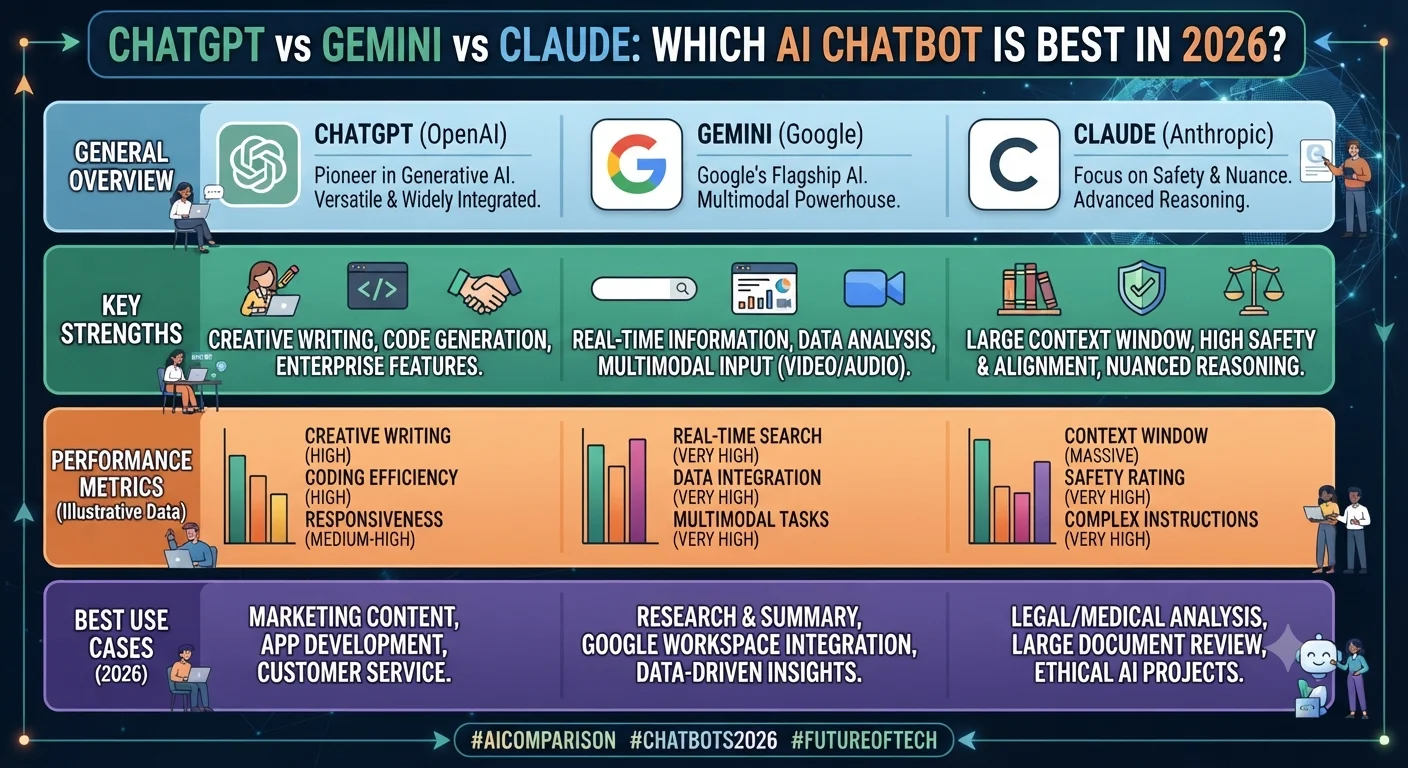
Deep learning refers to neural networks with many layers, sometimes hundreds or thousands. These deep networks are the technology behind virtually every major AI breakthrough of the past decade, including large language models (LLMs) like GPT-4, Claude, and Gemini, as well as image generation systems like Midjourney and DALL-E.
The reason deep learning became so powerful after 2012 is a combination of three factors. First, the availability of massive datasets for training. Second, the development of graphics processing units (GPUs) from Nvidia, which can perform the parallel computations neural networks require at extraordinary speed. Third, algorithmic improvements in training techniques.
Nvidia CEO Jensen Huang described AI as "the most transformative technology in human history" at the company's 2026 GPU Technology Conference, reflecting the hardware company's central role in powering the AI revolution.
Real-World AI Applications in 2026
The practical impact of artificial intelligence in 2026 spans nearly every sector of the global economy. The following are among the most significant areas where AI is actively deployed.
AI in Healthcare and Medicine
Healthcare is arguably the domain where AI is producing the most consequential results. Specific applications in 2026 include:
Google DeepMind's AlphaFold 3, released in 2024, can predict the structure of nearly all proteins known to science with near-experimental accuracy. This capability has accelerated drug discovery dramatically. Before AlphaFold, determining a protein's structure could take a research team years. AlphaFold produces predictions in minutes.
Recommended Articles
 TECHNOLOGY AI
 TECHNOLOGY AI
 TECHNOLOGY AI
AI diagnostic systems from companies including Zebra Medical Vision, Aidoc, and PathAI can detect cancer, diabetic retinopathy, and cardiovascular disease from medical images with accuracy matching or exceeding that of trained radiologists.
The FDA approved more than 700 AI-enabled medical devices by the end of 2025, according to the FDA's publicly available database. That number continues to grow rapidly.
Surgical robots enhanced by AI, including those from Intuitive Surgical (maker of the da Vinci system), assist surgeons with precision movements during complex procedures, reducing complication rates and recovery times.
AI in Finance and Banking
Financial institutions were among the earliest adopters of machine learning, primarily for fraud detection and risk assessment. In 2026, AI applications in finance include:
Real-time fraud detection systems at Visa and Mastercard analyze thousands of transaction attributes simultaneously to flag suspicious activity in milliseconds, with far lower false-positive rates than older rule-based systems.
Algorithmic trading systems manage an estimated 70 to 80 percent of daily trading volume on major stock exchanges, according to a 2025 report from JPMorgan Chase. These systems execute trades based on market signals in microseconds.
Credit scoring models from companies including Upstart and ZestFinance use machine learning to evaluate creditworthiness using hundreds of alternative data points beyond the traditional FICO score, expanding credit access to underserved populations.
AI-powered robo-advisors such as Betterment and Wealthfront manage more than $2 trillion in assets globally as of 2026, offering automated, low-fee portfolio management.
AI in Education
Education technology platforms increasingly use AI to personalize learning. Khan Academy's AI tutor Khanmigo, powered by GPT-4, provides one-on-one tutoring to students in any subject. Duolingo uses AI to adapt language lessons to each learner's pace and error patterns. Carnegie Learning's MATHia platform has demonstrated learning gains of up to twice the typical rate compared to traditional instruction in multiple peer-reviewed studies.
At the university level, AI tools assist with research, writing, and data analysis. A 2025 survey by the Pew Research Center found that 58 percent of college students in the United States reported using AI tools in their academic work on a regular basis.
Key AI Companies and Researchers to Know
Understanding the AI landscape in 2026 requires familiarity with the organizations and individuals driving the field forward.
OpenAI, founded in San Francisco in 2015, created the GPT series of large language models and launched ChatGPT, the fastest-growing consumer product in history, reaching 100 million users in just two months after its November 2022 launch.
Google DeepMind, formed by the merger of Google Brain and DeepMind in 2023, produced AlphaGo, AlphaFold, and the Gemini family of AI models. DeepMind's co-founder Demis Hassabis shared the 2024 Nobel Prize in Chemistry with John Jumper for their work on AlphaFold.
Anthropic, founded in 2021 by former OpenAI researchers including Dario Amodei and Daniela Amodei, develops the Claude family of AI models with a focus on safety, interpretability, and constitutional AI methods.
Meta AI, led by Chief AI Scientist Yann LeCun, has released multiple open-source models including the LLaMA series, which has become the foundation for thousands of customized AI applications worldwide.
Microsoft, through its partnership with OpenAI and integration of AI across its entire product suite (including Copilot for Windows, Office, and Azure), has invested more than $13 billion in OpenAI as of 2025.
Nvidia, while not primarily an AI research company, supplies the hardware that makes modern AI training possible. The company's H100 and H200 GPU chips are the most sought-after computing infrastructure in the world, and Nvidia's market capitalization reached $3.3 trillion in 2025, making it the world's most valuable company.
Prominent researchers shaping the field include Geoffrey Hinton (often called the "Godfather of AI" and 2024 Nobel Prize in Physics co-winner), Yann LeCun, Yoshua Bengio, Andrew Ng, Fei-Fei Li, and Ilya Sutskever.
Is Artificial Intelligence Dangerous? Risks and Ethics
Artificial intelligence presents genuine benefits and genuine risks. A balanced understanding requires examining both honestly.
The most immediate risks from current AI systems include algorithmic bias, where AI models reproduce and amplify existing societal biases present in training data. Research by MIT Media Lab researcher Joy Buolamwini demonstrated that commercial facial recognition systems from IBM, Microsoft, and Amazon had error rates for dark-skinned women up to 34 percentage points higher than for light-skinned men.
Misinformation and deepfakes represent another concrete risk. AI image and video generation tools can create realistic synthetic media that is increasingly difficult to distinguish from authentic content. The Center for Countering Digital Hate reported a 900 percent increase in AI-generated political misinformation between 2023 and 2025.
Economic disruption from automation is a third near-term concern. A 2023 Goldman Sachs report estimated that AI could automate tasks accounting for 300 million full-time jobs globally. However, the same report noted that most affected jobs would be partially rather than fully automated, and that AI would also create new roles.
Longer-term risks, sometimes called existential or catastrophic risks, concern the possibility of highly capable AI systems pursuing goals misaligned with human values. This is the focus of AI safety research at organizations including Anthropic, the Machine Intelligence Research Institute, and the Center for AI Safety.
Regulatory responses are accelerating. The European Union's AI Act, which came into force in August 2024, established the world's first comprehensive legal framework for AI regulation, classifying AI systems by risk level and imposing corresponding requirements. The United States issued a series of executive orders on AI in 2023 and 2024, and a bipartisan Senate AI working group published recommendations for AI governance in May 2024.
Frequently Asked Questions About AI
What is the simplest definition of artificial intelligence?
Artificial intelligence is computer software that can perform tasks typically requiring human intelligence, such as understanding language, recognizing images, and making decisions based on data.
What is the difference between AI, machine learning, and deep learning?
AI is the broad field encompassing any technique that enables machines to mimic human intelligence. Machine learning is a subset of AI in which systems learn from data. Deep learning is a subset of machine learning using multi-layered neural networks. Think of it as nested circles: AI is the largest, machine learning is inside it, and deep learning is inside machine learning.
Is ChatGPT a true artificial intelligence?
ChatGPT is a narrow AI system specifically a large language model. It is highly capable within the domain of language tasks but cannot perform tasks outside that domain, such as operating a robot arm or driving a car. It is not a general AI.
How is AI affecting jobs in 2026?
The World Economic Forum's Future of Jobs Report 2025 estimates that AI will displace 85 million jobs globally by 2025 while creating 97 million new roles, resulting in a net positive of approximately 12 million jobs. The shift heavily favors workers in AI-adjacent, creative, and interpersonal roles over those in repetitive, rules-based occupations.
Which countries lead in AI development?
The United States and China are the two dominant AI powers. The United States leads in AI research publications, private investment (attracting $67 billion in AI venture capital in 2023 alone), and the development of frontier models. China leads in AI patent filings and AI deployment in public infrastructure. The United Kingdom, Canada, Israel, France, and Singapore are also significant AI hubs.
Can I learn AI without a technical background?
Yes. Platforms including Coursera, edX, fast.ai, and Google's AI courses offer accessible introductions to AI and machine learning. Andrew Ng's "AI For Everyone" course on Coursera is specifically designed for non-technical learners and has been completed by more than five million people.
What is the future of artificial intelligence?
The near-term future of AI in 2026 and beyond involves AI agents that can complete multi-step tasks autonomously, deeper integration of AI into physical products (robotics), continued regulatory development, and progress toward artificial general intelligence, though the timeline remains genuinely uncertain.