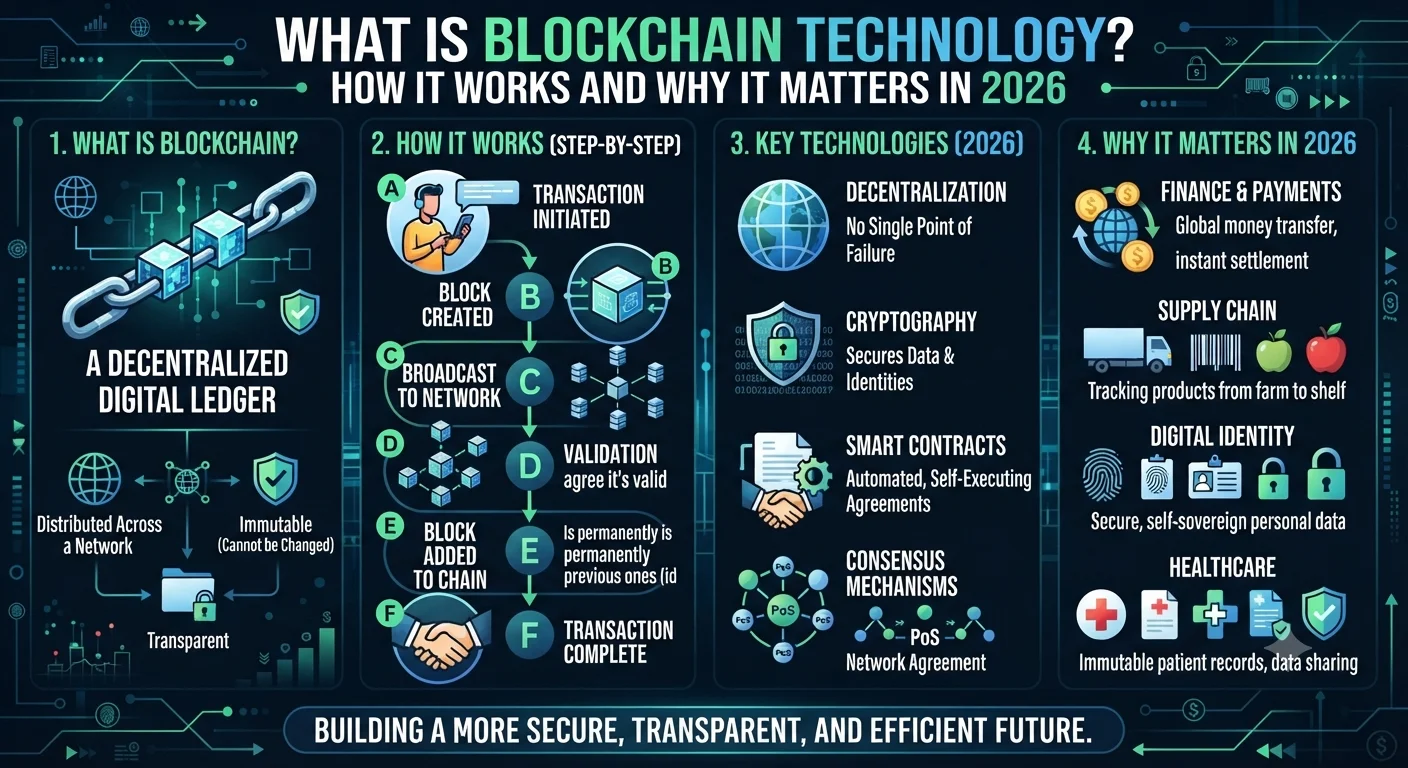
Blockchain is a distributed digital ledger that records transactions across a network of computers in a way that makes records permanent, transparent, and tamper-resistant. No single entity controls it. Once data is recorded, it cannot be altered without changing all subsequent records and gaining consensus from the majority of the network. This makes blockchain uniquely suited for applications requiring trust between parties who do not know each other.
Key Takeaways
- Bitcoin, the first major blockchain application, was introduced by the pseudonymous Satoshi Nakamoto in a 2008 whitepaper titled "Bitcoin: A Peer-to-Peer Electronic Cash System."
- The global blockchain market was valued at $17.57 billion in 2023 and is projected to reach $469.49 billion by 2030, growing at a compound annual growth rate of 59.9 percent, according to Grand View Research.
- Ethereum, launched in 2015 by Vitalik Buterin, extended blockchain from currency transfers to programmable "smart contracts," dramatically expanding the range of possible applications.
- Walmart, IBM, Maersk, and JPMorgan Chase are among the largest corporations actively using blockchain for supply chain transparency, trade finance, and payment settlement in 2026.
- Blockchain's three core properties are decentralization (no single controlling authority), immutability (records cannot be altered after confirmation), and transparency (transactions are verifiable by network participants).
Blockchain Defined: A Non-Technical Explanation
- Key Takeaways
- Blockchain Defined: A Non-Technical Explanation
- How Blockchain Technology Actually Works
- Distributed Ledger vs Centralized Database
- Blocks, Chains, and Cryptographic Hashing
- Consensus Mechanisms: Proof of Work vs Proof of Stake
- Real-World Applications of Blockchain Beyond Cryptocurrency
- Supply Chain Transparency: Walmart and Maersk
- Healthcare Records and Data Security
- Digital Identity Verification
- Smart Contracts in Legal and Financial Services
- Public vs Private Blockchain: Key Differences
- Challenges and Limitations of Blockchain Technology
- The Future of Blockchain in 2026 and Beyond
- Frequently Asked Questions About Blockchain Technology
Imagine a spreadsheet that records every transaction ever made between thousands of participants. Now imagine that instead of this spreadsheet being stored on one company's server (where it could be altered, hacked, or taken offline), identical copies of it exist simultaneously on thousands of computers around the world. Every time a new transaction is added, all copies update simultaneously, and every participant can verify any entry.
Now add one more property: every new entry is mathematically linked to all the entries that came before it in a way that makes changing any historical record immediately detectable. If someone tried to alter a transaction from three months ago, the mathematical link would break, the change would be visible to all participants, and the network would reject it.
That is the essence of blockchain. It is a shared, distributed ledger that is maintained collectively by participants rather than by a central authority, where records are added sequentially in cryptographically linked groups called blocks, forming a chain of blocks: a blockchain.
The significance of this design is that it allows strangers who do not trust each other and have no central authority to rely on (no bank, no government, no corporation) to conduct verifiable transactions with confidence that the record cannot be manipulated.
How Blockchain Technology Actually Works
Distributed Ledger vs Centralized Database
Traditional databases are centralized: a single entity (a bank, a company, a government agency) maintains the authoritative record, controls who can read or write to it, and is trusted to maintain its accuracy and availability. This model is efficient but creates several vulnerabilities: the central authority can be hacked, can manipulate records, can be taken offline, or can fail entirely.
A distributed ledger, the category of technology to which blockchain belongs, stores copies of the same data across multiple nodes (computers) simultaneously. There is no single point of failure and no single point of control. Any participant can verify the data, and no single participant can unilaterally alter it.
Blockchain adds several specific properties to the distributed ledger concept: cryptographic linking of sequential records, consensus mechanisms that determine how new records are validated, and transparency rules that govern who can see what.
Blocks, Chains, and Cryptographic Hashing
Each "block" in a blockchain contains three things: a set of transaction data (the actual records being stored), a timestamp indicating when the block was created, and a cryptographic hash.
- ChatGPT vs Gemini vs Claude: Which AI Chatbot Is Best in 2026?
- What Is Artificial Intelligence? A Complete Beginners Guide for 2026
A cryptographic hash is a fixed-length string of characters generated by running data through a mathematical algorithm (commonly SHA-256 for Bitcoin) that produces a unique fingerprint for that specific data. Changing even a single character of the input data produces a completely different hash output. This property, called the "avalanche effect," makes hashes useful for detecting any modification to data.
Each block contains not only its own hash but also the hash of the previous block. This is the "chain" in blockchain. A block at position 500 in the chain contains the hash of block 499, which contains the hash of block 498, and so on, all the way back to the first block (called the genesis block). This sequential linking means that changing any historical block would change its hash, which would break the link to the next block, which would need to be recalculated, which would break the link to the block after that, and so on through every subsequent block. On a large network where thousands of computers maintain copies of the chain, making such a change undetected is computationally infeasible.
Consensus Mechanisms: Proof of Work vs Proof of Stake
Adding a new block to the blockchain requires the network to reach consensus: a majority of participants must agree that the new block is valid. Different blockchains use different consensus mechanisms to achieve this agreement.
Proof of Work (PoW) is the original consensus mechanism used by Bitcoin. In PoW, network participants called "miners" compete to solve computationally intensive mathematical puzzles. The first miner to find a valid solution gets to add the next block and receives newly created cryptocurrency as a reward. This competition makes adding fraudulent blocks extremely expensive: an attacker would need to control more than 50 percent of the network's total computational power, which on the Bitcoin network in 2026 represents millions of specialized computers consuming enormous amounts of electricity.
The criticism of PoW is its energy consumption. Bitcoin mining consumed an estimated 91 terawatt-hours of electricity per year in 2024, comparable to the annual electricity consumption of countries like Finland or Chile, according to the Cambridge Centre for Alternative Finance.
Proof of Stake (PoS) is the alternative consensus mechanism used by Ethereum (which transitioned from PoW to PoS in September 2022 in an event called "The Merge") and most newer blockchain networks. In PoS, validators are selected to add new blocks based on the amount of cryptocurrency they "stake" (lock up as collateral) rather than computational work they perform. Ethereum's transition to PoS reduced its energy consumption by approximately 99.95 percent, according to the Ethereum Foundation, addressing the most significant environmental criticism of blockchain technology.
Real-World Applications of Blockchain Beyond Cryptocurrency
Supply Chain Transparency: Walmart and Maersk
Supply chain management is among the most mature and commercially proven applications of blockchain technology. The fundamental problem blockchain solves in supply chains is provenance verification: proving exactly where a product came from, how it was handled, and who was responsible for it at each stage of its journey from producer to consumer.
Walmart began using IBM Food Trust blockchain technology in 2018 to track leafy green vegetables after E. coli outbreaks. Before blockchain implementation, tracing the origin of a contaminated product required six days, eighteen hours, and twenty-six seconds according to Walmart's own measurements. After blockchain implementation, the same trace took 2.2 seconds. This speed is not merely operationally convenient; in food safety emergencies, the difference between hours and seconds determines whether a recall prevents or follows illness.
Maersk, the world's largest container shipping company, partnered with IBM to launch TradeLens, a blockchain-based trade platform. While TradeLens was discontinued in 2022 after failing to achieve sufficient industry-wide adoption, the lessons from that initiative informed a new generation of more focused blockchain supply chain implementations. DHL, FedEx, and Amazon have each developed proprietary blockchain tracking systems for specific supply chain challenges.
In luxury goods, brands including LVMH (Louis Vuitton, Christian Dior, Bulgari) use blockchain to provide consumers with cryptographically verifiable certificates of authenticity for high-value products, reducing counterfeiting.
Healthcare Records and Data Security
Healthcare data management is one of the sectors with the greatest potential for blockchain applications, though large-scale implementation remains in early stages. The fundamental challenge it addresses is the fragmentation and inaccessibility of health records across thousands of providers while simultaneously maintaining the privacy and security of extremely sensitive personal data.
Pilot projects and partial implementations in 2026 include patient-controlled health data sharing platforms where individuals hold cryptographic keys to their own health records and grant time-limited access to specific providers, pharmaceutical supply chain verification to prevent counterfeit medications (the World Health Organization estimates that 10 percent of drugs in low and middle-income countries are falsified or substandard), and clinical trial data integrity verification to prevent data manipulation or selective reporting.
Recommended Articles
 TECHNOLOGY AI
 TECHNOLOGY AI
 TECHNOLOGY AI
MedRec, developed by MIT researchers, and the Estonian government's health record system, which uses blockchain-based technology to secure health records for over 1.3 million citizens, are among the most cited real-world implementations.
Digital Identity Verification
Identity verification is a pervasive challenge in the digital economy. Centralized identity systems are vulnerable to large-scale data breaches. Decentralized Identity (DID) systems built on blockchain allow individuals to create cryptographically verifiable digital identities that they control, share selectively with services that require verification, and revoke at will.
The World Food Programme's Building Blocks project used an Ethereum-based identity system to provide Syrian refugees in Jordan with verifiable digital identities, enabling them to access food assistance without requiring physical documents. By 2022, the system was processing over 100,000 transactions per month and had served over 100,000 beneficiaries.
Microsoft's ION (Identity Overlay Network) is a decentralized identity system built on the Bitcoin blockchain, deployed in 2021. The W3C (World Wide Web Consortium) published a Decentralized Identifiers (DIDs) specification in 2022, establishing technical standards that could allow interoperable digital identity across blockchain platforms.
Smart Contracts in Legal and Financial Services
Smart contracts are self-executing programs stored on a blockchain that automatically carry out predetermined actions when specific conditions are met. They were introduced as a core concept by Ethereum in 2015. The name is somewhat misleading: they are not legal contracts in the traditional sense but programmable transaction logic.
A simple smart contract example: two parties agree to a transaction where Party A sends $10,000 to a smart contract, and the contract automatically releases the funds to Party B when Party B provides cryptographic proof that they have delivered a specified service. No bank, lawyer, or intermediary is needed to enforce the agreement; the code does so automatically.
Real-world smart contract applications in 2026 include decentralized finance (DeFi) protocols that allow lending, borrowing, and exchange of assets without traditional financial intermediaries, tokenization of real-world assets (real estate, art, commodities) that enables fractional ownership and automated distribution of proceeds, insurance claim automation where parametric insurance policies pay out automatically when verifiable trigger conditions (verified by oracles, which are blockchain interfaces to real-world data) are met, and royalty distribution in music and creative work where smart contracts automatically distribute payments to rights holders whenever their content is used.
Public vs Private Blockchain: Key Differences
Not all blockchains are created equal. The distinction between public and private (or permissioned) blockchains is fundamental to understanding which applications are appropriate for each.
Public blockchains like Bitcoin and Ethereum are open to anyone to participate in as a user or validator, fully transparent (all transactions visible to all participants), censorship-resistant (no entity can prevent valid transactions), and maximally decentralized. These properties make them suitable for applications requiring trustless interaction between unknown parties.
Private or permissioned blockchains restrict participation to pre-approved entities. Hyperledger Fabric (an open-source permissioned blockchain framework developed by the Linux Foundation and IBM) and R3 Corda (used extensively in financial services) are the most widely deployed enterprise blockchain frameworks. These systems sacrifice some decentralization in exchange for higher transaction throughput, privacy controls, and lower energy consumption, making them more suitable for enterprise applications where participants are known and compliance requirements apply.
Consortium blockchains sit between public and private models, allowing a group of organizations to jointly control a shared ledger without full public access. The Global Shipping Business Network (GSBN), used by major container shipping lines, is an example.
Challenges and Limitations of Blockchain Technology
Honest assessment of blockchain requires acknowledging its genuine limitations alongside its capabilities.
Scalability remains a significant technical challenge for public blockchains. Bitcoin processes approximately seven transactions per second. Ethereum, even after The Merge, processes approximately fifteen to twenty transactions per second. By comparison, Visa's payment network processes approximately 24,000 transactions per second at peak capacity. Layer 2 solutions (technology built on top of base blockchains to increase throughput) including the Lightning Network for Bitcoin and Polygon and Optimism for Ethereum address this limitation, but add complexity.
Energy consumption remains a concern for Bitcoin and other proof-of-work chains. Ethereum's PoS transition addressed this for that network, but Bitcoin's energy use continues to be a significant environmental criticism.
The oracle problem refers to the challenge of connecting blockchain systems to real-world data. Blockchains can verify on-chain events with certainty, but obtaining reliable data from the outside world (current market prices, weather conditions, physical delivery confirmation) requires trusted data oracles, which reintroduce trust dependencies that blockchain otherwise eliminates.
Regulatory uncertainty in many jurisdictions continues to constrain enterprise blockchain adoption, particularly for applications involving financial assets. The regulatory treatment of tokenized securities, DeFi protocols, and digital currencies varies significantly between countries and remains in active development globally.
The Future of Blockchain in 2026 and Beyond
The blockchain landscape in 2026 is characterized by selective maturation rather than universal adoption. Early predictions of blockchain disrupting every industry within years have proven overstated. What is actually happening is more targeted: specific applications where blockchain's unique properties (immutability, transparency, decentralization) solve genuinely important problems are achieving real deployment, while speculative or poorly suited applications have faded.
Tokenization of real-world assets is one of the most actively developing areas. BlackRock, the world's largest asset manager, launched its BUIDL tokenized fund on Ethereum in March 2024, providing institutional investors with blockchain-based access to US Treasury securities. JPMorgan, Goldman Sachs, and Fidelity have launched comparable initiatives. The tokenization of real estate, private equity, and other traditionally illiquid assets represents a potential multi-trillion dollar market expansion.
Central Bank Digital Currencies (CBDCs), which use blockchain or distributed ledger technology to issue digital versions of national currencies, represent perhaps the most significant near-term deployment of blockchain-adjacent technology. As of 2026, over 130 countries are exploring or have launched CBDC programs. China's Digital Yuan (e-CNY) has processed over 7 trillion yuan ($1 trillion) in transactions. The European Central Bank is in the design phase for a Digital Euro expected to pilot in 2027.
Frequently Asked Questions About Blockchain Technology
What is the difference between blockchain and cryptocurrency?
Cryptocurrency (Bitcoin, Ethereum, etc.) is one application built on blockchain technology. Blockchain is the underlying infrastructure: a distributed, immutable ledger. Just as the internet is an infrastructure on which email, websites, and streaming are applications, blockchain is an infrastructure on which cryptocurrency, supply chain tracking, smart contracts, and digital identity are applications. Blockchain has uses that have nothing to do with cryptocurrency.
Is blockchain the same as Bitcoin?
No. Bitcoin is the first and most well-known application of blockchain technology, specifically a decentralized digital currency. Blockchain is the underlying technology that enables Bitcoin to function without a central authority. Many other blockchain networks exist beyond Bitcoin, including Ethereum, Solana, Cardano, Polkadot, and thousands more, each with different technical properties and use cases.
Is blockchain secure?
Public blockchains like Bitcoin and Ethereum have proven highly resistant to direct attack. The Bitcoin blockchain has operated continuously since 2009 with no successful attack on the base protocol. However, blockchain security does not protect against all vulnerabilities. Smart contract code bugs have been exploited for hundreds of millions of dollars in losses. Centralized services built on top of blockchains (exchanges, wallets, custodians) have been successfully attacked. The security of blockchain-based systems depends on both the underlying protocol and all the software built on top of it.
Can blockchain be hacked?
The base layer of established public blockchains is highly resistant to direct attack due to the computational cost of a "51 percent attack" (gaining majority network control). Smaller, newer blockchains with less computing power securing them are more vulnerable. The far more common attack vector is not the blockchain itself but the applications, smart contracts, and custody services built on top of it, which have resulted in significant losses for users of specific platforms.
Will blockchain replace banks?
Blockchain will not replace traditional banking in any foreseeable timeframe. It will, however, continue to create complementary systems that perform specific financial functions with different trust and cost structures. DeFi protocols already provide lending, borrowing, and asset exchange without traditional intermediaries, but they serve a self-selecting technically sophisticated user base and carry their own risks. Traditional banking provides services including deposit insurance, regulatory consumer protection, and relationship-based credit assessment that decentralized systems have not yet replicated for general populations.