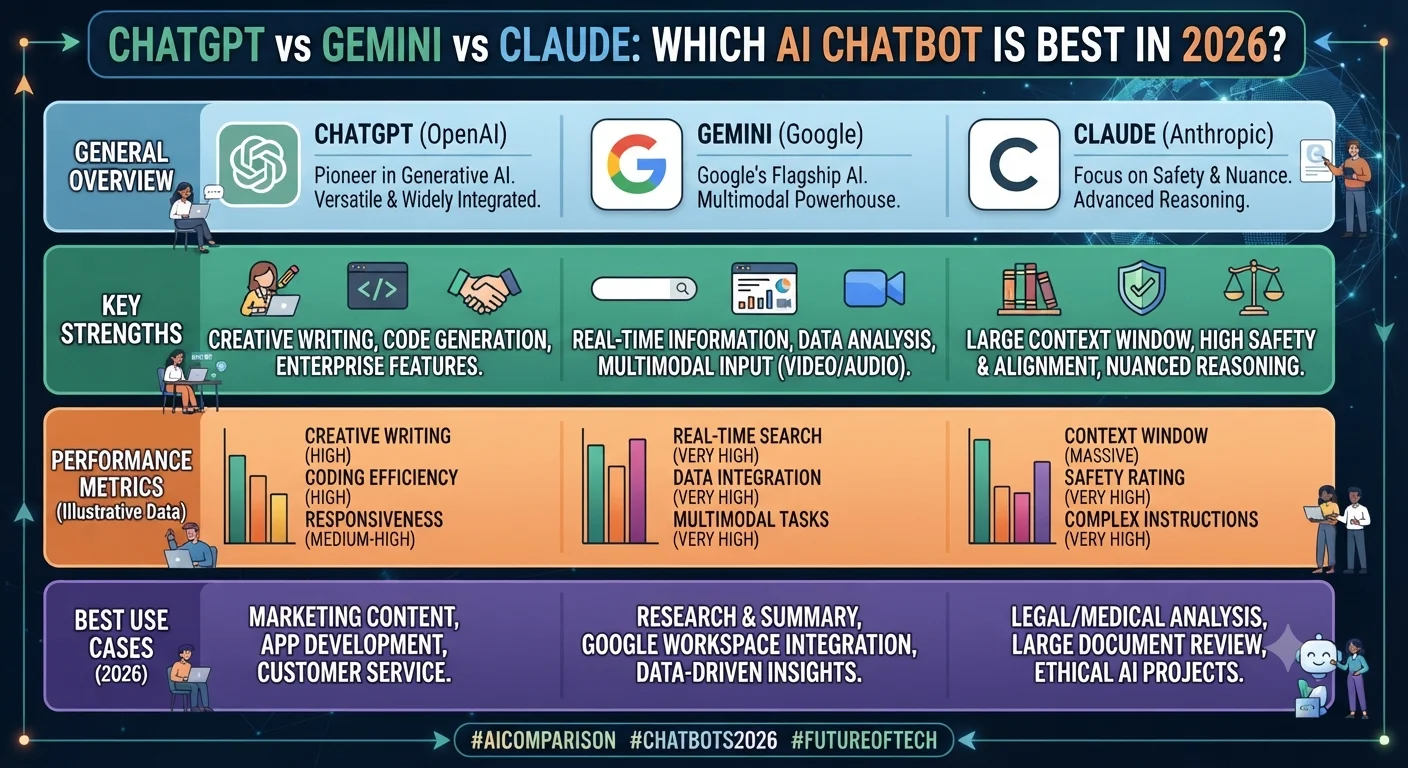
In 2026, ChatGPT (by OpenAI), Google Gemini, and Anthropic Claude are the three most widely used AI chatbots in the world. ChatGPT leads in user adoption and plugin ecosystem. Gemini leads in real-time web integration and Google Workspace productivity. Claude leads in document analysis, nuanced reasoning, and safety-conscious outputs. The best AI chatbot depends on your specific use case.
Key Takeaways
- ChatGPT reached 400 million weekly active users in February 2025, making it the most widely used AI chatbot globally.
- Google Gemini is deeply integrated with Google Search, Gmail, Docs, and Sheets, giving it a practical advantage for users already in the Google ecosystem.
- Anthropic Claude processes up to 200,000 tokens in a single context window, equivalent to approximately 500 pages of text, the largest of the three platforms.
- All three platforms offer free tiers with meaningful capability and paid tiers starting at approximately $20 per month for individual users.
- Independent benchmarks from MMLU, HumanEval, and LMSYS Chatbot Arena consistently show the three platforms at comparable intelligence levels, with margins shifting based on the specific task type.
Overview: The Three Leading AI Chatbots in 2026
- Key Takeaways
- Overview: The Three Leading AI Chatbots in 2026
- ChatGPT (OpenAI): Strengths, Weaknesses, and Pricing
- What ChatGPT Does Best
- ChatGPT's Key Limitations
- ChatGPT Pricing in 2026
- Google Gemini: Strengths, Weaknesses, and Pricing
- Gemini's Integration with Google Workspace
- Where Gemini Falls Short
- Gemini Pricing in 2026
- Anthropic Claude: Strengths, Weaknesses, and Pricing
- Why Claude Excels at Long Documents and Nuanced Reasoning
- Claude's Unique Safety-First Approach
- Claude's Key Limitations
- Claude Pricing in 2026
- Side-by-Side Feature Comparison Table (2026)
- Which AI Chatbot Should You Use? (By Use Case in 2026)
- Best AI for Students
- Best AI for Developers and Software Engineers
- Best AI for Business and Marketing Professionals
- Best AI for Legal, Medical, and Research Professionals
- Frequently Asked Questions About AI Chatbots
Three organizations have established themselves as the clear global leaders in consumer AI chatbot technology: OpenAI with ChatGPT, Google with Gemini, and Anthropic with Claude. Each emerged from a different research tradition and embodies a different philosophy about what AI should prioritize.
OpenAI, founded in San Francisco in 2015 and now a multi-billion dollar company after significant investment from Microsoft, built ChatGPT around the principle of broad capability and accessibility. The ChatGPT launch in November 2022 is widely credited with triggering the current public AI revolution.
Google, through its combined AI research organization Google DeepMind, built Gemini to be deeply integrated with Google's existing products and to leverage the company's unrivaled access to real-time web information through Google Search.
Anthropic, founded in 2021 by former OpenAI researchers Dario Amodei and Daniela Amodei, built Claude around a safety-first, interpretability-focused research program called Constitutional AI. This approach gives Claude a distinctive character: more cautious, more thorough in nuanced ethical reasoning, and more reliable when handling sensitive or complex topics.
ChatGPT (OpenAI): Strengths, Weaknesses, and Pricing
What ChatGPT Does Best
ChatGPT in 2026 runs on OpenAI's GPT-4o model as its standard tier and on the newer o3 reasoning model for complex analytical and mathematical tasks. It has a larger plugin and integration ecosystem than any competitor, with thousands of custom GPTs (purpose-built versions of ChatGPT for specific functions) available through the ChatGPT marketplace.
ChatGPT's strongest performing areas include creative writing and storytelling, coding assistance and debugging, data analysis using its built-in code interpreter, image generation through DALL-E 3, and voice conversation via Advanced Voice Mode. For developers building AI-powered applications, OpenAI's API remains the most widely adopted in the industry.
Code generation is a particular strength. On the HumanEval benchmark, a standardized assessment of Python programming ability, GPT-4o achieved a pass rate of 90.2 percent in 2025 evaluations. The specialized o3 model scored even higher on mathematical reasoning benchmarks, solving 87.5 percent of problems in the American Invitational Mathematics Examination (AIME), a competition that challenges the top mathematics students in the United States.
DALL-E 3 integration allows ChatGPT users to generate high-quality images directly within conversations without switching platforms. The voice mode, which allows real-time spoken conversation with the AI, has been praised by users for its natural prosody and responsive latency.
ChatGPT's Key Limitations
ChatGPT's primary weakness has historically been its knowledge cutoff, the date after which its training data ends. While ChatGPT now includes web search capability for paid users, the integration is not as seamless or comprehensive as Gemini's deep connection to Google Search.
ChatGPT can also be prone to confident-sounding errors, sometimes called "hallucinations," in domains requiring highly precise factual recall such as legal citations, medical dosages, and historical dates. Users relying on ChatGPT for high-stakes factual tasks should always verify outputs independently.
The free tier of ChatGPT operates with usage limits and slower response times than the paid tier, and access to the most advanced models (including o3 reasoning) requires a ChatGPT Plus subscription at $20 per month or higher enterprise tiers.
ChatGPT Pricing in 2026
ChatGPT Free: Access to GPT-4o with usage limits, basic web search, and DALL-E image generation.
ChatGPT Plus: $20 per month. Unlimited GPT-4o, priority access to o3, advanced voice mode, more image generation, and access to the full GPT store.
ChatGPT Team: $25 per user per month. Collaborative workspace, admin controls, higher usage caps.
ChatGPT Enterprise: Custom pricing. Highest security standards, SSO integration, advanced analytics.
Google Gemini: Strengths, Weaknesses, and Pricing
Gemini's Integration with Google Workspace
Google Gemini in 2026 runs on the Gemini 1.5 Pro and Gemini Ultra models. Its defining competitive advantage is its integration with Google's entire product ecosystem and its real-time access to web information through Google Search.
Gemini can retrieve and synthesize current information from the web in real time, with no knowledge cutoff in the same sense as standalone language models. When you ask Gemini about a news event from yesterday, it searches and responds with current data. This makes Gemini uniquely valuable for tasks requiring up-to-date information: stock prices, current events, recent research publications, and breaking news.
For users who live and work in Google Workspace, Gemini's integration is a substantial practical advantage. Gemini is embedded directly in Gmail (for email drafting and summarization), Google Docs (for writing and editing assistance), Google Sheets (for formula generation and data analysis), Google Slides (for presentation creation), and Google Meet (for meeting transcription and summarization). These integrations do not require switching tabs or copying text between applications.
Google also benefits from its Multimodal capabilities. Gemini can process and reason about text, images, audio, video, and code simultaneously. This multimodal reasoning capability, demonstrated in tests where Gemini analyzed video content and answered questions about its specific details, represents a frontier that other models are still catching up to in some respects.
Where Gemini Falls Short
Gemini's response quality for purely text-based creative and analytical tasks is generally considered marginally below ChatGPT's GPT-4o and Claude 3.5 Sonnet based on independent LMSYS Chatbot Arena rankings as of early 2026. This gap has narrowed considerably since Gemini's initial launch but persists in areas like creative writing nuance and complex multi-step reasoning.
Gemini has also faced criticism for factual errors in high-profile situations, most notably an early 2023 promotional video that showed Gemini making an incorrect factual claim about the James Webb Space Telescope, which contributed to a significant drop in Google's stock price on the day of the announcement.
Gemini's plugin ecosystem and customization options are less developed than ChatGPT's, making it less versatile for power users who want to extend the AI's capabilities with third-party tools.
Gemini Pricing in 2026
Gemini Free: Access to Gemini 1.5 Flash, basic web search integration, Google Workspace light integration.
Google One AI Premium: $19.99 per month. Full Gemini Ultra access, complete Workspace integration, 2TB Google storage.
Gemini for Workspace (Business): $30 per user per month. Enterprise-grade Gemini access across all Workspace apps with advanced admin controls.
Anthropic Claude: Strengths, Weaknesses, and Pricing
Why Claude Excels at Long Documents and Nuanced Reasoning
Anthropic Claude in 2026 is available as Claude Opus, Claude Sonnet, and Claude Haiku, representing different capability and speed tiers. Claude 3.5 Sonnet, released in mid-2024, topped multiple independent benchmarks upon release and maintained strong performance rankings through 2025 and into 2026.
Recommended Articles
 TECHNOLOGY AI
 TECHNOLOGY AI
 TECHNOLOGY AI
Claude's most distinctive technical advantage is its context window. Claude can process up to 200,000 tokens in a single conversation, equivalent to approximately 150,000 words or 500 pages of text. This capability makes Claude uniquely suited for tasks involving very long documents: analyzing entire legal contracts, reviewing full academic theses, working with complete codebases, or synthesizing multiple lengthy reports at once. GPT-4o supports up to 128,000 tokens, and while this is substantial, Claude's window is considerably larger.
On qualitative assessments, Claude consistently receives higher marks than competitors for nuanced writing, analytical depth, and careful handling of morally complex or sensitive topics. Claude's Constitutional AI training methodology, which involves the model evaluating its own outputs against a set of principles, produces responses that are generally more cautious and well-reasoned in gray-area situations.
Users who work in legal, medical, research, and policy domains frequently prefer Claude for its willingness to engage with complex technical content carefully and its tendency to acknowledge genuine uncertainty rather than producing confident-sounding but potentially inaccurate responses.
In coding tasks, Claude 3.5 Sonnet scored highly on SWE-bench Verified, a benchmark that tests whether AI models can resolve real-world software engineering issues from GitHub repositories. A 2024 evaluation found Claude resolving 49 percent of tasks on this benchmark, which was at the time the highest score of any publicly available model.
Claude's Unique Safety-First Approach
Anthropic's founding mission was explicitly safety-focused. The company was created on the premise that frontier AI systems pose meaningful risks if developed without rigorous safety research, and it has published extensively on topics including mechanistic interpretability (understanding what is happening inside neural networks), scalable oversight (how to supervise AI systems smarter than humans), and Constitutional AI.
In practical terms, this means Claude is less likely than competitors to generate potentially harmful content and more likely to clearly explain its reasoning, acknowledge uncertainty, and flag when a question falls outside its reliable knowledge. Some users find this caution slightly restrictive in specific creative or edge-case scenarios. Others consider it a significant quality advantage, particularly in professional and institutional settings.
Anthropic raised $7.3 billion in total funding as of early 2025, including investments from Google and Spark Capital, reflecting significant institutional confidence in its approach.
Claude's Key Limitations
Claude does not generate images. Unlike ChatGPT with DALL-E 3 integration, Claude is a text-only system (supporting text input with image and document reading capability but no image generation output). For workflows requiring AI image creation alongside text work, ChatGPT or standalone image generation tools are necessary.
Claude's web browsing capability in 2026 is available but less deeply integrated than Gemini's connection to Google Search. Claude's knowledge cutoff for training data means that for real-time current events, Gemini has a structural advantage.
Claude also has a smaller third-party integration ecosystem than ChatGPT's GPT store, though its API is widely used by enterprise developers.
Claude Pricing in 2026
Claude Free: Access to Claude Sonnet with daily message limits.
Claude Pro: $20 per month. Priority access to Claude Opus (the most capable model), higher message limits, priority during peak hours.
Claude Team: $25 per user per month. Shared workspace, team management, higher context limits.
Claude for Enterprise: Custom pricing. Maximum security, data privacy protections, SAML SSO, custom deployments.
Side-by-Side Feature Comparison Table (2026)
| Feature | ChatGPT (OpenAI) | Google Gemini | Anthropic Claude |
|---|---|---|---|
| Best Model | GPT-4o / o3 | Gemini 1.5 Ultra | Claude 3.5 Opus |
| Context Window | 128,000 tokens | 1 million tokens (Gemini Pro) | 200,000 tokens |
| Real-Time Web | Yes (Paid) | Yes (Built-in) | Limited |
| Image Generation | Yes (DALL-E 3) | Yes (Imagen 3) | No |
| Coding Ability | Excellent | Very Good | Excellent |
| Long Document Analysis | Very Good | Good | Best |
| Google Workspace Integration | No | Native | No |
| Plugin Ecosystem | Largest (GPT Store) | Growing | Smaller |
| Monthly Price (Individual) | $20 | $19.99 | $20 |
| Free Tier | Yes | Yes | Yes |
| API Availability | Yes | Yes | Yes |
| Multimodal Input | Yes | Yes | Yes (No Image Output) |
Which AI Chatbot Should You Use? (By Use Case in 2026)
Best AI for Students
For students, ChatGPT offers the most versatile combination of writing assistance, research summarization, math problem solving via the o3 reasoning model, and image generation for presentations. The free tier is robust enough for many student tasks. Gemini is particularly useful for students who need current news and research, given its real-time web access. Claude is ideal for deep reading and analysis of academic papers, given its long context window.
Overall recommendation for students: Start with ChatGPT free. Upgrade to Claude Pro if your work involves analyzing long academic texts regularly.
Best AI for Developers and Software Engineers
ChatGPT with its code interpreter and GPT-4o's strong programming performance is the most popular choice among developers. The OpenAI API has the largest developer ecosystem, with the most documentation, community support, and third-party tooling. Claude's SWE-bench performance makes it a strong alternative for complex software engineering tasks.
Overall recommendation for developers: ChatGPT for day-to-day coding and API integration. Claude Sonnet for complex, long-codebase analysis and refactoring.
Best AI for Business and Marketing Professionals
Gemini's Google Workspace integration makes it the most practical choice for professionals who use Gmail, Docs, and Sheets daily. For content strategy, copywriting, and creative marketing work, ChatGPT and Claude both perform well. For generating research on current market trends and competitors, Gemini's real-time web access is a meaningful advantage.
Overall recommendation for business users: Gemini if you are a Google Workspace user. ChatGPT or Claude for content creation and analytical depth.
Best AI for Legal, Medical, and Research Professionals
Claude's long context window, careful reasoning, and tendency to acknowledge uncertainty rather than confabulate makes it the strongest choice for high-stakes professional work involving complex, lengthy documents. Its Constitutional AI training makes it more reliable in nuanced ethical scenarios.
Overall recommendation for professionals: Claude Pro is the strongest choice for document-heavy, precision-requiring professional work.
Frequently Asked Questions About AI Chatbots
Is ChatGPT still the best AI chatbot in 2026?
ChatGPT remains the most widely used AI chatbot with 400 million weekly active users as of early 2025 and continues to lead in plugin ecosystem breadth, image generation, and voice interaction. However, "best" depends on the use case. Claude and Gemini match or exceed ChatGPT in specific areas.
Which AI chatbot is most accurate?
All three top chatbots can produce errors. No AI chatbot in 2026 should be used as a sole authoritative source for high-stakes decisions. Independent evaluations from the LMSYS Chatbot Arena show the three platforms closely matched, with task-specific variation. For factual accuracy on current events, Gemini has a structural advantage due to real-time web access.
Are these AI chatbots safe to use for sensitive information?
All three platforms offer enterprise tiers with enhanced data privacy and security agreements, including provisions that user data is not used for model training. The free and standard paid tiers of all three may use conversation data for model improvement depending on your account settings and jurisdiction. For genuinely sensitive professional information, review the specific data handling policies of each platform and consider using enterprise tiers.
Can I use multiple AI chatbots?
Yes, and many power users do. A common workflow uses ChatGPT for quick tasks and image generation, Claude for long document work, and Gemini for current events research. All three offer free tiers that allow exploration before committing to a paid subscription.
Which AI chatbot is best for writing?
For long-form analytical writing, Claude is often preferred for its nuance and depth. For creative fiction and storytelling, ChatGPT has a strong following. For business writing with current data support, Gemini performs well.
How do these AI chatbots handle privacy?
All three platforms comply with GDPR in the European Union and have published privacy policies. By default, conversation data may be reviewed by teams to improve models. This can typically be opted out of in account settings. For regulated industries such as healthcare and finance, enterprise tiers with explicit data protection agreements are the appropriate choice.