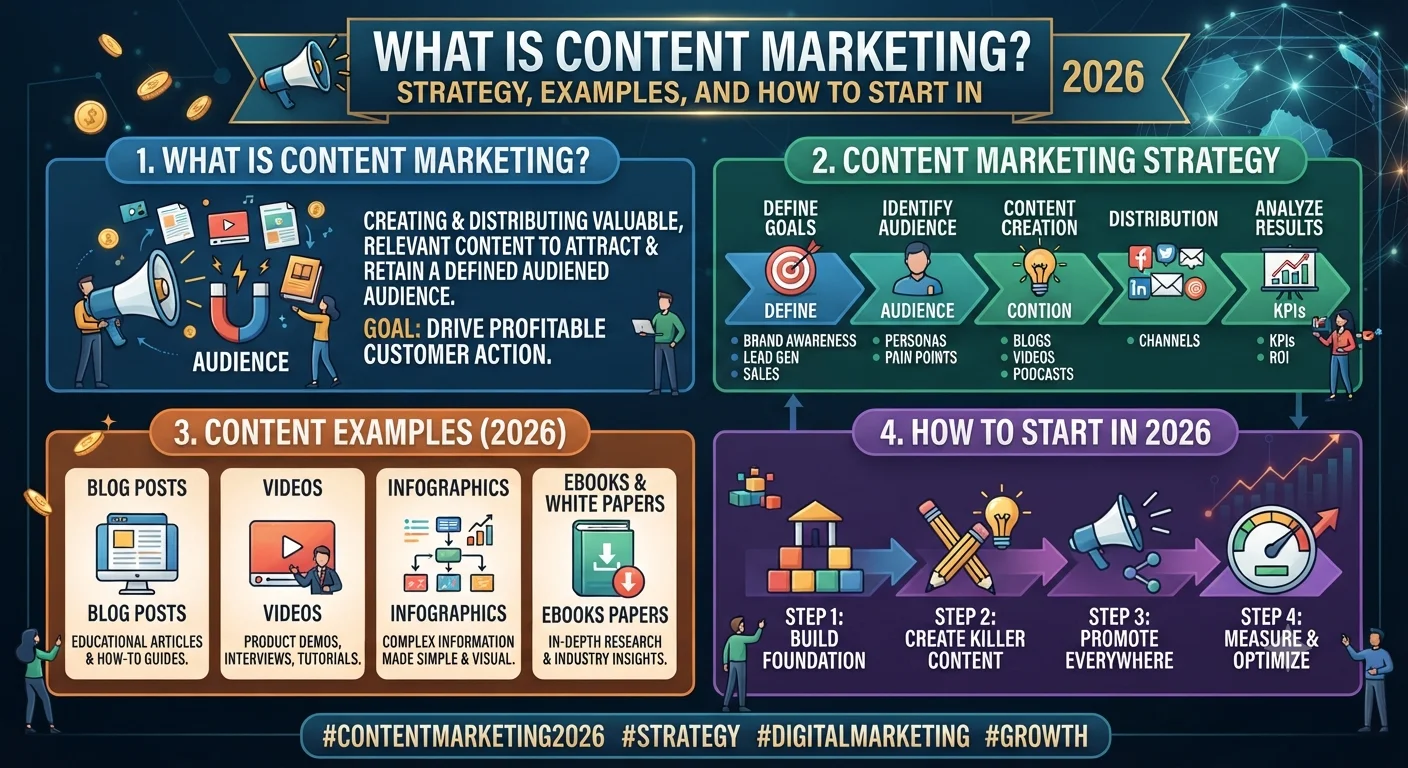
Content marketing is a strategic marketing approach focused on creating and distributing valuable, relevant content to attract and retain a clearly defined audience, and ultimately drive profitable customer action. Unlike traditional advertising, content marketing earns attention rather than buying it, building trust and authority over time. In 2026, content marketing encompasses blogs, videos, podcasts, email newsletters, social media content, and AI-generated search results.
Key Takeaways
- The global content marketing industry is projected to reach $600 billion in value by 2026, up from $63 billion in 2018, according to Statista and Content Marketing Institute data.
- Content marketing generates three times more leads than outbound marketing (paid advertising, cold calling, trade shows) and costs 62 percent less, according to Demand Metric research.
- 70 percent of consumers report that they prefer to learn about a company through articles rather than advertisements, according to Content Marketing Institute's 2025 annual report.
- Businesses that blog consistently generate 55 percent more website visitors and 97 percent more inbound links than businesses that do not blog, according to HubSpot Research.
- In 2026, content marketing increasingly requires optimization for both traditional search engines (Google, Bing) and AI search platforms (ChatGPT Search, Google AI Overviews, Perplexity), a practice known as Generative Engine Optimization (GEO).
Content Marketing: A Clear Definition
- Key Takeaways
- Content Marketing: A Clear Definition
- Why Content Marketing Outperforms Traditional Advertising
- The 5 Core Types of Content Marketing
- Blog Content and Long-Form Articles
- Video Content and YouTube Strategy
- Social Media Content
- Email Marketing Sequences
- Podcasts and Audio Content
- Real-World Content Marketing Success Stories
- HubSpot's Blog-Driven Growth
- Red Bull's Media Empire Strategy
- How to Build a Content Marketing Strategy From Scratch
- Measuring Content Marketing ROI
- Frequently Asked Questions About Content Marketing in 2026
The Content Marketing Institute (CMI), the leading professional organization in the field, defines content marketing as "a strategic marketing approach focused on creating and distributing valuable, relevant, and consistent content to attract and retain a clearly defined audience and, ultimately, to drive profitable customer action."
Three words in that definition deserve attention. Valuable means the content genuinely benefits the reader, viewer, or listener, solving a problem, answering a question, or providing entertainment, rather than simply promoting the brand. Relevant means the content addresses topics that matter to the specific audience the business serves. Consistent means that content is produced on a reliable schedule rather than sporadically.
The term "content marketing" was popularized by Joe Pulizzi, who founded the Content Marketing Institute in 2007, though the practice itself has much earlier roots. John Deere's customer magazine "The Furrow," launched in 1895 to teach farmers about agricultural techniques and technology, is one of the most frequently cited examples of content marketing predating the digital era. Michelin's travel guides, first published in 1900 to encourage road trips and thereby increase tire wear, is another. Both brands created genuinely useful content for their target audiences as a strategy to grow their core businesses.
In 2026, content marketing operates primarily in digital formats and is deeply integrated with SEO, email marketing, social media, and increasingly with AI search optimization. However, the underlying strategic principle remains unchanged from these hundred-year-old examples: provide genuine value to your audience consistently, and they will trust your brand and buy your products over time.
Why Content Marketing Outperforms Traditional Advertising
Traditional advertising operates on an interruption model. A television commercial interrupts a program. A display ad appears in the margin of a webpage. A billboard interrupts a view. Users have become increasingly resistant to and efficient at ignoring these interruptions.
The data on traditional advertising effectiveness reflects this resistance. Digital advertising click-through rates have declined steadily since the early days of the commercial internet. Display advertising click-through rates average 0.05 percent in 2025, meaning that for every 2,000 people who see a display ad, only one person clicks. Television advertising recall among younger demographics has declined significantly with the growth of ad-free streaming subscriptions.
Content marketing, by contrast, operates on a permission and value model. A user who searches for "how to invest $1,000" and finds a comprehensive, helpful article from a financial services company has sought out that content. Their engagement is voluntary and their receptivity to the brand message is correspondingly high. If the article is genuinely helpful, the user associates the brand with competence and trustworthiness, a far more valuable marketing outcome than an impression on a display ad they scrolled past.
The competitive economics support content marketing's long-term advantage. A piece of content created once (a well-researched blog article, a comprehensive video guide, a detailed comparison tool) can generate traffic, leads, and sales continuously for months or years after creation. A paid advertising campaign generates results only while the budget is active. One stops; the other compounds.
Forrester Research estimated in a 2024 report that the average buyer consumes 27 pieces of content before making a business purchase decision. In this environment, a brand that has provided 27 pieces of genuinely helpful content to a prospect has a profound competitive advantage over a brand that has only served ads.
The 5 Core Types of Content Marketing
Blog Content and Long-Form Articles
Blog content is the foundation of most content marketing strategies and remains the most widely used content type. Written long-form content (typically 1,500 to 4,000 words for comprehensive articles) performs particularly well in organic search because search engines reward in-depth, authoritative coverage of topics.
Effective blog content in 2026 addresses specific user questions, covers topics comprehensively, integrates primary research and current data, and is structured for both human readers and AI search systems. The blog articles that earn the most organic traffic combine E-E-A-T (Experience, Expertise, Authoritativeness, Trustworthiness) signals with clear, structured writing optimized for featured snippets and AI Overview citations.
HubSpot, the marketing software company that made content marketing central to its own growth, publishes approximately 200 blog posts per month and generates millions of organic visitors through search. The company attributes a significant portion of its $2.2 billion in annual revenue (2024) to content-driven inbound marketing.
Video Content and YouTube Strategy
Video has become the dominant content format for consumer engagement. YouTube is the world's second-largest search engine after Google (both owned by Alphabet), processing more than 3 billion searches per month in 2026. Short-form video on platforms including TikTok, Instagram Reels, and YouTube Shorts has become a primary discovery mechanism for younger demographics.
Video content marketing serves different objectives depending on format. Long-form YouTube videos (8 to 20 minutes) build deep audience engagement and education. Short-form video clips (15 to 90 seconds) drive discovery and brand awareness through algorithmic distribution. Product demonstration videos reduce purchase hesitation at the bottom of the sales funnel. Customer testimonial videos build social proof and trust.
The production quality threshold for effective video content marketing has become more accessible in 2026, with smartphone cameras, affordable lighting equipment, and AI-assisted video editing tools enabling high-quality production without professional studio budgets.
Social Media Content
Social media content marketing builds audience relationships, drives brand awareness, and distributes content to followers who have opted in to receive communications from a brand.
Different platforms serve different content marketing functions. LinkedIn is the dominant platform for B2B content marketing, particularly thought leadership articles, industry insights, and professional case studies. Instagram and TikTok serve product-focused brands with visual and short-video content. Pinterest functions as a visual search engine, particularly valuable for brands in fashion, home decor, food, and crafts. X (formerly Twitter) supports real-time commentary, brand personality, and industry conversation.
Social media content marketing is most effective when it mirrors the native communication style of each platform rather than cross-posting identical content universally. A LinkedIn article written in a professional tone for B2B decision-makers should not be cross-posted unchanged to Instagram, where shorter, more visual, personality-driven content performs better.
Email Marketing Sequences
Email marketing is consistently rated the highest-ROI digital marketing channel. The Direct Marketing Association and Litmus have both reported email marketing ROI in the range of $36 to $42 return for every $1 spent, higher than any other digital marketing channel including search advertising and social media.
Content marketing through email typically takes the form of email newsletters that provide consistent value to subscribers (industry insights, curated resources, original essays), automated email sequences that nurture new subscribers through a planned content journey, and broadcast emails announcing new content, products, or offers.
Building an email list is a priority for content marketers because, unlike social media followers, email subscribers are an asset you own. Platform algorithm changes can reduce organic social media reach to near zero overnight, as many brands discovered during major Facebook algorithm changes. An email list provides direct, algorithm-independent communication with your audience.
Platforms including Mailchimp, ConvertKit (rebranded as Kit), Beehiiv, and Substack provide email marketing infrastructure ranging from basic newsletter tools to sophisticated automation platforms.
Podcasts and Audio Content
Podcast listenership has grown substantially over the past decade. Edison Research's "The Infinite Dial" 2025 report found that 42 percent of Americans aged 12 and older listen to podcasts monthly, and 28 percent weekly. Globally, podcast audiences are estimated at over 500 million regular listeners.
Recommended Articles
 DIGITAL MARKETING BUSINESS
 DIGITAL MARKETING BUSINESS
Podcasting as a content marketing channel builds deep audience relationships through the intimacy of the audio format. Regular podcast listeners report higher trust in podcast hosts than in most other media personalities. For B2B brands in particular, a podcast featuring interviews with industry experts and thought leaders generates authority, networking relationships, and a steady content asset that can be repurposed into blog articles, social media clips, and email newsletters.
The production barrier to podcasting has decreased significantly in 2026. AI tools including Descript, Cleanvoice, and Adobe Podcast's AI cleaning tool make professional-sounding podcast production achievable with basic equipment and moderate editing skill.
Real-World Content Marketing Success Stories
HubSpot's Blog-Driven Growth
HubSpot provides perhaps the most frequently cited example of content marketing as a primary business growth engine. Founded in 2006, HubSpot built its marketing software business almost entirely on the back of educational blog content targeting marketing and sales professionals.
By consistently publishing high-quality, search-optimized articles on topics including email marketing, SEO, content strategy, and sales techniques, HubSpot accumulated domain authority that made it one of the most visible websites in the marketing category globally. Its blog generates tens of millions of organic visits per month and serves as the primary lead generation engine for a business that went public in 2014 and reached $2.2 billion in annual recurring revenue in 2024.
HubSpot also pioneered the concept of "inbound marketing," a philosophy it has promoted extensively through free content, including its free HubSpot Academy certification courses which have educated over 500,000 marketing professionals globally. This educational content simultaneously provides genuine value to the market and establishes HubSpot as the authoritative brand in its category.
Red Bull's Media Empire Strategy
Red Bull's content marketing strategy represents a different and equally instructive model. Rather than creating content primarily about energy drinks or health benefits, Red Bull built an entire media company, Red Bull Media House, producing content about extreme sports, music, culture, and adventure.
Red Bull Media House produces professional-quality documentaries, live sports broadcasts (including ownership of the Red Bull Racing Formula One team and its associated media rights), magazines (Red Bulletin), digital platforms, and a dedicated YouTube channel with over 14 million subscribers that generates hundreds of millions of views annually.
The strategic logic is that Red Bull's target consumer (young, active, thrill-seeking individuals) is deeply engaged by extreme sports and adventure content. By providing world-class content in those areas, Red Bull builds the deepest possible relationship with its ideal consumer. The energy drink product exists as the brand connection between the consumer's aspirational lifestyle and their purchasing behavior.
Red Bull's approach demonstrates that content marketing at its most ambitious does not just support a business but can become a business in its own right. Red Bull Media House licenses content to major broadcasters and generates significant independent revenue.
How to Build a Content Marketing Strategy From Scratch
Building an effective content marketing strategy requires completing six sequential steps before publishing your first piece of content.
Step one is defining your target audience with specificity. A content marketing strategy built for "people interested in personal finance" will fail. A strategy built for "millennial renters in urban areas earning $60,000 to $90,000 annually who want to build wealth without homeownership" has the clarity needed to create content that resonates deeply with a specific, valuable audience.
Step two is conducting keyword and topic research to identify what your target audience actively searches for. Tools including Ahrefs, SEMrush, Ubersuggest, and Google's free Keyword Planner reveal search volume and competition data for relevant topics. AnswerThePublic identifies the specific questions your audience asks around your topic area.
Step three is defining your content pillars, the three to five core topic areas that your brand will cover comprehensively. For a personal finance website, pillars might be budgeting fundamentals, investing for beginners, side hustle income, and debt elimination. Every piece of content you create should fall within one of these pillars, building topical authority progressively.
Step four is creating a content calendar with specific publication dates, assigned responsibilities, and format decisions for each piece. Consistency is more important than frequency. Three high-quality articles per week published consistently outperforms ten articles per week published sporadically in terms of both audience relationship and search engine favor.
Step five is producing content to a standard that genuinely serves your audience better than competing content. Read the top-ranking articles for your target keywords before writing. Identify what they cover well and what they miss. Create something that is more comprehensive, more current, more specific, or more actionable. Original research, expert quotes, case studies, and proprietary data differentiate content from generic topic overviews.
Step six is promoting and distributing each piece of content through every available channel: sharing on social media, including in your email newsletter, pitching to other websites for potential backlinks, and repurposing into multiple formats. Most content marketing fails not because the content is poor but because distribution is neglected.
Measuring Content Marketing ROI
Content marketing ROI measurement requires tracking a hierarchy of metrics from leading indicators (traffic, engagement) to lagging indicators (leads, revenue).
Traffic metrics including organic search sessions, page views, and unique visitors measure content's ability to attract an audience. These are measured through Google Analytics and Google Search Console.
Engagement metrics including average time on page, scroll depth, pages per session, and email open and click rates measure how effectively content is holding audience attention and building relationships.
Lead generation metrics including email subscribers, contact form submissions, free trial signups, and content download rates measure content's ability to move audience members toward a relationship with the brand.
Revenue metrics including leads attributed to content (tracked through UTM parameters and CRM attribution), customer lifetime value of content-sourced customers, and content marketing cost per acquisition provide the most direct measure of business impact.
A complete content marketing measurement framework connects all four levels. A piece of content that drives 10,000 organic visits per month, converts 2 percent to email subscribers (200 new subscribers), converts 5 percent of those to customers over three months (10 customers), with an average customer lifetime value of $500 ($5,000 in revenue) represents a clear, attributable business result.
Frequently Asked Questions About Content Marketing in 2026
How long does content marketing take to produce results?
Content marketing is a long-term strategy. Most businesses begin seeing meaningful organic search traffic from content in three to six months. Significant lead generation and revenue impact typically materializes in six to twelve months for new content programs. The compounding nature of content marketing means that year two and three results are dramatically larger than year one, assuming consistent execution.
How much does content marketing cost?
Content marketing costs vary enormously based on whether it is executed in-house or outsourced, and the quality level targeted. A solo creator managing their own blog can execute content marketing for the cost of hosting, tools, and their own time. A business outsourcing content to professional writers, designers, and video producers typically invests $2,000 to $15,000 per month for a comprehensive program. Even at the higher end, this typically compares favorably to equivalent paid advertising spend given the compounding long-term returns.
What is the difference between content marketing and social media marketing?
Social media marketing focuses specifically on building an audience and promoting content through social platforms. Content marketing is the broader strategy of creating valuable content across all channels (blogs, video, email, podcasts, and social media). Social media is one distribution channel within a content marketing strategy.
Do small businesses need content marketing?
Yes, though the scale and complexity should match the business's resources. Even a simple content marketing approach, publishing one well-researched blog article per week, maintaining an email newsletter, and posting consistently on one or two relevant social platforms, produces meaningful results for small businesses competing against larger players who may have advertising budget advantages.
How does AI affect content marketing in 2026?
AI tools have significantly accelerated content production (research, drafting, editing, repurposing), but have also raised the quality bar for content that performs well in search. Google's Helpful Content System and AI Overview selection algorithms favor content with genuine expertise, original insights, and human editorial judgment. Using AI tools to assist content production while maintaining high editorial standards is the dominant effective approach in 2026. Pure AI-generated content published without meaningful human enhancement performs poorly in both search and with discerning audiences.
What type of content gets the most traffic?
Research from Backlinko and Semrush consistently shows that comprehensive, long-form content addressing specific user questions generates the most sustained organic search traffic. Specifically, ultimate guides (comprehensive topic overviews), comparison articles (X vs Y), how-to guides with specific steps, and research-based articles with original data tend to earn the most traffic and backlinks over time.