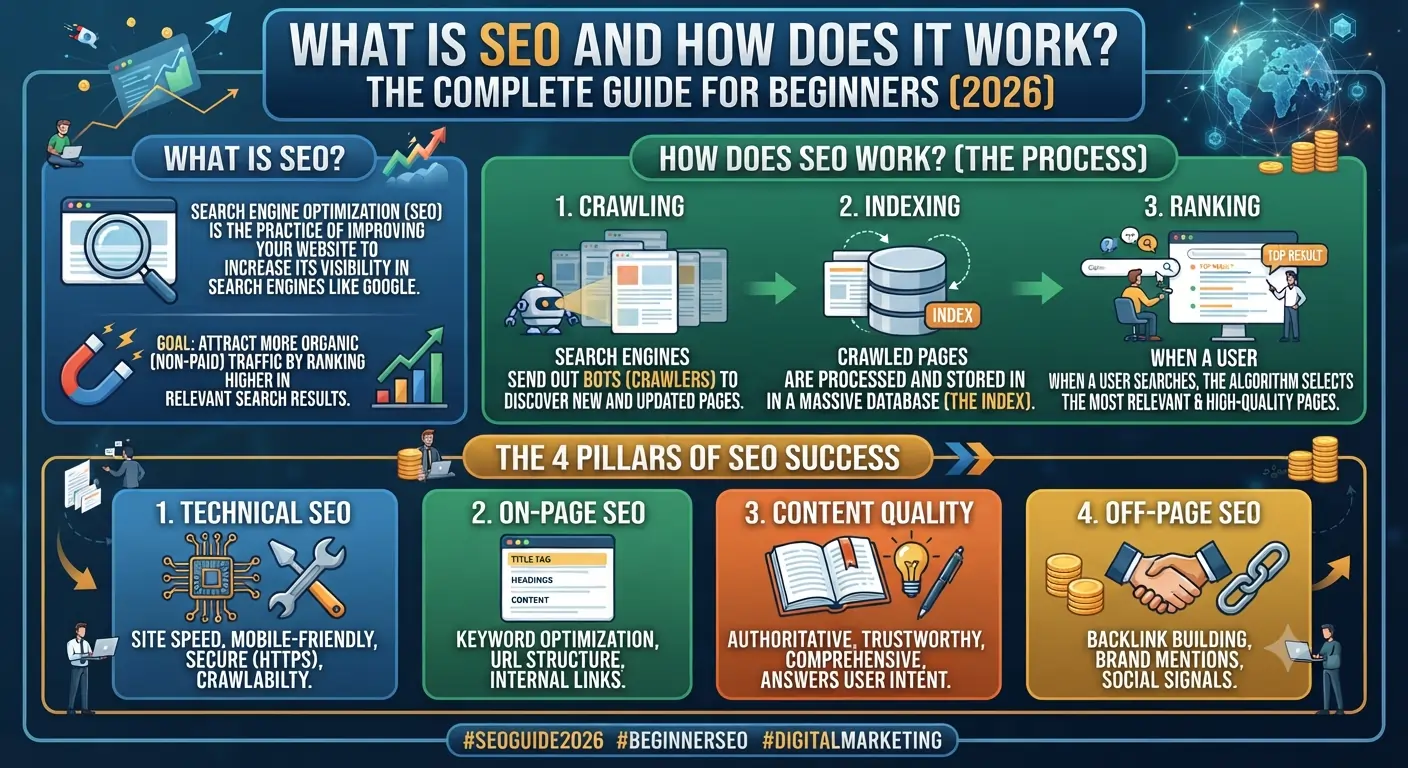
SEO (Search Engine Optimization) is the practice of improving a website's visibility in unpaid (organic) search engine results. When someone types a query into Google, SEO determines whether your website appears on page one or page ten. SEO in 2026 operates across three pillars: on-page optimization, off-page authority building, and technical performance, all evaluated against Google's core ranking principle of E-E-A-T (Experience, Expertise, Authoritativeness, and Trustworthiness).
Key Takeaways
- Google processes approximately 8.5 billion search queries per day in 2026, according to data compiled by Internet Live Stats.
- The first organic result on a Google search page receives an average click-through rate of 27.6 percent, while the tenth position receives approximately 2.4 percent, according to Backlinko's 2024 CTR study.
- 68 percent of all online experiences begin with a search engine, and Google holds 91.5 percent of the global search engine market share as of 2026, per Statista.
- Google uses over 200 ranking factors in its algorithm, according to former Google employees and research into Google's patent filings.
- SEO typically requires three to six months to produce measurable organic traffic results for new websites, though competitive industries may require twelve months or longer.
- In 2026, AI-generated search experiences including Google's AI Overviews, ChatGPT Search, and Perplexity AI have added a new layer of optimization called GEO (Generative Engine Optimization) that complements traditional SEO.
The Simple Definition of SEO (Search Engine Optimization)
- Key Takeaways
- The Simple Definition of SEO (Search Engine Optimization)
- How Google's Algorithm Works: The Basics
- Crawling: How Google Discovers Your Content
- Indexing: How Google Stores Your Pages
- Ranking: How Google Decides What Shows Up First
- The 3 Pillars of SEO
- On-Page SEO: Optimizing Your Content
- Off-Page SEO: Building Authority and Links
- Technical SEO: Site Speed, Structure, and Crawlability
- Google's Top Ranking Factors in 2026
- How Long Does SEO Take to Work?
- Free SEO Tools Every Beginner Should Use in 2026
- Frequently Asked Questions About SEO Basics
Search Engine Optimization is the discipline of improving the quality and quantity of organic (unpaid) traffic to a website from search engines, primarily Google. Unlike paid search advertising (Google Ads), which requires ongoing budget to maintain visibility, SEO produces traffic that continues without per-click payment once rankings are achieved.
SEO was first discussed as a distinct practice around 1997, in the early years of the commercial internet. Since then it has evolved from simple keyword stuffing and link acquisition into a sophisticated, multi-disciplinary practice requiring understanding of content strategy, web development, data analysis, user psychology, and increasingly, how AI systems interpret and evaluate content.
The fundamental goal of SEO has always been the same: create content and a website that search engines consider the most relevant, authoritative, and trustworthy answer to a given user query. Everything else in SEO is a tactic in service of that goal.
In 2026, SEO practitioners must also optimize for AI-generated search results. Google's AI Overviews (formerly Search Generative Experience), launched broadly in 2024, now appear at the top of search results for millions of queries, generating a synthesized answer directly in the search interface. Appearing as a cited source within AI Overviews requires the same GEO (Generative Engine Optimization) signals that make content attractive to ChatGPT Search, Perplexity, and other AI search tools.
How Google's Algorithm Works: The Basics
Google's search algorithm is one of the most complex and consequential software systems ever built. It processes billions of queries daily and evaluates hundreds of billions of web pages to determine which results best answer each query. Understanding its three fundamental operations, crawling, indexing, and ranking, is essential for anyone working with SEO.
Crawling: How Google Discovers Your Content
Crawling is the process by which Google's automated programs, called Googlebots or spiders, discover and download web pages from the internet. Googlebot begins with a list of known URLs, then follows hyperlinks on those pages to discover new URLs, and continues this process continuously across the web.
Several factors affect how effectively Google can crawl your website. A well-structured XML sitemap, submitted through Google Search Console, gives Googlebot a complete map of all pages you want indexed. Your robots.txt file can direct Googlebot away from pages you do not want crawled, such as administrative pages or duplicate content. Your internal linking structure, the web of links between your own pages, helps Googlebot discover all your content and understand which pages are most important.
Google allocates a "crawl budget" to each website based on its authority, server speed, and the frequency of content changes. Websites with technical problems (slow server response times, excessive redirect chains, crawl errors) waste crawl budget and may have significant portions of their content go undiscovered by Google.
Indexing: How Google Stores Your Pages
After crawling a page, Google decides whether to add it to its index, a massive database of web pages that forms the pool from which search results are drawn. Pages that Google determines are low-quality, duplicate, or inaccessible may be crawled but not indexed.
Google Search Console's URL Inspection tool allows website owners to check whether any given page has been indexed and to request indexing for new or updated pages. The "Coverage" report in Search Console identifies pages with indexing errors or exclusions and is an essential diagnostic tool for any SEO practitioner.
Content that Google considers thin (insufficient information for a user), duplicate (substantially similar to other pages on the web or on your own site), or low-quality (lacking E-E-A-T signals) is frequently excluded from the index even when technically crawlable.
Ranking: How Google Decides What Shows Up First
Ranking is the process of ordering indexed pages by relevance and quality for a given query. This is where Google's 200-plus ranking factors apply. At the broadest level, ranking is determined by the intersection of relevance (does this page address what the user is searching for?) and authority (does Google trust this website as an expert source on this topic?).
Google's algorithm evaluates both the query intent (what the user actually wants to accomplish with this search) and the content's ability to satisfy that intent. Search intents are classified as informational (seeking information), navigational (trying to reach a specific website), transactional (intending to make a purchase or take an action), and commercial investigation (researching before a purchase). Content that matches the intent type of the target query ranks significantly better than content that matches keywords but misses intent.
The 3 Pillars of SEO
Modern SEO operates on three interconnected pillars. Strength in all three compounds to produce exceptional rankings. Weakness in any one limits the potential of the others.
On-Page SEO: Optimizing Your Content
On-page SEO refers to all optimizations made directly to the content and HTML of individual web pages. It addresses the relevance dimension of ranking.
The title tag is the HTML element that appears as the clickable headline in Google search results. It should include the primary target keyword naturally, communicate the page's topic clearly, and be between 50 and 60 characters to display fully in search results. The title tag is one of the most heavily weighted on-page ranking signals.
The meta description is the brief summary shown beneath the title in search results. While not a direct ranking factor, a well-written meta description significantly affects click-through rate, which influences rankings indirectly. Meta descriptions should be 150 to 160 characters, include the primary keyword naturally, and contain a compelling reason for the user to click.
Heading structure (H1 through H6 tags) organizes content hierarchically for both users and search engines. Each page should have exactly one H1 (the main topic), multiple H2s (major sections), and H3s as needed for subsections. Including target and related keywords in headings naturally reinforces topical relevance.
Content depth and comprehensiveness are increasingly important ranking factors. Google's Helpful Content system, expanded significantly in 2023 and 2024, evaluates whether content was created primarily for people (to genuinely help users) or primarily for search engines (to rank for keywords without providing real value). Comprehensive content that thoroughly covers a topic from multiple angles, answers follow-up questions, and provides specific, accurate information outperforms thin content even when thin content is keyword-optimized.
Internal linking, placing hyperlinks from one page on your site to other relevant pages, distributes authority across your site, helps Google understand your content structure, and improves user navigation. A consistent internal linking strategy is one of the highest-return, lowest-cost on-page optimizations available.
Image optimization involves adding descriptive alt text to all images (describing the image content for accessibility and providing keyword context for Google), compressing images to reduce file size, and using modern image formats (WebP rather than JPEG or PNG) to improve page loading speed.
URL structure should be clean, descriptive, and keyword-inclusive. A URL like tokotaf.online/what-is-seo-beginners-guide is significantly better for SEO than tokotaf.online/?p=4872.
Off-Page SEO: Building Authority and Links
Off-page SEO refers to actions taken outside your website that influence search rankings, primarily through building the site's authority and reputation in Google's eyes.
Backlinks, hyperlinks from other websites pointing to your website, remain one of the most powerful ranking signals in Google's algorithm. Google's original PageRank algorithm, invented by Larry Page and Sergey Brin at Stanford University, was built on the premise that a page linked to by many high-quality pages is likely to be a high-quality page itself. This principle remains central to Google's ranking system in 2026, though Google now evaluates links far more qualitatively than in earlier years.
The authority of the linking website matters far more than the quantity of links. One backlink from a high-authority publication such as Forbes, The New York Times, or a major industry trade journal can have more ranking impact than hundreds of links from low-authority or unrelated websites. Links from topically relevant websites (a health publication linking to a health article) are more valuable than links from unrelated domains.
Link acquisition strategies for legitimate SEO include creating genuinely useful, original content that earns links naturally (often called "linkable assets"), digital PR and outreach to publications covering your topic area, guest posting on relevant industry websites, building partnerships and resource collaborations with complementary businesses, and creating original research or data studies that media outlets and bloggers cite.
Recommended Articles
 DIGITAL MARKETING BUSINESS
 DIGITAL MARKETING BUSINESS
Practices that Google explicitly penalizes as link spam include buying links, participating in private blog networks (PBNs), excessive reciprocal link exchanges, and link schemes of any kind. Google's SpamBrain system has become substantially more sophisticated at detecting unnatural link patterns, and the penalties for link manipulation include algorithmic de-ranking or manual action penalties that can significantly suppress traffic.
Brand signals, the frequency with which your brand name is mentioned and searched for on the web independent of links, have grown in importance as a ranking factor. Google tracks branded searches, brand mentions in online discussions, reviews on platforms including Google Business Profile, Yelp, and industry-specific review sites, and social media presence as additional trust signals.
Technical SEO: Site Speed, Structure, and Crawlability
Technical SEO addresses the infrastructure of your website, ensuring that search engines can effectively access, crawl, interpret, and index your content, and that users have a fast, functional experience.
Core Web Vitals, Google's user experience metric framework introduced as a ranking factor in 2021, measures three specific loading and interaction performance metrics. Largest Contentful Paint (LCP) measures how quickly the main content of a page loads; Google's target is under 2.5 seconds. Cumulative Layout Shift (CLS) measures visual stability as the page loads; targets are below 0.1. Interaction to Next Paint (INP), which replaced First Input Delay in March 2024, measures responsiveness to user interactions; the target is under 200 milliseconds.
Website speed broadly affects both rankings and user behavior. A 2023 Google study found that pages that load in one second have a 32 percent lower bounce rate than pages that load in three seconds, and a 90 percent lower bounce rate than pages loading in five seconds. PageSpeed Insights (free, from Google) and GTmetrix provide specific speed improvement recommendations for any URL.
HTTPS security, achieved via an SSL/TLS certificate, has been a confirmed Google ranking factor since 2014. All pages served over HTTP rather than HTTPS display a "Not Secure" warning in Chrome and receive a ranking disadvantage. Most modern hosting platforms provide free SSL certificates through Let's Encrypt.
Mobile-friendliness is essential because Google uses mobile-first indexing, meaning it evaluates your site's mobile version as the primary version for ranking purposes. Sites that are not fully functional and readable on smartphones are penalized in mobile search results, which represent the majority of Google searches globally.
Schema markup, also called structured data, is code added to page HTML that provides Google with explicit, machine-readable information about the content type. Schema types relevant to blog content include Article schema (providing publication date, author, headline), FAQ schema (for frequently asked questions sections), How-to schema (for step-by-step guides), and Review schema. Implementing schema markup helps Google understand content more precisely and can earn enhanced search result features (rich snippets) that improve click-through rates.
Google's Top Ranking Factors in 2026
Based on analysis of Google's own documentation, statements from Google engineers, patent filings, and the independent research community (including Moz's annual Search Engine Ranking Factors survey, Backlinko's ranking factor studies, and SEMrush ranking factor analyses), the following represent the most influential factors in Google's 2026 algorithm.
Content quality and helpfulness is the overarching factor. Google's Helpful Content System, which began as a separate signal and was integrated into the core algorithm in 2023, evaluates whether content was created to genuinely help people rather than to rank for keywords. Original research, first-hand experience, specific expertise, and comprehensive topic coverage are characteristics associated with helpful content.
Backlink authority and relevance remains critical. High-quality backlinks from authoritative, topically relevant websites signal to Google that your content is trusted by credible sources.
E-E-A-T signals (Experience, Expertise, Authoritativeness, Trustworthiness) are evaluated holistically. Author credentials and bylines, citations of authoritative sources, factual accuracy, a track record of reliable content, and transparent website information (About page, Contact page, Privacy Policy) all contribute to E-E-A-T assessment.
User experience signals including Core Web Vitals scores, mobile-friendliness, HTTPS security, and site architecture affect both direct ranking and the quality of user behavior signals (time on page, pages per session, bounce rate) that Google monitors.
Topical authority, the depth of content coverage within a specific subject area, has grown in importance. Websites that comprehensively cover all aspects of a topic through multiple interlinked articles demonstrate subject matter expertise more convincingly than websites with isolated articles on unrelated topics.
How Long Does SEO Take to Work?
This is one of the most frequently asked questions in digital marketing, and the honest answer is that it depends on several variables.
New websites with no existing authority, backlinks, or content typically require six to twelve months before organic traffic becomes meaningful. Google tends to treat new websites cautiously, taking time to evaluate their trustworthiness before granting significant ranking positions. This pattern is informally called the "Google Sandbox," though Google has never officially confirmed such a mechanism.
Established websites in low-competition niches may see ranking improvements within four to eight weeks of publishing optimized content. Established websites targeting competitive keywords in high-authority niches may require twelve to twenty-four months of consistent effort to challenge entrenched first-page results.
Ahrefs, one of the leading SEO data companies, conducted a study analyzing 2 million randomly selected web pages and found that only 5.7 percent of pages that were less than one year old ranked in the top 10 search results for at least one keyword. Of the pages that did rank in the top 10, the average page age was over two years.
The implication for new websites like tokotaf.online is that consistent, high-quality content publication combined with patient link building produces results, but requires a six to twelve month time horizon before expecting meaningful organic traffic.
Free SEO Tools Every Beginner Should Use in 2026
Google Search Console is the single most important free SEO tool available, provided directly by Google. It shows which search queries bring visitors to your site, which pages are indexed, Core Web Vitals scores, mobile usability issues, and manual action penalties. Every website owner should have Search Console set up before publishing their first piece of content.
Google Analytics 4 (GA4) tracks user behavior on your website, showing which pages attract the most traffic, how long visitors stay, where they come from, and what actions they take. It integrates directly with Search Console for a complete picture of organic search performance.
Google PageSpeed Insights analyzes any URL and provides specific recommendations for improving loading speed, organized by priority and estimated impact.
Ubersuggest (free tier available) provides keyword research data, competition analysis, and backlink information. It is among the most accessible keyword research tools for beginners.
AnswerThePublic visualizes the questions and related searches people make around any keyword, providing a goldmine of content ideas and FAQ topics aligned with actual user intent.
Screaming Frog SEO Spider (free up to 500 URLs) crawls your website the way Googlebot does and identifies technical issues including broken links, duplicate content, missing meta descriptions, and redirect errors.
Ahrefs Webmaster Tools (free tier) provides backlink analysis and site audit capabilities for your own website, offering data quality comparable to paid tools for the specific site you own and verify.
Frequently Asked Questions About SEO Basics
What is the difference between SEO and paid search advertising?
SEO generates organic (unpaid) traffic by improving your website's ranking in search results. Paid search advertising (Google Ads, Microsoft Ads) places your website at the top of search results in exchange for a per-click payment. SEO requires time and sustained effort to produce results but generates traffic at no cost per click once rankings are established. Paid advertising produces immediate visibility but stops completely when the budget runs out.
Does social media affect SEO rankings?
Social media does not directly affect Google rankings. Google has stated that social media signals are not used as direct ranking factors. However, social media indirectly supports SEO by increasing content distribution, which generates opportunities for backlinks from people who discover and share your content. A strong social presence also builds brand recognition that contributes to branded search volume.
How many words should an SEO article be?
Word count alone is not a ranking factor. Google's guidance is that content should be as long as it needs to be to fully and usefully address the topic, and no longer. Analysis by Backlinko of 11.8 million Google search results found that the average first-page result contains 1,447 words. However, comprehensive guides on complex topics commonly rank at 2,000 to 4,000 words, while simple queries are often best served by 500 to 800 word responses.
What is keyword research and why does it matter?
Keyword research is the process of identifying the specific words and phrases that your target audience types into search engines when looking for information related to your content. Targeting keywords with meaningful search volume and manageable competition allows you to create content that real people are actively searching for, rather than content on topics with no search demand.
Is SEO still relevant in 2026 with AI search growing?
Yes. While AI-generated search experiences including Google AI Overviews, ChatGPT Search, and Perplexity have changed how some users interact with search results, Google Search still processes 8.5 billion queries per day. The majority of these queries still produce traditional organic results alongside or instead of AI overviews. SEO and GEO (Generative Engine Optimization) are now complementary practices. Content optimized for traditional SEO through E-E-A-T, comprehensiveness, and factual authority also performs well as a source cited by AI search systems.
What is the biggest SEO mistake beginners make?
The most common and costly beginner mistake is targeting highly competitive keywords without the domain authority to rank for them. A new website targeting "best credit cards 2026" competes against NerdWallet, Bankrate, and The Points Guy, all of which have domain ratings above 90 and thousands of backlinks. A more effective strategy for new websites is to target "long-tail keywords," which are longer, more specific queries with lower competition and still meaningful search volume.