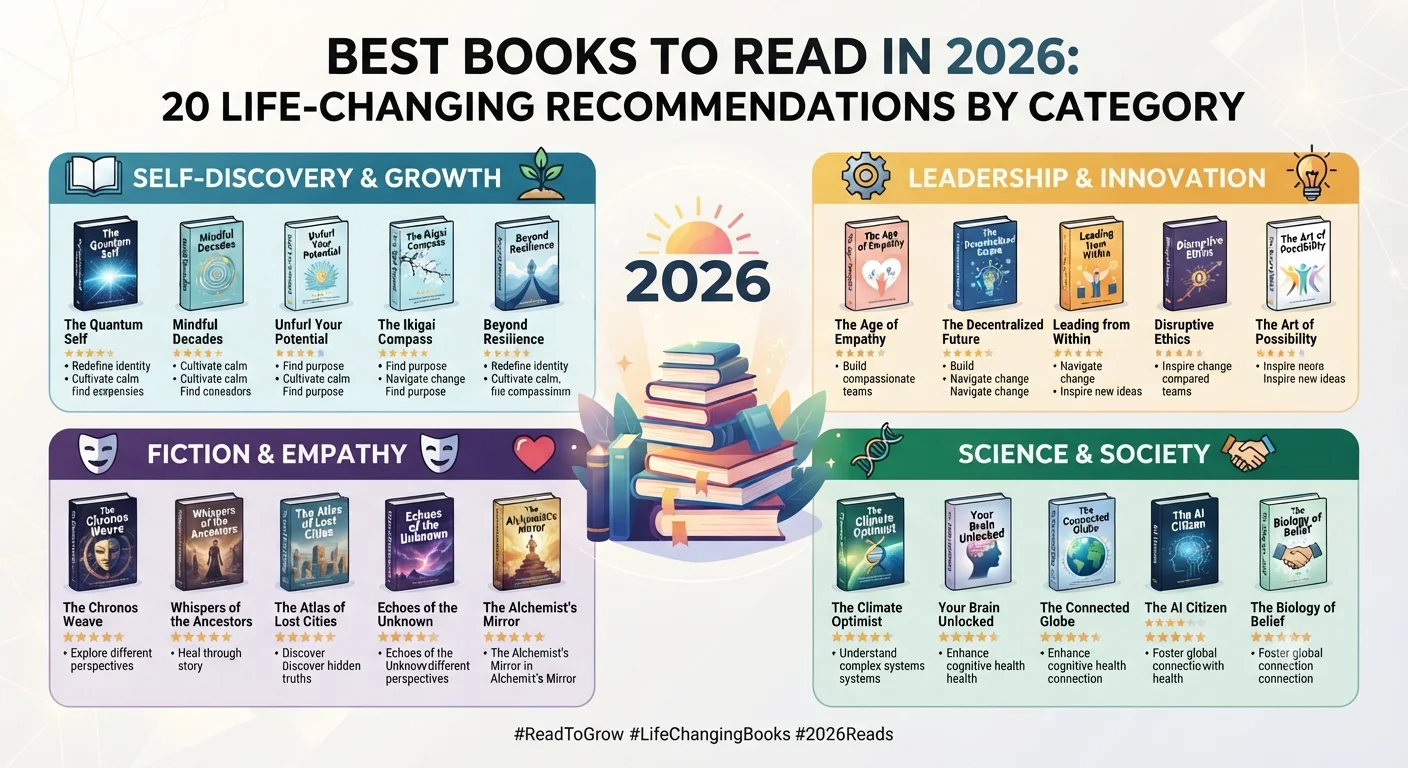
The 20 best books to read in 2026 span personal development, personal finance, technology, health, and fiction. Top recommendations include "Atomic Habits" by James Clear for behavior change, "The Psychology of Money" by Morgan Housel for financial wisdom, "Outlive" by Peter Attia for longevity science, and "The Coming Wave" by Mustafa Suleyman for understanding AI's future. Each book on this list offers ideas that transfer directly into how you think, work, or live.
Key Takeaways
- Reading consistently is one of the most evidence-supported habits associated with long-term cognitive health and career success. A 2021 study in "Neurology" found that regular readers had a 32 percent lower rate of cognitive decline in older age compared to non-readers.
- Warren Buffett, Chairman of Berkshire Hathaway and one of history's most successful investors, attributes much of his intellectual development to reading 500 pages per day, describing it as the compound interest of knowledge.
- A 2026 Pew Research Center survey found that 72 percent of American adults read at least one book in the past year, with nonfiction continuing to grow in share at the expense of fiction.
- Books require sustained attention across hours of engagement, producing deeper understanding and stronger memory encoding than shorter content forms, according to cognitive science research on reading depth.
- The books on this list were selected based on reader reviews, expert recommendations, sales longevity (sustained relevance rather than fleeting bestseller status), and the measurable impact reported by readers on their thinking and behavior.
Why Reading Books Still Matters in an AI World
- Key Takeaways
- Why Reading Books Still Matters in an AI World
- Best Personal Development Books of 2026
- Atomic Habits by James Clear (2018)
- The 4-Hour Workweek by Tim Ferriss (2007, updated 2009)
- Can't Hurt Me by David Goggins (2018)
- Think Again by Adam Grant (2021)
- Best Finance Books of 2026
- The Psychology of Money by Morgan Housel (2020)
- Rich Dad Poor Dad by Robert Kiyosaki (1997, continuously updated)
- I Will Teach You to Be Rich by Ramit Sethi (2009, updated 2019)
- Best Technology and AI Books of 2026
- The Coming Wave by Mustafa Suleyman (2023)
- Human Compatible by Stuart Russell (2019)
- Chip War by Chris Miller (2022)
- Best Health Books of 2026
- Why We Sleep by Matthew Walker (2017)
- Outlive: The Science and Art of Longevity by Peter Attia (2023)
- Best Fiction Books of 2026 with Real-World Lessons
- The Kite Runner by Khaled Hosseini (2003)
- Educated by Tara Westover (2018)
- The Alchemist by Paulo Coelho (1988)
- Thinking, Fast and Slow by Daniel Kahneman (2011)
- How to Read More Books in 2026: 5 Practical Strategies
- Frequently Asked Questions About Books to Read in 2026
In 2026, where AI systems can summarize any book in seconds and video essays distill complex ideas into digestible formats, a reasonable question is whether reading full books remains the most valuable use of intellectual time.
The answer, grounded in cognitive science, is yes, for reasons that summaries and shortened formats cannot fully replicate.
Books develop ideas at the depth and pace required for genuine understanding rather than surface familiarity. Reading "Thinking, Fast and Slow" by Daniel Kahneman produces a different cognitive relationship with his ideas about System 1 and System 2 thinking than reading a three-paragraph summary. The extended engagement allows the reader to test the ideas against their own experience, anticipate and resolve objections, and integrate the framework into their existing mental models.
Research on reading and neural processing, including a 2012 fMRI study by Dr. Gregory Berns at Emory University published in "Brain Connectivity," found that reading a novel produces lasting changes in the somatosensory cortex and language processing regions that persist for days after reading, suggesting structural neural effects from deep reading that brief content consumption does not produce.
In the attention economy of 2026, the ability to sustain focused engagement with a single long-form text for hours is itself a valuable and increasingly rare cognitive capacity. The books you read and deeply understand become part of how you think, not just what you know.
The twenty books below are worth that depth of engagement.
Best Personal Development Books of 2026
Atomic Habits by James Clear (2018)
James Clear's "Atomic Habits" is one of the most practically actionable books on behavior change ever written and has maintained exceptional reader engagement since its publication, selling over 15 million copies globally. The core thesis is that small improvements compounding over time produce remarkable long-term results, and that behavior change is most durable when it operates at the level of identity (who you are) rather than outcomes (what you want) or processes (what you do).
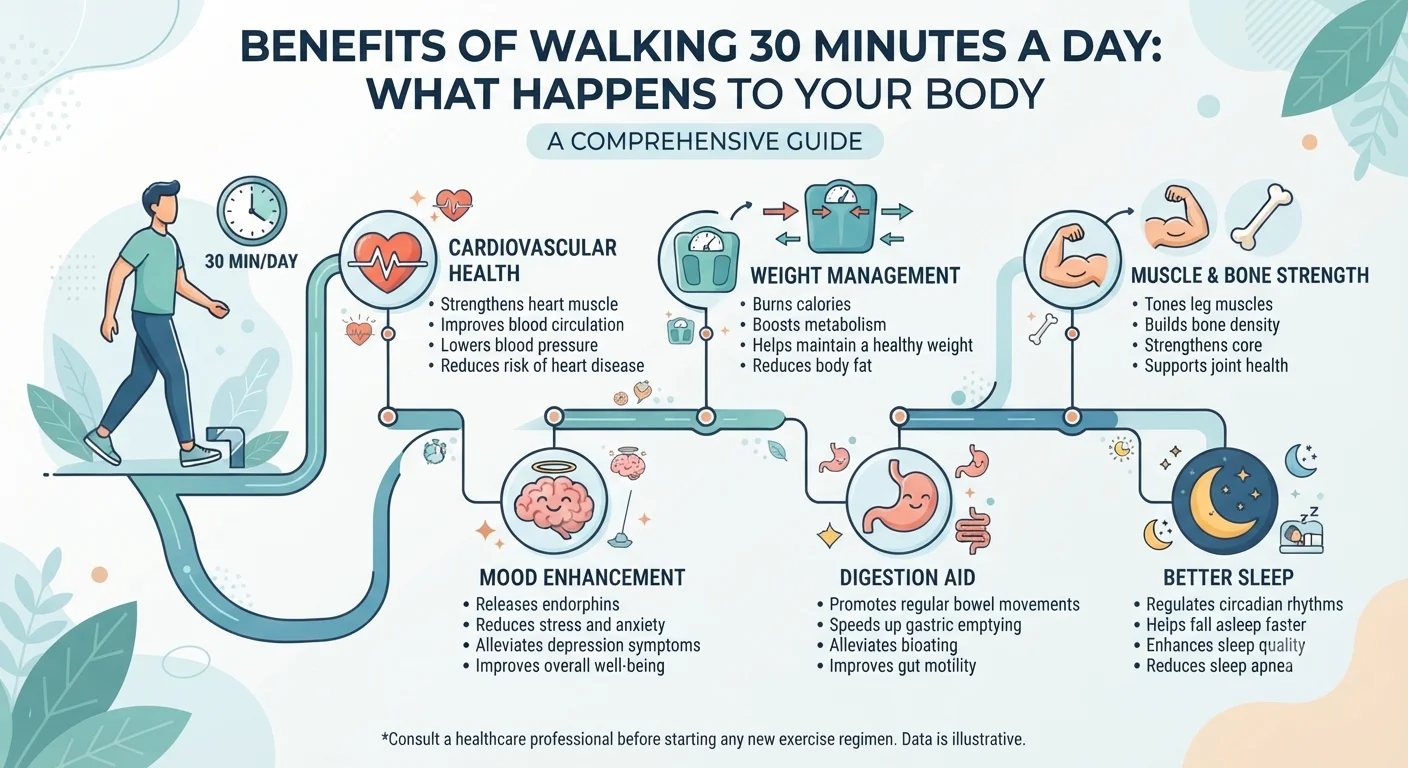
- Benefits of Walking 30 Minutes a Day: What Happens to Your Body
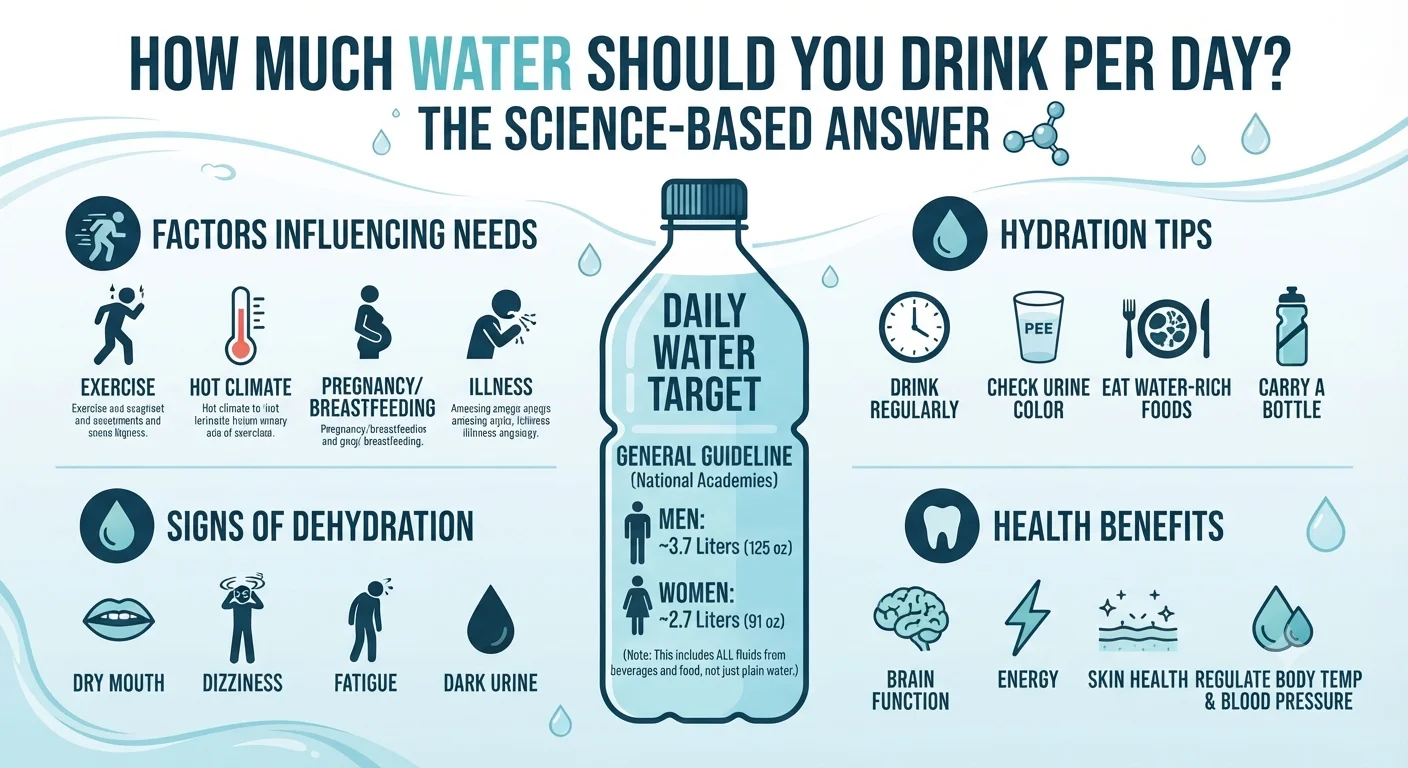
- How Much Water Should You Drink Per Day? The Science-Based Answer
- Mental Health vs Mental Illness: Key Differences Everyone Should Understand
Key ideas: The habit loop (cue, craving, response, reward) and how to design environments and cues that make desired behaviors obvious, attractive, easy, and satisfying. The Two-Minute Rule for habit initiation. The concept of "habit stacking" for integrating new behaviors with established ones. The distinction between goals (outcomes you want) and systems (processes that produce them): "You do not rise to the level of your goals. You fall to the level of your systems."
Who should read it: anyone who has repeatedly tried and failed to establish healthy habits, anyone in a coaching or leadership role responsible for developing others, and anyone who wants to understand the mechanics of human behavior change at a practical level.
The 4-Hour Workweek by Tim Ferriss (2007, updated 2009)
Despite being published in 2007, Tim Ferriss's manifesto on lifestyle design, outsourcing, and the "new rich" remains one of the most paradigm-shifting books for professionals reconsidering conventional career paths. Its core argument, that working fewer hours with more intentional systems is both possible and superior to conventional career progression for many people, anticipated the remote work, gig economy, and digital nomad movements by more than a decade.
Key ideas: The DEAL framework (Definition, Elimination, Automation, Liberation). The Pareto principle applied ruthlessly to work (80 percent of outcomes from 20 percent of inputs). Geographic arbitrage (living in lower-cost locations while earning higher-cost economy salaries). Mini-retirements rather than deferred lifetime retirement. The concept of "lifestyle design" as an alternative to the standard 40-year career then retire model.
Who should read it: professionals feeling trapped in conventional career structures, entrepreneurs building online businesses, anyone interested in rethinking the relationship between work, time, and life satisfaction.
Can't Hurt Me by David Goggins (2018)
David Goggins's memoir and self-development framework is arguably the most extreme personal development book available, and for a specific type of reader, transformatively effective. Goggins, a former Navy SEAL who grew up in an abusive household and overcame significant adversity to become an endurance athlete and motivational figure, argues that most people operate at approximately 40 percent of their potential and that discomfort, done deliberately, is the primary mechanism for expanding that ceiling.
Key ideas: The 40 percent rule (when your mind says stop, you are at approximately 40 percent of actual capacity). The Accountability Mirror (confronting honest self-assessment of failures and excuses). Callousing the mind through deliberate exposure to difficulty. The value of achieving what others consider impossible as a way of overriding limiting self-beliefs.
Who should read it: people seeking radical motivation rather than incremental improvement, athletes, military personnel, and anyone who suspects they are substantially underperforming their actual potential.
Think Again by Adam Grant (2021)
Organizational psychologist Adam Grant's "Think Again" makes the case that the ability to reconsider and update beliefs, a skill he calls "rethinking," is the most important intellectual capability for navigating a fast-changing world. Where most self-help focuses on learning, Grant argues that unlearning and belief revision deserve equal attention.
Key ideas: The "intelligence trap" of being too confident in one's own expertise. The difference between a preacher (defending beliefs), a prosecutor (attacking others' views), a politician (seeking approval), and a scientist (seeking truth through evidence). How to hold opinions more loosely and update them more readily without losing conviction on core values. Interpersonal rethinking: how to help others change their minds through motivational interviewing and curiosity rather than persuasion or argument.
Who should read it: managers and leaders, professionals in evidence-based fields, anyone who recognizes they hold beliefs they have never rigorously examined.
Best Finance Books of 2026
The Psychology of Money by Morgan Housel (2020)
Morgan Housel's "The Psychology of Money" is the personal finance book most frequently recommended by financial professionals, behavioral economists, and ordinary readers who wish they had read it earlier. Its argument is that financial success depends less on technical knowledge and more on behavioral patterns, emotional discipline, and realistic expectations.
Key ideas: "Wealth is what you don't see" (the visible trappings of wealth often indicate high spending rather than accumulated assets). The role of luck and risk in financial outcomes that people routinely attribute entirely to skill or failure. The importance of "enough," knowing what you are optimizing for and when to stop competing. The value of long time horizons and the magic of compounding as the supreme financial force. "Getting rich and staying rich are different skills": accumulation requires risk-taking; preservation requires conservatism.
Who should read it: everyone who manages money, from teenagers earning their first income to retirees managing accumulated savings. The book requires no financial background and produces outsized insight regardless of the reader's starting financial sophistication.
Rich Dad Poor Dad by Robert Kiyosaki (1997, continuously updated)
Robert Kiyosaki's "Rich Dad Poor Dad" is the bestselling personal finance book of all time, with over 40 million copies sold globally. While some of its specific investment advice is contested by financial professionals, its conceptual framework about assets, liabilities, financial education, and the mindset differences between those who build wealth and those who do not has genuinely changed how millions of people think about money.
Key ideas: The fundamental distinction between assets (things that put money in your pocket) and liabilities (things that take money out). The "Rat Race" of earning money to spend on liabilities rather than acquiring income-producing assets. The importance of financial education that schools do not provide. Making money work for you rather than working for money.
Who should read it: young adults beginning their financial journey who need a framework for thinking about wealth differently from the earn-spend-repeat cycle that most people inherit from their environment.
I Will Teach You to Be Rich by Ramit Sethi (2009, updated 2019)
Ramit Sethi's approach to personal finance is distinctly practical, targeted at young adults, and unapologetically focused on automating good financial behavior so that money management requires minimal ongoing attention. His framework covers bank account optimization, credit card selection and use, retirement account setup, investing basics, and negotiation, all oriented toward what he calls living your "Rich Life" rather than maximizing savings for its own sake.
Key ideas: The "Ladder of Personal Finance" for prioritizing financial actions. Automating finances so that saving and investing happen without conscious monthly decision. The distinction between "Big Wins" (high-impact financial decisions that dramatically affect outcomes) versus optimizing small recurring expenses. Spending lavishly on what you love and cutting ruthlessly on what you do not.
Who should read it: people in their 20s and early 30s who want a clear, specific, actionable financial setup they can implement in a few weekends.
Best Technology and AI Books of 2026
The Coming Wave by Mustafa Suleyman (2023)
Mustafa Suleyman, co-founder of Google DeepMind and CEO of Microsoft AI, wrote one of the most important technology books of the decade in "The Coming Wave." It argues that a convergence of AI and synthetic biology represents a technological wave unlike any in history, one that is simultaneously enormously beneficial and genuinely dangerous in ways that existing governance frameworks are wholly unprepared to manage.
Recommended Articles
 HEALTH WELLNESS
 HEALTH WELLNESS
 HEALTH WELLNESS
 HEALTH WELLNESS
Key ideas: The "containment problem": advanced technology tends to proliferate beyond the control of any organization, government, or individual. Why the combination of general-purpose AI and biological tools creates unprecedented dual-use risk. The case for "co-evolution" between technology development and institutional governance. The specific policy and technical approaches the author argues could constrain the worst risks while preserving the benefits.
Who should read it: anyone in technology, policy, business leadership, or with genuine concern about how advanced AI and biotechnology will reshape the world. Essential reading for understanding the stakes of the current AI development moment.
Human Compatible by Stuart Russell (2019)
Stuart Russell, professor of computer science at UC Berkeley and co-author of the leading AI textbook used in universities worldwide, makes a rigorous technical and philosophical argument in "Human Compatible" that the conventional approach to building AI systems is fundamentally flawed in ways that could produce catastrophic outcomes as AI becomes more powerful. He proposes a specific alternative approach based on machines that are uncertain about human preferences rather than certain about fixed objectives.
Key ideas: The "standard model" of AI (machines with fixed objectives that they pursue optimally) is dangerous because sufficiently powerful machines pursuing wrong objectives is worse than machines pursuing no objective at all. The "inverse reward design" approach: building machines that learn human preferences through observation rather than having them hard-coded. Why AI safety is not a fringe concern but the central challenge of our technological moment.
Who should read it: technology professionals, AI researchers, policy makers, and anyone who wants the most rigorous accessible treatment of why advanced AI development carries genuine risk.
Chip War by Chris Miller (2022)
Chris Miller's "Chip War" won the 2022 Financial Times Business Book of the Year and provides the most comprehensive and accessible account of how semiconductor chips became the most strategically important technology in the world, why the global struggle over chip manufacturing and design capability is reshaping geopolitics, and why Taiwan's TSMC occupies a position of extraordinary strategic fragility.
Key ideas: The history of the semiconductor industry from Bell Labs to TSMC. Why chip manufacturing requires a global supply chain of irreplaceable technical expertise concentrated in very few locations. How the U.S.-China technology competition is fundamentally a competition over semiconductor capability. The strategic implications of TSMC's position as the manufacturer of virtually all the world's most advanced chips.
Who should read it: business leaders, investors, technology professionals, and anyone who wants to understand the geopolitical and economic dynamics that semiconductor technology is driving in 2026 and beyond.
Best Health Books of 2026
Why We Sleep by Matthew Walker (2017)
Matthew Walker, Professor of Neuroscience and Psychology at UC Berkeley and founder of the Center for Human Sleep Science, wrote what is arguably the most important health book of the past decade. "Why We Sleep" synthesizes decades of sleep science research and makes a compelling case that chronic sleep deprivation is the most consequential and most neglected public health crisis of our time.
Key ideas: Sleep is not passive rest but an active process essential for memory consolidation, emotional processing, immune function, hormonal regulation, and cellular repair. Chronic sleep deprivation of six hours per night produces cognitive impairment equivalent to 24 hours without sleep while the individual believes they are functioning normally. The specific mechanisms connecting insufficient sleep to Alzheimer's disease (beta-amyloid and tau protein clearance occurs during sleep via the glymphatic system), cardiovascular disease, cancer, obesity, and depression. How to improve sleep quality through evidence-based practices.
Note: some specific claims in "Why We Sleep" have faced scientific scrutiny and debate, and Walker has acknowledged certain presentation errors in specific statistics. The book's core thesis and the broad scientific consensus on sleep's importance remain well-supported even as specific data points have been contested.
Who should read it: everyone, but especially adults who regularly sleep fewer than seven hours and believe they are functioning well.
Outlive: The Science and Art of Longevity by Peter Attia (2023)
Peter Attia's "Outlive" represents the most comprehensive and rigorously evidence-based approach to longevity medicine available in book form. Dr. Attia, a physician trained at Johns Hopkins who now runs a longevity-focused medical practice, argues that "Medicine 2.0" (which he defines as the current model of treating disease after it occurs) is fundamentally inadequate for extending healthy lifespan, and proposes "Medicine 3.0" (preventing the diseases that kill most people decades before they occur through aggressive risk reduction and personalized optimization).
Key ideas: The "Four Horsemen" of chronic disease that kill most people (cardiovascular disease, cancer, neurodegenerative disease, metabolic dysfunction) and the specific interventions that meaningfully reduce their risks. Exercise as the single most powerful longevity intervention, particularly Zone 2 aerobic training and strength training for muscle mass preservation. The critical importance of muscle mass and VO2 max (maximum oxygen consumption) as predictors of long-term health outcomes and functional independence in later life. Nutrition principles based on evidence rather than dogma. Sleep, emotional health, and their underappreciated roles in longevity.
Who should read it: adults of any age who want an evidence-based framework for how to live such that their healthspan matches their lifespan. Particularly valuable for adults aged 35 and older who are beginning to think seriously about long-term health.
Best Fiction Books of 2026 with Real-World Lessons
The Kite Runner by Khaled Hosseini (2003)
Khaled Hosseini's debut novel set in Afghanistan before and after the Soviet invasion remains one of the most powerful explorations of guilt, redemption, friendship, and the long consequences of betrayal in modern fiction. Its emotional intelligence about the complexity of human relationships and its historical grounding in Afghanistan across multiple political periods give it a resonance that transcends its specific cultural setting.
The real-world lesson: moral courage is not the absence of fear but the choice to act rightly despite it. Redemption is possible through action rather than through suffering alone.
Educated by Tara Westover (2018)
Tara Westover's memoir of growing up in a survivalist family in rural Idaho with no formal education and eventually earning a PhD from Cambridge University is one of the most remarkable stories of intellectual self-transformation in modern memoir. It is simultaneously a story about education, family loyalty, identity, and the difficulty of choosing a different life from the one in which you were raised.
The real-world lesson: education is not merely the acquisition of knowledge but the development of the capacity to question what you were taught, a process that is simultaneously liberating and painful.
The Alchemist by Paulo Coelho (1988)
Paulo Coelho's philosophical fable about a young shepherd's journey to find his "Personal Legend" (the life he was meant to live) has sold over 65 million copies globally, making it one of the bestselling books in history. Its allegorical structure and simple prose make it accessible to any reader, while its themes of courage, purpose, and the cost of not pursuing one's deepest ambitions resonate across cultures and ages.
The real-world lesson: the journey toward a meaningful goal transforms the traveler as much as the destination, and the courage to begin is itself the most difficult step.
Thinking, Fast and Slow by Daniel Kahneman (2011)
Daniel Kahneman's summary of a lifetime of behavioral economics research remains the most comprehensive and scientifically grounded exploration of human judgment and decision-making available to general readers. Kahneman, who won the Nobel Prize in Economics in 2002 for his work with Amos Tversky, describes the architecture of human thinking as two systems: fast (intuitive, emotional, pattern-matching) and slow (deliberate, effortful, logical).
The real-world lesson: understanding the systematic ways in which human judgment fails (anchoring, availability bias, loss aversion, the planning fallacy, overconfidence) is the prerequisite for making better decisions in business, personal life, and institutional design.
How to Read More Books in 2026: 5 Practical Strategies
The most commonly reported barrier to reading more books is not lack of interest but lack of time. The following strategies consistently help readers overcome this barrier.
Schedule reading as a fixed daily appointment rather than fitting it in when other tasks are complete. The tasks will always fill available time. A 20-minute reading appointment immediately after waking, during a lunch break, or before bed takes time from no other activity because it replaces time that would otherwise go to phone scrolling or passive media consumption.
Always have your current book physically present in the environments where reading is possible: the commute, lunch break, waiting rooms, and pre-sleep time. Reading apps including Kindle, Apple Books, and Libby (free library ebook access) ensure your book is always on your smartphone. The friction of accessing a book should be lower than the friction of accessing social media.
Abandon books that have failed to engage you by the 50-page mark without guilt. Life is short, the list of outstanding books is long, and a book you dread reading will not be read. The sunk cost of fifty pages is not a reason to invest five hundred more.
Use audiobooks for time that cannot otherwise be reading time: commuting, exercising, doing household tasks. Audible, Spotify Audiobooks, and Libro.fm are leading platforms. Research suggests audiobooks produce comparable comprehension and retention to visual reading for most non-technical content.
Join a book club or reading community, which provides social accountability, discussion that deepens comprehension, and exposure to titles you would not independently select. Online communities including Goodreads, the r/books subreddit, and Book of the Month Club provide structured reading contexts that increase completion rates.
Frequently Asked Questions About Books to Read in 2026
How do I choose which book to read next?
The most reliable method is to follow curiosity rather than obligation. Reading a book you are genuinely curious about produces better comprehension and higher completion rates than reading something because it feels like you should. Goodreads recommendations based on books you have enjoyed, the "customers also bought" algorithm on Amazon, and personal recommendations from people whose judgment you trust in adjacent areas of interest are all reliable discovery mechanisms.
Are nonfiction books better than fiction for personal development?
Research does not support the hierarchy implied in this question. Reading literary fiction specifically has been shown to improve emotional intelligence and theory of mind (the ability to understand others' mental states) more effectively than nonfiction, according to research by David Comer Kidd and Emanuele Castano published in "Science" in 2013. Nonfiction provides frameworks and information. Fiction provides emotional intelligence and perspective. Both have high developmental value.
How do I remember what I read?
The most evidence-supported technique for improving retention of nonfiction books is active recall immediately after reading each chapter: close the book and write down the key ideas you remember. A brief written note summarizing the three most important insights from each book, entered into a notes system (Notion, Obsidian, a physical notebook) immediately after finishing, builds a personal knowledge library that makes insights findable and retrievable months or years later. Discussing the book with someone else within days of finishing it also significantly improves retention.