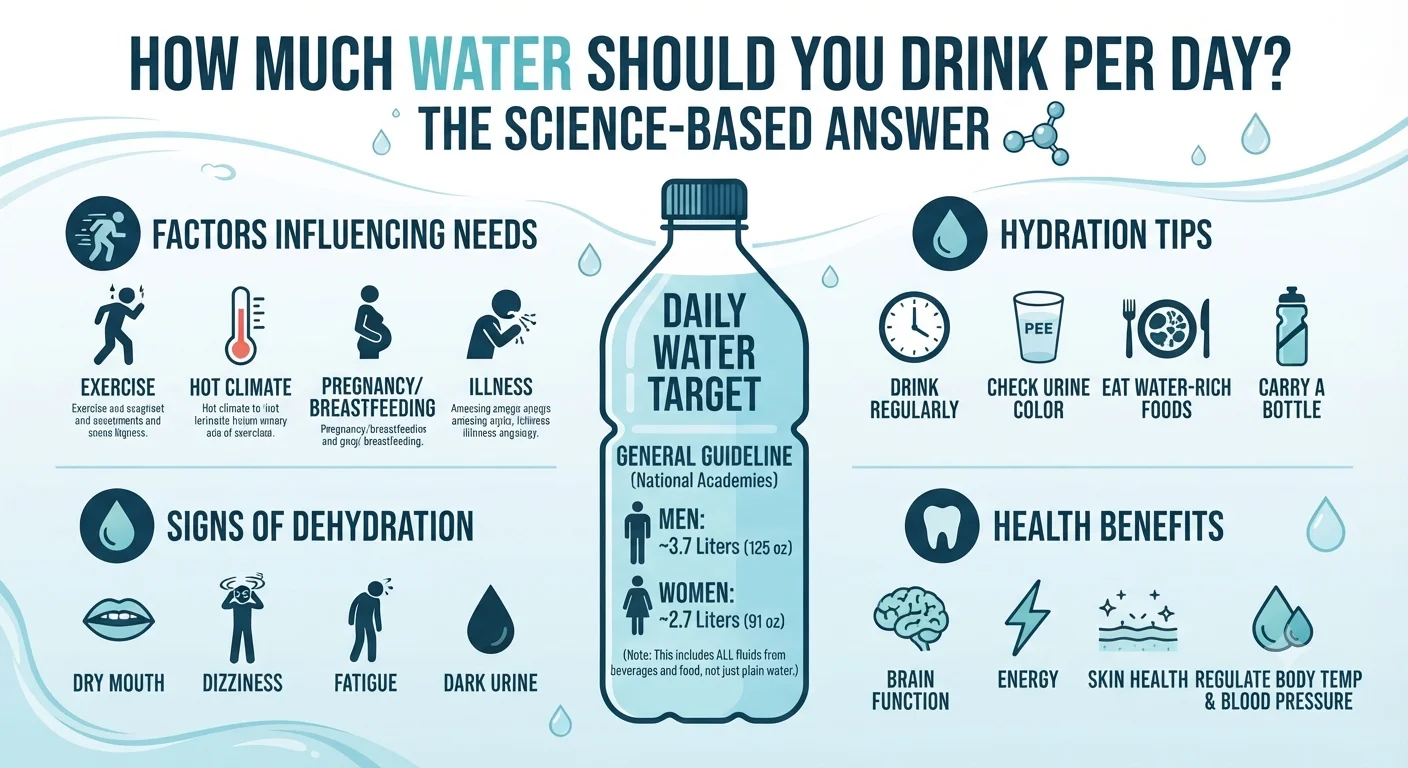
The National Academies of Sciences recommends a total daily water intake of approximately 3.7 liters (125 ounces) for men and 2.7 liters (91 ounces) for women from all sources including food and beverages. Individual needs vary significantly based on body weight, activity level, climate, health status, and diet. The "8 glasses a day" rule is a simplification without a strong scientific basis. Your actual needs may be higher or lower.
Key Takeaways
- The "8 glasses a day" rule (also written as 8x8: eight 8-ounce glasses) has no strong scientific foundation. It is traced to a 1945 U.S. Food and Nutrition Board recommendation that was widely misinterpreted and never rigorously validated in clinical trials.
- The human body is approximately 60 percent water by weight. Even mild dehydration of 1 to 2 percent of body weight impairs cognitive performance, physical endurance, and mood.
- A 2022 landmark study published in "Science" and led by Dr. Dale Schoeller at the University of Wisconsin analyzed data from 5,604 people in 26 countries and found that actual human water turnover (water consumed and replaced daily) varies from 1 to 6 liters per day based on age, size, activity, and environment.
- Approximately 20 percent of daily water intake comes from food, particularly fruits and vegetables with high water content. The remaining 80 percent comes from beverages.
- Urine color is the most practical real-time indicator of hydration status: pale yellow indicates adequate hydration; dark yellow or amber indicates dehydration; colorless indicates possible overhydration.
The "8 Glasses a Day" Myth: What Science Really Says
- Key Takeaways
- The "8 Glasses a Day" Myth: What Science Really Says
- How Your Body Uses Water: Key Functions
- Daily Water Intake Recommendations by Category
- By Body Weight: The Per-Kilogram Formula
- By Activity Level: Athletes vs Sedentary Individuals
- By Climate and Temperature
- Pregnant and Breastfeeding Women
- Children and Teenagers
- Signs You Are Not Drinking Enough Water
- Can You Drink Too Much Water? Hyponatremia Explained
- Does Coffee Count Toward Hydration?
- Best Sources of Hydration Beyond Plain Water
- Frequently Asked Questions About Daily Water Intake
The "eight glasses of water per day" recommendation is one of the most durable health myths in popular culture. Most people have heard it, many follow it, and almost no one knows where it actually came from or whether the science supports it.
The rule is most commonly traced to a 1945 recommendation by the U.S. Food and Nutrition Board, which suggested that adults consume approximately 2.5 liters of water daily. The critical part of that recommendation, which was almost universally overlooked in subsequent popularization, was the sentence immediately following: "most of this quantity is contained in prepared foods." The original guidance included water from food, not just drinking water.
Dr. Heinz Valtin, professor emeritus of physiology at Dartmouth Medical School, conducted an extensive review of the scientific literature published in the American Journal of Physiology in 2002 specifically to evaluate the evidence behind the 8x8 rule. His conclusion was unambiguous: there is no evidence that healthy adults in temperate climates need to drink eight glasses of water per day, and the recommendation has no clear scientific support for sedentary adults who are not in hot environments.
This does not mean hydration is unimportant. Adequate hydration is absolutely essential for health and cognitive function. What it means is that your body has sophisticated, sensitive thirst mechanisms specifically designed to regulate fluid balance, and that the amount of water you need is not a fixed universal number but varies based on multiple individual and environmental factors.
How Your Body Uses Water: Key Functions
Water is involved in virtually every physiological process in the human body. Understanding these functions clarifies why hydration genuinely matters, even if the "eight glasses" rule is an oversimplification.
Temperature regulation is one of water's most critical roles. Sweating, the body's primary cooling mechanism, requires water to produce sweat, which evaporates from skin and carries heat away from the body. In hot conditions or during vigorous exercise, sweat losses can reach 1 to 2 liters per hour, creating substantial hydration demands.
- Mental Health vs Mental Illness: Key Differences Everyone Should Understand
- How to Lose Weight Without Dieting: 12 Sustainable Science-Based Strategies
Nutrient transport and waste removal depend on water as the medium through which the bloodstream carries glucose, oxygen, vitamins, minerals, and hormones to cells, and transports metabolic waste products including urea, carbon dioxide, and cellular debris to the kidneys and lungs for elimination. Inadequate hydration concentrates these waste products and impairs elimination efficiency.
Joint lubrication and cushioning is provided by synovial fluid, which is primarily water. Cartilage, the tissue covering joint surfaces, is 65 to 80 percent water. Chronic dehydration may contribute to joint pain and reduced shock absorption in load-bearing joints.
Cognitive function is highly sensitive to hydration status. The brain is approximately 75 percent water. A 2012 study in the "Journal of Nutrition" by Harris Lieberman at the U.S. Army Research Institute of Environmental Medicine found that dehydration of just 1 to 2 percent of body weight impaired cognitive performance, particularly vigilance, working memory, and psychomotor speed, in young women. A companion study found similar effects in young men.
Digestive function requires water for saliva production, stomach acid secretion, intestinal motility, and the movement of food and waste through the digestive tract. Inadequate hydration is one of the leading contributing factors to constipation.
Daily Water Intake Recommendations by Category
By Body Weight: The Per-Kilogram Formula
The most scientifically grounded individualized approach to water intake recommendation is based on body weight. The most commonly referenced clinical guideline, used in hospital and medical nutrition settings, recommends approximately 30 to 35 milliliters of water per kilogram of body weight per day for healthy adults.
For a person weighing 70 kilograms (154 pounds), this formula recommends 2,100 to 2,450 milliliters (2.1 to 2.45 liters, or approximately 71 to 83 ounces) of water per day from all sources including food.
For a person weighing 90 kilograms (198 pounds), the formula recommends 2,700 to 3,150 milliliters (2.7 to 3.15 liters, or approximately 91 to 106 ounces) per day.
For a person weighing 55 kilograms (121 pounds), the formula recommends 1,650 to 1,925 milliliters (1.65 to 1.93 liters, or approximately 56 to 65 ounces) per day.
These are baseline estimates for sedentary adults in temperate climates. Activity, heat, illness, and other factors require upward adjustment as discussed below.
By Activity Level: Athletes vs Sedentary Individuals
Physical exercise creates substantial additional hydration demands through sweat losses, respiratory water loss during elevated breathing rates, and increased metabolic water production.
The American College of Sports Medicine recommends that exercising individuals drink 500 milliliters (approximately 17 ounces) of water in the two hours before exercise, continue drinking 150 to 250 milliliters (5 to 8.5 ounces) every 15 to 20 minutes during exercise, and drink 1.5 liters for every kilogram of body weight lost during exercise in the recovery period.
For endurance athletes training for one to three hours per day in warm conditions, total daily water intake requirements may reach 5 to 8 liters, with electrolyte replacement (sodium, potassium, magnesium) becoming critical to prevent hyponatremia (dangerously low blood sodium caused by excessive plain water consumption without electrolytes).
Sedentary office workers in air-conditioned environments with mild climates have significantly lower water requirements than the same person if they exercised vigorously outdoors in hot weather. This variability is why fixed universal recommendations are inherently imprecise.
By Climate and Temperature
Ambient temperature and humidity are among the most powerful drivers of hydration needs. In hot, humid conditions, sweat rates increase dramatically while evaporation of sweat from skin slows, increasing the sense of heat stress and the total fluid lost before body temperature is controlled.
Research from the U.S. Army Research Institute of Environmental Medicine found that soldiers working in desert environments could have water turnover exceeding 10 liters per day. Even non-exercising individuals in very hot environments (above 35 degrees Celsius or 95 degrees Fahrenheit) experience significantly elevated baseline water loss through sweat and respiratory moisture.
Practical guideline: add approximately 500 milliliters to daily baseline intake for every hour spent in temperatures above 28 degrees Celsius (82 degrees Fahrenheit), adjusting upward further for humidity and activity.
High altitude environments also increase water requirements because the lower partial pressure of oxygen at altitude increases breathing rate, and each additional breath cycle exhales water vapor. Mountaineers and travelers to high-altitude destinations often experience significant dehydration unless they consciously increase fluid intake beyond what thirst alone would prompt.
Pregnant and Breastfeeding Women
Pregnancy significantly increases water requirements to support amniotic fluid production, expanded maternal blood volume, fetal development, and increased metabolic rate.
The National Academies of Sciences recommends approximately 3.0 liters (10 cups) total daily water from all sources during pregnancy, compared to 2.7 liters for non-pregnant women of reproductive age.
Breastfeeding women have the highest water requirements of any demographic group per the National Academies guidelines, needing approximately 3.8 liters (13 cups) total daily water from all sources to support milk production in addition to their own metabolic needs. Breast milk is approximately 87 percent water, and adequate maternal hydration is closely linked to adequate milk supply.
Children and Teenagers
Children's water requirements per kilogram of body weight are higher than adults' because their higher metabolic rate per unit body weight and greater body surface area to weight ratio creates relatively higher water losses.
Recommended Articles
 HEALTH WELLNESS
 HEALTH WELLNESS
 HEALTH WELLNESS
 HEALTH WELLNESS
The European Food Safety Authority (EFSA) 2010 guidelines remain the most comprehensive reference, recommending:
Children aged 2 to 3 years: 1.3 liters total daily water. Children aged 4 to 8 years: 1.6 liters. Boys aged 9 to 13 years: 2.1 liters. Girls aged 9 to 13 years: 1.9 liters. Boys aged 14 to 18 years: 2.5 liters. Girls aged 14 to 18 years: 2.0 liters.
These are total water from all sources. Children are often less responsive to thirst cues than adults, particularly during engaging activities, making caregiver-prompted hydration especially important during hot weather and physical activity.
Signs You Are Not Drinking Enough Water
Dehydration manifests across a spectrum from mild (noticeable but not dangerous) to severe (medically urgent). The following are common signs of mild to moderate dehydration in adults.
Dark yellow or amber urine is the most reliable early indicator. Adequately hydrated individuals produce urine that is pale yellow or straw-colored. Consistently dark yellow or amber urine indicates inadequate fluid intake.
Infrequent urination is a related signal. Adequately hydrated adults typically urinate 6 to 8 times per day. Fewer than 4 urinations per day suggests inadequate fluid intake.
Persistent thirst, counterintuitively, is already a sign of mild dehydration. Thirst sensation is triggered when body fluid deficits have already reached approximately 1 to 2 percent of body weight, meaning you are already mildly dehydrated when you first notice thirst.
Headache is one of the most common symptoms of mild dehydration, related to reduced brain volume slightly shrinking away from the skull as it loses water, activating pain-sensitive structures. A 2012 study in the journal "Headache" found that increasing fluid intake significantly reduced headache frequency and duration in headache-prone individuals.
Fatigue and reduced physical performance are well-documented consequences of even mild dehydration. A 2015 study by Dr. Mindy Millard-Stafford at Georgia Institute of Technology found that dehydration of 2 to 3 percent of body weight reduced aerobic exercise capacity by approximately 7 percent and maximal strength by 2 to 3 percent.
Dry mouth and reduced saliva production occur as the body conserves fluid, reducing salivary gland output.
Difficulty concentrating and impaired short-term memory, as documented in the cognitive performance studies cited earlier, are often attributed to stress or fatigue when dehydration is the actual underlying cause.
Can You Drink Too Much Water? Hyponatremia Explained
Water intoxication, while rare, is a genuine medical risk, particularly for endurance athletes and people with certain medical conditions. The clinical name for the condition it causes is hyponatremia, which means dangerously low blood sodium concentration.
Hyponatremia occurs when large volumes of plain water are consumed without corresponding electrolyte intake, diluting the concentration of sodium in the bloodstream below normal levels. Sodium is essential for nerve and muscle function, including cardiac muscle. Severe hyponatremia can cause nausea, headache, confusion, seizures, coma, and in extreme cases, death.
Most cases of exercise-associated hyponatremia occur in endurance events (marathons, triathlons, ultramarathons) among slower participants who drink large volumes of plain water during events lasting four hours or more, believing that more water is always better.
The prevention is straightforward: for exercise lasting more than 60 to 90 minutes, replace fluids with electrolyte-containing beverages (sports drinks, electrolyte tablets dissolved in water) rather than plain water alone, and drink to thirst rather than forcing maximum fluid consumption.
For non-athletes in ordinary daily life, consuming more than 4 liters of plain water in a short period would be required to produce hyponatremia in an otherwise healthy adult. Casual overdrinking beyond thirst is unlikely to create this risk.
Does Coffee Count Toward Hydration?
This is one of the most frequently asked hydration questions, and the evidence-based answer is yes, with nuance.
Coffee and tea do contain caffeine, a mild diuretic that increases urine production. However, the diuretic effect of caffeine in moderate doses (up to 400 milligrams per day, equivalent to approximately three to four standard cups of coffee) is insufficient to offset the hydrating effect of the fluid in the beverage.
A pivotal 2014 study by Dr. Sophie Killer and colleagues at the University of Birmingham published in the journal "PLOS ONE" directly tested this question by assigning 50 habitual male coffee drinkers to consume either 4 cups of coffee or equivalent volumes of water per day for three days each in a crossover design. Blood and urine markers of hydration were identical between the two conditions, leading the researchers to conclude that moderate coffee consumption provided equivalent hydration to water in habitual coffee drinkers.
A 2022 review in the "European Journal of Nutrition" confirmed that tea, coffee, milk, fruit juice, and soft drinks all contribute meaningfully to daily fluid intake. The practical implication is that you do not need to consume your entire daily fluid target as plain water. Coffee, tea, milk, and other beverages count toward total fluid intake.
The exception is alcohol, which is genuinely diuretic at typical drinking quantities. A 2016 study found that drinks containing more than 4 percent alcohol produce net fluid losses exceeding their fluid content, meaning alcohol consumption at drinking quantities genuinely requires compensatory water intake.
Best Sources of Hydration Beyond Plain Water
Water from food sources contributes approximately 20 percent of total daily fluid intake for most adults, with significant variation based on diet quality. Fruits and vegetables with particularly high water content include:
Cucumber (96 percent water), lettuce (95 percent water), celery (95 percent water), tomatoes (94 percent water), strawberries (91 percent water), watermelon (91 percent water), cantaloupe (90 percent water), peaches (89 percent water), oranges (86 percent water), and plain yogurt (85 to 88 percent water).
A diet rich in fruits and vegetables meaningfully reduces the volume of drinking water needed to meet daily fluid requirements, which partially explains why populations with high fruit and vegetable consumption (Mediterranean and East Asian dietary patterns) show lower drinking water consumption without evidence of chronic dehydration.
Coconut water, often marketed as a natural sports drink, contains meaningful electrolytes including potassium (approximately 600 milligrams per cup) and provides good hydration with natural sugars. It is a reasonable alternative to commercial sports drinks for moderate-duration exercise hydration.
Herbal teas contribute to fluid intake with zero caffeine and, in the case of chamomile, peppermint, ginger, and hibiscus, potential additional health benefits from plant compounds.
Frequently Asked Questions About Daily Water Intake
Should I drink water even when I am not thirsty?
For most healthy young to middle-aged adults, drinking to thirst is sufficient guidance. However, thirst sensitivity decreases with age. Research consistently shows that older adults aged 65 and above have significantly blunted thirst responses and are at elevated risk of dehydration if they rely solely on thirst signals. For older adults, structured reminders to drink throughout the day are recommended regardless of thirst.
Does drinking more water help with weight loss?
Drinking water before meals reduces meal-time calorie intake, as described in the weight loss article in this series. Replacing sugar-sweetened beverages with water eliminates significant calorie intake. Adequate hydration supports optimal metabolic function and physical performance, which facilitates exercise. However, water is not a weight loss agent in itself. Its contributions to weight management are real but indirect.
Is alkaline water healthier than regular water?
The marketing claims for alkaline water lack strong scientific support. The human body tightly regulates blood pH between 7.35 and 7.45 regardless of the pH of consumed beverages, which are rapidly neutralized by stomach acid and buffer systems. No well-designed study has demonstrated that alkaline water provides meaningful health benefits over regular water for healthy individuals.
How does hydration affect skin?
Adequate hydration maintains skin turgor (the firmness that returns when pinched skin is released) and supports the skin's barrier function. Severe dehydration causes visibly reduced skin elasticity. However, the relationship between drinking extra water beyond adequate hydration and improving skin appearance is not as strong as popular belief suggests. A 2015 review in the journal "Dermato-Endocrinology" found that drinking more water than required for hydration adequacy does not produce additional skin benefits beyond what adequate hydration already provides.
What is the best way to increase daily water intake if I forget to drink?
Habit stacking, attaching the habit of drinking water to existing reliable habits, is the most evidence-based approach to increasing water intake. Drink a glass of water immediately upon waking, before each meal, and before each cup of coffee or tea. This produces three to five structured hydration opportunities without requiring separate reminders. Keeping a water bottle visible on your desk activates the cue-routine-reward habit loop, as the visible bottle cues drinking behavior. Setting hourly hydration reminders on a smartwatch or using apps including WaterMinder, Hydro Coach, or the built-in Apple Watch hydration tracking feature also support consistency.
Is sparkling water as hydrating as still water?
Yes. Carbonated water (sparkling water, seltzer, club soda) hydrates equally to still water. The dissolved carbon dioxide creates carbonic acid, giving a slightly lower pH, but does not meaningfully affect hydration. Some research suggests that carbonated beverages may slightly increase the sensation of fullness and reduce appetite. The only meaningful difference is that high consumption of carbonated beverages may contribute to dental enamel erosion over long periods due to acidity, though sparkling water is substantially less erosive than sodas, fruit juices, or sports drinks.