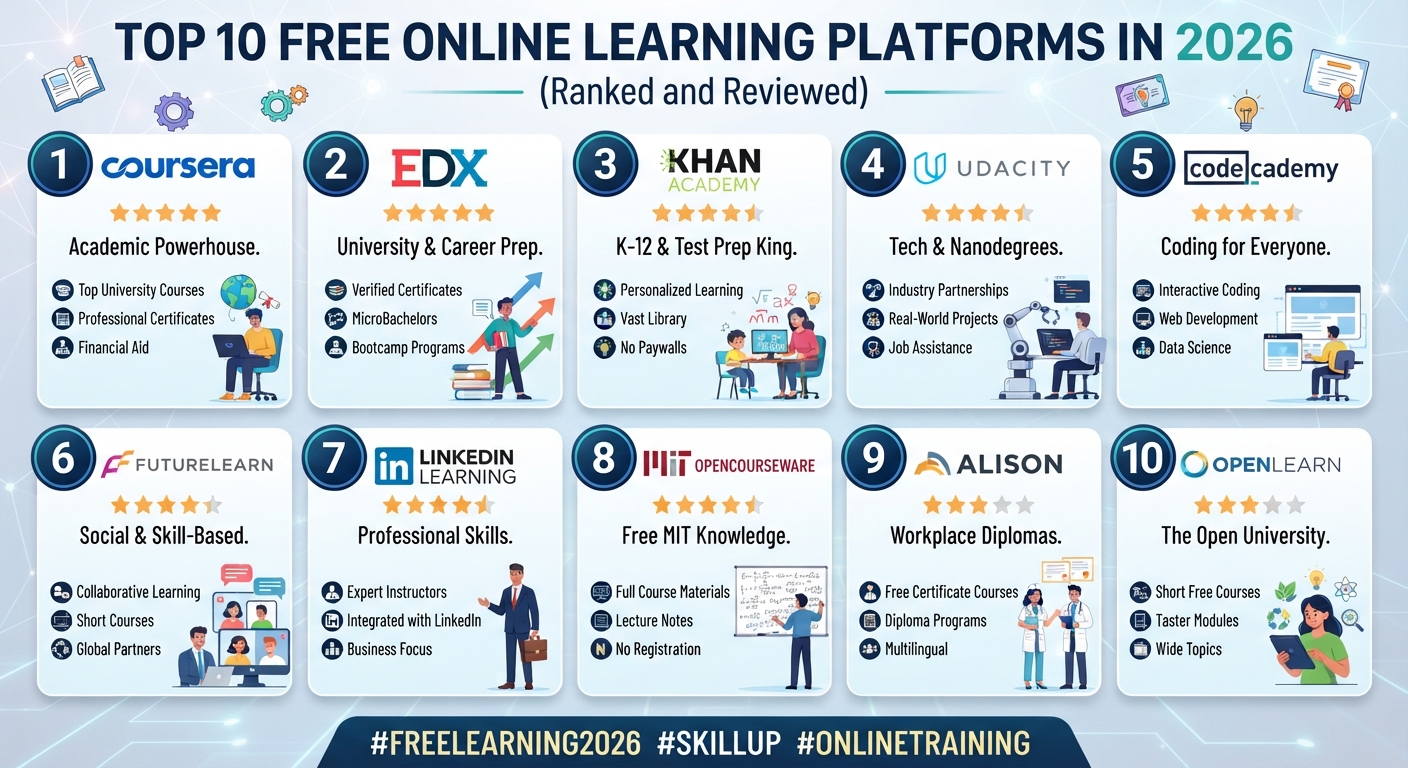
The best free online learning platforms in 2026 are Coursera, edX, Khan Academy, Google Digital Garage, and MIT OpenCourseWare for structured academic and professional learning. YouTube Learning, FutureLearn, Alison, LinkedIn Learning, and Class Central round out the top ten, each excelling in specific subject areas or learner types. Most offer free course access with optional paid certificates.
Key Takeaways
- The global e-learning market reached $325 billion in 2025 and is projected to grow to $600 billion by 2030, according to Global Market Insights.
- Coursera has more than 148 million registered learners globally as of 2026, making it the largest online learning platform by registered users.
- A 2025 LinkedIn Workforce Report found that 74 percent of hiring managers now consider verified online certifications from recognized platforms (Coursera, edX, Google) equivalent to or better than traditional continuing education credentials for technical roles.
- Khan Academy serves over 140 million learners globally and has been translated into 46 languages, making it the most widely accessible free educational resource ever created.
- MIT OpenCourseWare has made course materials from over 2,500 MIT courses freely available online since its launch in 2001, representing the most comprehensive free university curriculum in existence.
Why Online Learning Has Transformed Education
- Key Takeaways
- Why Online Learning Has Transformed Education
- How We Evaluated These Platforms
- Top 10 Free Online Learning Platforms in 2026 Reviewed
- 1. Coursera: World-Class University Courses
- 2. edX: MIT and Harvard Open Courseware
- 3. Khan Academy: K-12 to College Level
- 4. Google Digital Garage: Digital Skills Focus
- 5. YouTube Learning: The Underrated Educational Hub
- 6. MIT OpenCourseWare: Raw University Content
- 7. FutureLearn: Short Course Flexibility
- 8. Alison: Workplace Skills Certifications
- 9. LinkedIn Learning: Career-Focused Development
- 10. Class Central: The Free Course Aggregator
- Comparison Table: Features, Certificates, and Subject Areas
- How to Choose the Right Platform for Your Learning Goals
- Frequently Asked Questions About Free Online Learning Platforms
The democratization of world-class education through the internet is one of the most consequential social developments of the past two decades. Before platforms like Coursera and edX existed, access to university-level instruction from institutions including MIT, Stanford, Harvard, and Yale required admission to those institutions, which filtered for academic credentials, geography, and financial means.
Today, a student in Karachi, Lagos, or rural Indonesia can take the same machine learning course taught by Andrew Ng at Stanford that Stanford undergraduates took, for free, from their smartphone. This is an unprecedented shift in who has access to high-quality knowledge.
The COVID-19 pandemic of 2020 to 2022 accelerated the adoption of online learning dramatically. A UNESCO report found that at the pandemic's peak, 1.6 billion students across 194 countries had their in-person education disrupted, and online learning platforms absorbed a significant portion of this educational demand. Many learners who switched to online platforms during this period continued using them after returning to in-person settings.
The 2026 landscape of online learning is shaped by three additional forces: AI-powered personalization (platforms increasingly use AI to adapt content difficulty and sequence to individual learner needs), AI itself as a subject (nearly every major platform now offers substantial AI and machine learning curricula), and credential recognition (growing employer acceptance of platform certifications has given online learning clearer professional value).
How We Evaluated These Platforms
Each platform in this ranking was evaluated across five criteria based on publicly available platform data, independent learner reviews, employer surveys, and subject expert assessments.
Course quality refers to the academic rigor, production quality, and practical relevance of available courses. Content breadth measures the range of subjects covered. Certification value assesses how employers and academic institutions regard credentials from the platform. Usability evaluates the learning interface, mobile accessibility, and learner support features. Accessibility refers to genuinely free content availability versus requiring payment to access meaningful content.
Top 10 Free Online Learning Platforms in 2026 Reviewed
1. Coursera: World-Class University Courses
Coursera was founded in 2012 by Stanford professors Andrew Ng and Dah-Wen Kung with the mission of providing universal access to world-class education. It now partners with more than 300 universities and companies worldwide, including Stanford, Duke, Johns Hopkins, University of Michigan, Google, IBM, and Meta.
What sets Coursera apart is the genuine university provenance of its content. Courses are not produced by the platform but by actual university faculty and corporate experts. The machine learning specialization taught by Andrew Ng, taken by over six million learners, uses the same teaching approach Ng used at Stanford. Johns Hopkins' Data Science Specialization draws on faculty from one of the world's top research universities.
The free access model at Coursera allows auditing of virtually all course materials (video lectures, readings, practice quizzes) without payment. Graded assignments, peer review, and certificates require enrollment in the paid course option, which typically costs $39 to $79 per month per specialization. The Coursera Financial Aid program provides free access including certificates to learners who cannot afford fees, available through a simple application.
Strengths: highest institutional prestige of any platform, broad subject coverage from computer science and data science to business, humanities, and public health, and industry-recognized Professional Certificates from Google, IBM, and Meta.
Best for: university students seeking supplementary instruction, career changers seeking recognized credentials, professionals pursuing continuing education.
2. edX: MIT and Harvard Open Courseware
edX was founded in 2012 as a joint project of MIT and Harvard University, making it the only major MOOC platform created directly by elite research universities. It was acquired by 2U (a higher education technology company) in 2021 while maintaining its open course access commitments. edX currently partners with over 230 universities and companies.
edX's flagship offering, MicroMasters programs, are graduate-level sequences developed by institutions including MIT, Harvard, Columbia, and Berkeley. MicroMasters credits can be applied toward full master's degrees at the issuing institutions in some programs, creating a genuine on-ramp from free online learning to accredited postgraduate credentials.
The free audit option at edX provides access to all course videos, readings, and ungraded exercises. Graded assignments and certificates require the Verified Certificate track (typically $50 to $300 per course). Some individual courses are completely free including assessments.
Strengths: strongest academic credentials of any platform (MIT and Harvard content), graduate-level MicroMasters programs with degree pathway potential, strong computer science, engineering, and STEM coverage.
Best for: learners seeking the most academically rigorous free courses, those considering graduate education who want to test commitment first.
3. Khan Academy: K-12 to College Level
Khan Academy occupies a unique position in the online learning ecosystem as a genuinely, completely free platform with no paywalls. Founded by educator Sal Khan in 2008 after he began making tutorial videos for his cousins, Khan Academy has grown into a global educational institution serving over 140 million learners in 190 countries and 46 languages.
Its core strength is K-12 mathematics and science education. The mathematics curriculum is particularly comprehensive, covering topics from basic arithmetic through calculus, linear algebra, and differential equations with interactive exercises, immediate feedback, and intelligent mastery-based progression. Students cannot advance to new topics until demonstrating proficiency in prerequisites, mirroring effective tutoring.
In 2023, Khan Academy launched Khanmigo, an AI tutor powered by OpenAI's GPT-4. Rather than providing students with direct answers, Khanmigo guides students through Socratic questioning, simulating the one-on-one tutoring experience shown by Benjamin Bloom's 2 Sigma study to produce learning outcomes two standard deviations above typical classroom instruction.
Khan Academy's SAT preparation materials, developed in partnership with the College Board, have been shown in research to be highly effective: students who completed 20 or more hours of Khan Academy SAT prep improved their scores by an average of 115 points, which is substantially better than outcomes from commercial test preparation programs costing hundreds of dollars.
Strengths: truly free with no hidden paywalls, exceptional mathematics and science content, mastery-based progression, AI tutoring with Khanmigo, comprehensive SAT prep partnership.
Best for: students from K-12 through early university, anyone looking to fill foundational gaps in mathematics or science, parents supplementing their children's education.
4. Google Digital Garage: Digital Skills Focus
Google Digital Garage is Google's free online learning platform focused specifically on digital marketing, career development, and online business skills. It offers over 150 free courses certified by Google, covering topics including digital marketing fundamentals, data analytics, Python programming, UX design, project management, and IT support.
Google's "Fundamentals of Digital Marketing" course, developed in partnership with the Interactive Advertising Bureau Europe and The Open University, has been completed by over 1 million people globally and carries an IAB Europe certification. For small business owners, entrepreneurs, and professionals in non-technical roles seeking digital marketing competency, this course represents exceptional value.
Google Career Certificates, available through Coursera but developed entirely by Google, cover IT Support, Data Analytics, Project Management, UX Design, Cybersecurity, and Business Intelligence. These certificates are specifically designed to prepare learners for entry-level roles in these fields within three to six months, with over 150 employer partners in the United States committed to recognizing them in hiring.
Strengths: industry-recognized certificates with direct employer partnerships, focus on immediately job-relevant digital skills, free course access with low-cost certificate option.
Best for: career changers entering technology-adjacent roles, small business owners developing digital competencies, marketing professionals building credentials.
5. YouTube Learning: The Underrated Educational Hub
YouTube is the world's second-largest search engine and hosts an estimated 800 million videos, representing arguably the largest repository of free educational content in human history. While YouTube is not primarily designed as a learning platform, its educational content spans every conceivable subject from university-level physics to professional culinary skills.
Educational YouTube channels with exceptional quality include 3Blue1Brown (mathematical visualization and intuition), CrashCourse (humanities and sciences curricula), Kurzgesagt (science and philosophy), MIT OpenCourseWare's YouTube channel (full university lecture recordings), TED and TEDx (ideas from global experts), Lex Fridman (long-form conversations with scientists, engineers, and thinkers), and Khan Academy's own channel (millions of tutorial videos).
The weakness of YouTube as a learning platform is the absence of structure, sequencing, assessment, and certificates. Its strength is depth, breadth, and accessibility. For motivated learners who can self-direct and self-assess, YouTube provides access to world-class instruction in virtually any subject for free.
In 2026, YouTube's AI-powered search and recommendation has improved its ability to suggest genuinely educational content rather than engagement-optimized entertainment, and features including chapter markers, automatic transcription, and learning playlists have improved its utility as a structured study resource.
Recommended Articles
 EDUCATION CAREER
Best for: supplementary explanations of difficult concepts, visual learners who need to see worked examples, self-directed learners with high motivation across any subject.
6. MIT OpenCourseWare: Raw University Content
MIT OpenCourseWare (OCW), launched in 2001, is MIT's commitment to making the course materials from virtually every MIT course freely available on the internet. As of 2026, it hosts materials from over 2,500 courses covering all of MIT's departments, including complete lecture notes, problem sets, exams (with solutions), and for many courses, full video lecture recordings.
MIT OCW is not a MOOC platform. It does not offer interactive courses, student-instructor interaction, or certificates. It is raw, unmediated access to MIT course materials exactly as they are used by MIT students. This makes it one of the most challenging and demanding free educational resources available, and also one of the most intellectually rewarding for those prepared to use it.
For anyone wanting to understand what MIT computer science, mathematics, physics, or engineering education actually consists of, OCW provides complete transparency. The 18.01 (Calculus) and 18.02 (Multivariable Calculus) course materials with video lectures from Professor Gilbert Strang have been accessed by millions of learners globally who credit them with fundamentally changing their mathematical understanding.
Best for: advanced learners who already have domain foundations and want exposure to elite university-level content, independent researchers, students supplementing formal university courses with MIT-level rigor.
7. FutureLearn: Short Course Flexibility
FutureLearn, founded in 2012 by The Open University in the United Kingdom, partners with over 240 universities and educational organizations globally. It focuses on short courses (typically two to twelve weeks) designed to be completed alongside work or study, making it particularly practical for busy professionals seeking targeted skill development.
FutureLearn's content strengths include healthcare and medicine (reflecting partnerships with institutions including the Wellcome Trust and NHS England), business and management, education and psychology, and creative arts. Its social learning model, which emphasizes discussion and peer interaction rather than isolated self-paced learning, produces community engagement that many learners find motivating.
Free access on FutureLearn allows unlimited course enrollment and learning for the duration of the course run. Unlimited access to course content after the end date and certificate downloads require a FutureLearn subscription or per-course upgrade.
Best for: professionals seeking short targeted upskilling, healthcare workers accessing medical education content, learners who value social and discussion-based learning.
8. Alison: Workplace Skills Certifications
Alison, founded in 2007 in Galway, Ireland by Mike Feerick, was among the first platforms to offer genuinely free online courses with recognized certifications and has remained committed to that model. With over 6,000 courses and 40 million registered learners as of 2026, it focuses particularly on professional and vocational skills.
Alison's course library is strongest in workplace essentials including project management, health and safety, human resources, customer service, IT literacy, accounting fundamentals, and professional communication. These courses are designed for learners entering or developing in professional roles rather than pursuing academic credentials.
Courses on Alison are completely free to complete. Certificates are available for a modest fee (typically $10 to $20) or as part of a subscription. Alison's certificates, while not carrying the institutional prestige of Coursera's university-backed credentials, are recognized by many employers as evidence of specific skill acquisition.
Best for: early career professionals seeking to build a portfolio of verifiable workplace skills, learners in developing markets with limited financial resources, anyone needing foundational professional certifications.
9. LinkedIn Learning: Career-Focused Development
LinkedIn Learning (formerly Lynda.com) is integrated directly into the LinkedIn professional network, giving its courses immediate visibility on professional profiles and direct relevance to job search activities. Its library of over 21,000 courses covers business, technology, and creative skills, with a particular emphasis on software tools, professional communications, leadership, and industry-specific competencies.
The LinkedIn Learning model is subscription-based ($39.99 per month or included with LinkedIn Premium subscriptions), which limits its "free" classification. However, LinkedIn provides a one-month free trial, many public libraries in the United States and United Kingdom provide free LinkedIn Learning access to cardholders, and LinkedIn regularly offers free access to select courses.
The distinctive value of LinkedIn Learning is its integration with the professional network. Completed courses and certificates appear directly on LinkedIn profiles, where they are visible to recruiters and are indexed by LinkedIn's own recruiter search tools. This direct professional visibility gives LinkedIn Learning credentials a practical career utility that free-standing certifications may lack.
Best for: active job seekers seeking to signal skill development to recruiters, professionals developing software-specific competencies (Microsoft Office, Adobe Suite, data tools), managers and leaders developing business competencies.
10. Class Central: The Free Course Aggregator
Class Central, founded in 2011, is not a learning platform itself but a comprehensive aggregator and review platform that indexes free online courses from over 950 MOOC providers globally, including Coursera, edX, FutureLearn, Udemy free courses, and hundreds of smaller platforms.
With a database of over 220,000 online courses and 60 million learners using it to discover courses, Class Central functions as the most comprehensive directory of free learning opportunities available anywhere. Its search functionality allows filtering by subject, university, provider, language, certificate availability, and learner reviews.
Class Central's learner reviews, contributed by verified course completers, provide authentic quality assessments that help learners choose between equivalent courses on the same topic from different providers. Its curated "Best Online Courses" lists for specific subjects, compiled annually from review data, are among the most reliable course quality rankings available.
Best for: learners who already know what subject they want to study and want to find the best free option from among all available providers, anyone overwhelmed by the proliferation of online learning options who wants to compare quality before committing time.
Comparison Table: Features, Certificates, and Subject Areas
| Platform | Free Content | Certificate Available | Best Subject Area | Learner Count |
|---|---|---|---|---|
| Coursera | Audit access | Yes (paid, $39/month) | Computer Science, Business | 148M+ |
| edX | Audit access | Yes (paid, $50-$300) | Engineering, STEM | 45M+ |
| Khan Academy | Fully free | No | K-12 Math and Science | 140M+ |
| Google Digital Garage | Fully free | Yes (free) | Digital Marketing, Tech | 1M+ completions |
| YouTube Learning | Fully free | No | Any subject | 2.7B users |
| MIT OpenCourseWare | Fully free | No | STEM, Engineering | Millions/year |
| FutureLearn | During course run | Yes (paid) | Healthcare, Business | 20M+ |
| Alison | Fully free | Yes (low cost) | Workplace Skills | 40M+ |
| LinkedIn Learning | Free trial/library | Yes | Professional Skills | 27M monthly |
| Class Central | Aggregator (free) | N/A | All subjects | 60M+ |
How to Choose the Right Platform for Your Learning Goals
Selecting the right platform requires matching your specific goals, current level, time availability, and career context to platform strengths.
For academic learning at university level, Coursera and edX offer the strongest instructional quality and credential recognition. For foundational skills building from scratch, Khan Academy provides the clearest structured pathway. For professional digital skills with employer-recognized certificates, Google Career Certificates via Coursera represent the strongest combination of free content and career utility. For quick professional upskilling in specific tools and workplace skills, LinkedIn Learning's breadth and profile integration make it the most career-practical option for employed professionals. For exploring what is available before committing, Class Central's aggregation saves significant research time.
The most important variable is completing what you start. Research on MOOC completion rates is sobering: MIT and Harvard researchers found average completion rates of 5 to 15 percent for free courses. The learners who complete courses consistently share several characteristics: they had a specific, intrinsically motivated reason for taking the course, they scheduled specific study time rather than fitting study around other commitments, and they joined community groups or study partners to build accountability.
Frequently Asked Questions About Free Online Learning Platforms
Are certificates from free online platforms recognized by employers?
It depends on the platform and the role. Google Career Certificates from Coursera have formal employer recognition agreements with hundreds of companies. University certificates from Coursera (Stanford, Michigan, Johns Hopkins) carry significant employer recognition for technical and professional roles. A 2025 LinkedIn Workforce Report found that 74 percent of hiring managers in technology and data roles consider these certificates equal to or better than traditional continuing education credentials. For roles not requiring specific technical skills, traditional degrees still carry more weight.
Which free online platform is best for learning programming?
For complete beginners, CS50 on edX (Harvard's Introduction to Computer Science, consistently rated among the best online courses ever made) and Khan Academy's computing courses provide the strongest foundations. For intermediate learners seeking Python specifically, Coursera's Python for Everybody specialization from the University of Michigan is outstanding and widely used. For web development, The Odin Project (free, not on a major platform) is particularly highly regarded. MIT OpenCourseWare provides the most rigorous computer science theory content.
Can free online courses lead to a university degree?
Some can. edX MicroMasters programs allow credits to be applied toward full master's degrees at the issuing institutions in specific programs. Western Governors University (WGU) accepts specific Coursera and edX certificates as credit-by-examination equivalents. The University of the People is an accredited, tuition-free online university that incorporates open educational resources. These pathways are still limited compared to traditional enrollment but represent genuine academic credit opportunities.
How much time should I dedicate to online learning per week?
Research on effective skill acquisition from online courses suggests that three to seven hours per week of consistent, focused engagement produces meaningful skill development over a three to six month period. Less than two hours per week rarely produces sufficient progress to maintain motivation. The key is consistency over time rather than intensive occasional sessions.
What is the fastest way to get a job-ready skill through free online learning?
Google Career Certificates, available through Coursera, are specifically designed for this purpose. The IT Support, Data Analytics, Cybersecurity, Project Management, and UX Design certificates are designed to take three to six months at ten hours per week, cost approximately $39 per month (with financial aid available), and have formal employer partnerships. Multiple independent analyses of certificate completion outcomes show meaningful employment improvements for completers in these fields.