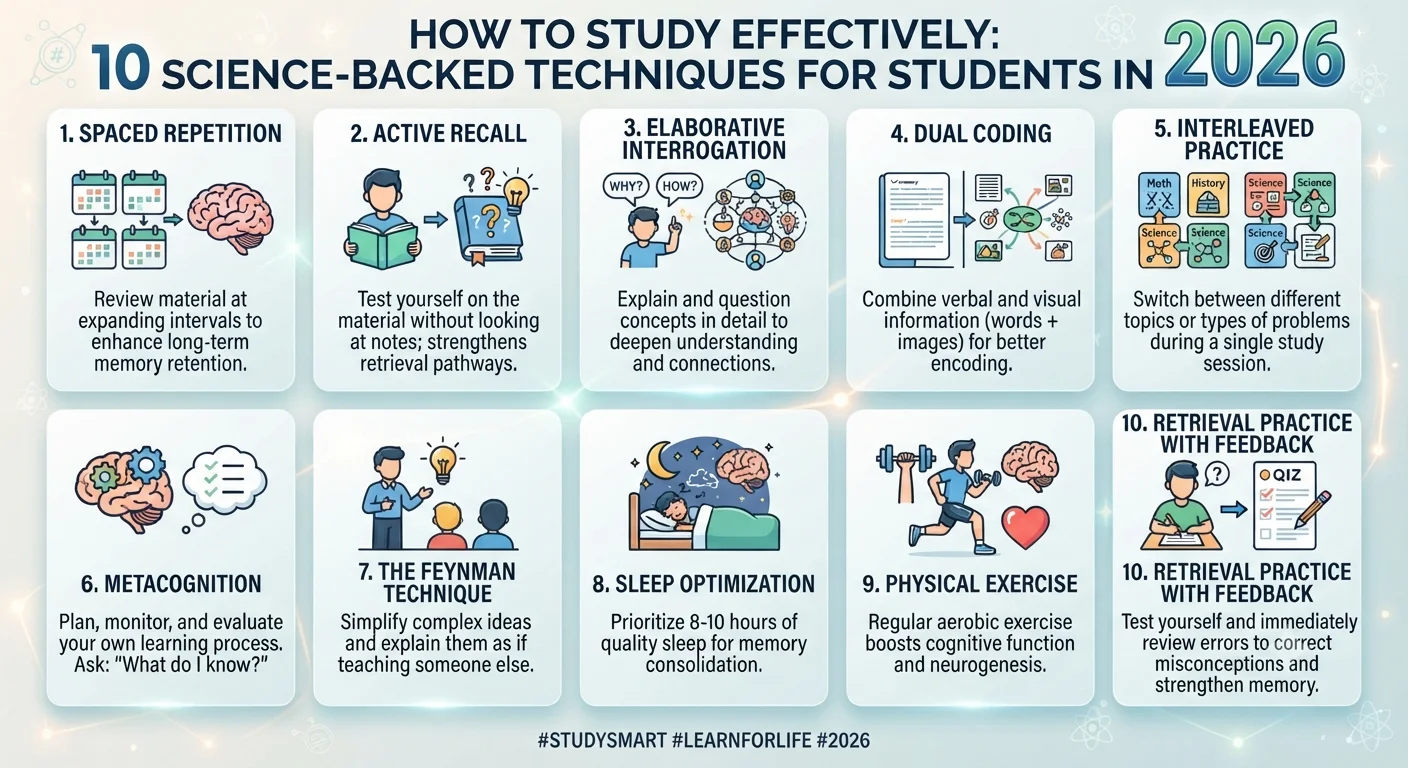
The most effective study techniques are active recall, spaced repetition, and the Feynman Technique. These methods are backed by decades of cognitive science research and consistently outperform passive strategies like re-reading, highlighting, and summarizing. Using them together for just 30 to 45 minutes per day produces better retention than three hours of traditional studying.
Key Takeaways
- A landmark meta-analysis by Dunlosky et al. published in "Psychological Science in the Public Interest" (2013) rated active recall and distributed practice as the only two study techniques with "high utility" out of ten commonly used methods.
- Re-reading, the most commonly used study method among students, was rated "low utility" in the same meta-analysis, meaning time spent re-reading produces minimal long-term retention.
- The "Forgetting Curve" discovered by German psychologist Hermann Ebbinghaus in 1885 demonstrated that people forget approximately 70 percent of new information within 24 hours without review, and spaced repetition is specifically designed to counteract this decay.
- A 2021 study from MIT found that interleaving different subjects or problem types during study sessions (mixing topics rather than blocking them) improved test performance by 43 percent compared to blocked practice.
- Research from the National Survey of Student Engagement in 2025 found that students who used active study strategies (self-testing, practice problems, teaching peers) spent an average of 30 percent less time studying while achieving higher grades than students using passive strategies.
Why Traditional Studying Often Does Not Work
- Key Takeaways
- Why Traditional Studying Often Does Not Work
- The Cognitive Science Behind Effective Learning
- 10 Proven Study Techniques That Work
- 1. Active Recall: The Single Most Effective Method
- 2. Spaced Repetition: Defeating the Forgetting Curve
- 3. The Feynman Technique: Learn by Teaching
- 4. Interleaving: Mix Subjects Deliberately
- 5. The Pomodoro Study Method
- 6. Mind Mapping for Visual Learners
- 7. Elaborative Interrogation: Ask Why
- 8. Practice Testing Under Real Conditions
- 9. Teach What You Learn to Someone Else
- 10. Optimize Your Study Environment
- Best Apps for Studying and Retention in 2026
- How Successful Students Structure Their Study Weeks in 2026
- Frequently Asked Questions About Effective Studying in 2026
The gap between how students typically study and how the brain actually learns is one of the most consequential mismatches in education. Most students adopt study strategies that feel productive but produce minimal durable learning. Re-reading notes feels like learning because the material becomes familiar on re-exposure. Highlighting feels productive because it involves physical engagement with the text. Summarizing feels constructive because it requires some processing. Yet all three methods fail to generate the conditions that produce long-term memory consolidation.
The fundamental error underlying these approaches is confusing familiarity with knowledge. Recognition, the sense that material looks familiar when you see it again, is a weak and unreliable form of memory that provides almost no useful access to information during actual performance situations like exams, professional applications, or problem-solving. What is needed instead is retrieval, the ability to generate accurate information from memory without seeing it first.
Cognitive psychologists Henry Roediger and Mark McDaniel, in their influential book "Make It Stick: The Science of Successful Learning" (2014), summarize decades of laboratory and classroom research demonstrating that the most effective learning methods are also the ones that feel most effortful and uncomfortable in the moment. Fluency of re-reading feels good but signals false mastery. The struggle of trying to retrieve something from memory feels uncomfortable but is precisely what builds durable knowledge structures.
Understanding this distinction is the first and most important step to transforming how you study.
The Cognitive Science Behind Effective Learning
Before examining individual techniques, three foundational principles from cognitive science explain why the methods below work.
The testing effect, first demonstrated rigorously in a 1909 experiment by Arthur Gates at Columbia University and replicated hundreds of times since, shows that testing yourself on material after initial learning produces dramatically better long-term retention than equivalent time spent re-studying the same material. Testing is not just a measurement tool. It is itself a learning tool that strengthens memory traces in ways that passive review cannot.
Desirable difficulty, a concept developed by cognitive psychologist Robert Bjork at UCLA, refers to the finding that learning conditions that make acquisition slower, more effortful, and more error-prone during practice often produce stronger long-term retention and transfer compared to conditions that make initial learning feel easy. Interleaving, spaced practice, and varied contexts all introduce desirable difficulties that benefit long-term learning even while impairing short-term performance.
Elaborative encoding, described by cognitive psychologist Fergus Craik in his "levels of processing" framework (1972), refers to the finding that information is better remembered when it is connected to existing knowledge and processed for meaning rather than surface features. Asking "why does this work?" produces deeper encoding than asking "what does this say?"
10 Proven Study Techniques That Work
1. Active Recall: The Single Most Effective Method
Active recall is the practice of retrieving information from memory without looking at it, as opposed to reading material and passively recognizing it as familiar. The mechanism is straightforward: every time you successfully retrieve a memory, that memory trace becomes stronger and more accessible for future retrieval.
Practical implementations of active recall include closing your notes after reading a section and writing down everything you can remember, answering practice questions from memory before checking answers, using flashcard systems where you see a prompt and generate the answer from memory, explaining a concept aloud without referring to notes, and creating your own exam questions and answering them.
A 2006 study by Henry Roediger and Jeffrey Karpicke published in "Psychological Science" compared three study conditions: studying material four times, studying three times then taking one retrieval test, or studying once then taking three retrieval tests. One week later, the study-once-test-three-times group outperformed the study-four-times group by 61 percent on a final retention test. The investment in retrieval practice dramatically outperformed the investment in additional reading.
For maximum efficiency, attempt active recall immediately after first learning material (after each section of reading, after each class), and then again at increasing intervals using a spaced repetition schedule.
2. Spaced Repetition: Defeating the Forgetting Curve
Hermann Ebbinghaus's Forgetting Curve, derived from his self-experiments on memory in 1885, demonstrates that memory retention falls to approximately 30 percent within 24 hours of learning, continues declining to about 20 percent by day seven, and stabilizes at a low level thereafter. However, each time a memory is reviewed before it is forgotten, the decay curve resets at a higher baseline, making each subsequent forgetting episode slower.
Spaced repetition is the systematic scheduling of reviews at optimal intervals to counteract this forgetting curve with the minimum number of review sessions. Rather than reviewing all material equally, spaced repetition algorithms track which items you know well (and schedule them for distant future review) and which items you struggle with (scheduling them for imminent review).
The Anki flashcard application implements a sophisticated spaced repetition algorithm (SuperMemo SM-2) that automatically schedules each card based on your performance. Anki is free for desktop and Android, with a one-time purchase for iOS. It is used by tens of thousands of medical students globally as a core study tool because the volume of factual knowledge required in medical education makes it one of the highest-value applications of spaced repetition technology.
Research published in "Psychological Review" found that optimally spaced learning of new vocabulary produced retention rates of 80 percent at one year with 50 percent less study time compared to massed practice (cramming). For students studying any content requiring long-term retention, including language vocabulary, anatomy, law, history, and chemistry, spaced repetition is among the highest-leverage investments of study time.
3. The Feynman Technique: Learn by Teaching
The Feynman Technique is a four-step learning method named after Nobel Prize-winning physicist Richard Feynman, who was legendarily capable of explaining complex physics concepts to non-specialist audiences with clarity and simplicity. Feynman famously said that if you cannot explain something simply, you do not understand it.
Step one is choosing a concept and writing its name at the top of a blank page. Step two is explaining the concept in simple language as if teaching it to someone with no background knowledge, including a complete beginner or a curious child. Step three is identifying gaps: wherever your explanation becomes vague, circular, or requires jargon you cannot define, you have found a gap in your understanding. Step four is returning to your source material specifically to fill the identified gaps, then repeating the explanation until it is complete and genuinely simple.
The technique works because it forces the transition from recognition to generation. Writing a simple explanation from memory is active recall. The requirement for simplicity prevents the self-deception of using memorized jargon to disguise incomplete understanding. Identifying gaps precisely targets further study rather than spreading review time uniformly across material you already know.
Studies on the "protege effect," the learning benefit derived from teaching or preparing to teach, consistently show that students asked to teach material to others learn it more deeply than students who study with the expectation of taking a test. The Feynman Technique captures this effect without requiring a second learner.
4. Interleaving: Mix Subjects Deliberately
Interleaving is the practice of alternating between different subjects, topics, or problem types during a single study session, rather than spending the entire session on one topic before moving to the next (blocked practice). Despite feeling less productive and more disjointed in the moment, interleaving consistently produces superior test performance in follow-up assessments.
The 2021 MIT study referenced in the key takeaways found that interleaved practice of different mathematical problem types improved test performance by 43 percent compared to blocked practice. The benefit was observed even though participants subjectively rated interleaved practice as harder and less effective than blocked practice, demonstrating the counterintuitive nature of desirable difficulties.
The mechanism relates to discrimination learning: when you study different problem types together, you must identify what type of problem you are facing before applying the appropriate procedure. Blocked practice removes this identification step, which is precisely the step that most resembles the challenge of a real exam or real-world application.
Practical interleaving for a student studying mathematics, history, and biology might involve a 90-minute session structured as 25 minutes of math problems, 25 minutes of history active recall, 25 minutes of biology Feynman technique practice, and 15 minutes returning to math for a different problem type.
5. The Pomodoro Study Method
The Pomodoro Technique, developed by Francesco Cirillo in the late 1980s and named after a tomato-shaped kitchen timer (pomodoro is Italian for tomato), structures study into 25-minute focused sessions separated by five-minute breaks. After four consecutive Pomodoros, a longer break of 20 to 30 minutes is taken.
Applied specifically to studying, the Pomodoro method addresses two distinct challenges: starting (the most psychologically difficult moment of any study session) and sustaining attention over time. The 25-minute unit is short enough to feel manageable when beginning, reducing procrastination. The scheduled breaks prevent the cognitive fatigue and attention decline that occur during unstructured extended study sessions.
Research from the University of Illinois at Urbana-Champaign by Dr. Alejandro Lleras found that brief mental breaks during a prolonged task dramatically improved sustained attention and performance compared to uninterrupted work. The Pomodoro Technique formalizes these breaks into a predictable structure that allows the brain's default mode network to consolidate and integrate learning during rest periods.
During the five-minute breaks, genuinely resting (stretching, walking, looking at something distant, or brief non-screen relaxation) rather than switching to passive phone scrolling preserves the restorative function of the break. Research by Microsoft Research in 2021 found that back-to-back video meetings without breaks produced measurable stress increases as detected by EEG, while breaks between meetings allowed the brain to reset to a resting state.
6. Mind Mapping for Visual Learners
Mind mapping is a visual note-taking technique developed by British psychologist Tony Buzan in the 1960s and 1970s. A mind map places the central topic in the center of the page and branches outward to major subtopics, then sub-branches to specific details, creating a visual hierarchy that mirrors the brain's associative structure.
Recommended Articles
 EDUCATION CAREER
The cognitive advantage of mind mapping over linear notes is that it explicitly represents the relationships between concepts rather than simply listing them sequentially. Research by Farrand, Hussain, and Hennessy published in "Medical Education" (2002) found that medical students who used mind maps for essay revision recalled 10 percent more information than students using standard notes, with the advantage growing over time.
Mind mapping is most effective for subjects with hierarchical or networked conceptual structures, including biology (organ systems and their components), history (cause, event, and consequence relationships), literature (thematic analysis), and business strategy. It is less effective for procedural subjects like mathematics, where linear worked examples are more appropriate.
Digital mind mapping tools including MindMeister, Coggle, XMind, and the Obsidian knowledge management app enable searchable, linkable digital maps that integrate with note-taking workflows.
7. Elaborative Interrogation: Ask Why
Elaborative interrogation is a simple but powerful study technique that involves generating explanations for factual statements by asking "Why is this true?" rather than simply accepting and memorizing the statement.
A student memorizing that "the heart pumps blood through the circulatory system" using plain rote rehearsal encodes the statement as a disconnected fact. A student who asks "why does the heart need to pump blood actively rather than allowing it to flow passively?" engages prior knowledge about blood pressure, cell oxygenation, and circulatory distance, encoding the fact within a rich network of related knowledge that makes it far more retrievable.
A 1992 review by Mark McDaniel and Carol Donnelly published in the "Journal of Memory and Language" found that elaborative interrogation improved recall of factual material by 72 percent compared to plain reading in studies with undergraduate participants. The effect was largest for participants with some prior domain knowledge, suggesting the technique works by activating and strengthening connections to existing knowledge rather than creating connections from nothing.
Practical implementation requires only adding the question "why?" or "why is this true?" after every significant factual statement encountered during study, and taking the time to generate a genuine explanation before moving forward.
8. Practice Testing Under Real Conditions
Practice testing, also known as retrieval practice or the testing effect described in technique one, is most powerful when the testing conditions closely simulate the conditions of the actual performance situation. Studying in conditions identical to how you will be tested activates context-dependent memory cues that improve performance on the real assessment.
Research on context-dependent memory by Dr. Godden and Dr. Baddeley (1975) found that divers who learned word lists underwater recalled significantly more words when tested underwater than on land, and vice versa. While this study used extreme environmental context, the principle applies to cognitive context: studying in conditions similar to your exam produces better exam performance.
Practical implications include practicing with past exam papers under timed conditions with no notes, practicing recall of important information without looking at the source material, practicing in the same room or similar environment to where you will be tested when possible, and answering questions in the format they will appear on the actual assessment (multiple choice, essay, problem-solving) rather than only in the format most comfortable during study.
Retrieval practice under these conditions also reduces test anxiety by familiarizing the brain with the performance context. A 2010 meta-analysis of 23 studies by Cassady found that practice testing significantly reduced test anxiety compared to additional studying.
9. Teach What You Learn to Someone Else
The act of teaching, explaining, or tutoring reinforces learning through a combination of the Feynman effect (forced simplification reveals gaps), retrieval practice (generating explanations from memory), and the elaboration effect (connecting material to what the learner already knows to create meaningful explanations).
Studies on peer teaching and tutoring consistently show benefits for the tutor as well as the student. A 2018 meta-analysis by Alegre et al. published in "Educational Research Review" found that peer tutors demonstrated significantly higher achievement gains than non-tutoring control students across 197 studies in multiple subject areas.
Study groups structured around teaching and explaining to each other, rather than reviewing notes together, produce substantially better learning outcomes than passive group study. Each member of the group should take turns teaching a concept to the others while they listen critically and ask questions.
In the absence of a study partner, teaching to an imaginary audience, narrating explanations aloud to yourself, or using the "rubber duck debugging" technique (explaining concepts to an inanimate object) produces similar cognitive benefits because the generation requirement is what matters, not the presence of an actual listener.
10. Optimize Your Study Environment
Physical and digital environment significantly affects study quality through attention, alertness, and the removal of competing cognitive demands.
Research from Princeton Neuroscience Institute published in the "Journal of Neuroscience" (2011) found that physical clutter in a workspace competes for neural representation in the visual cortex, reducing cognitive resources available for the primary task. A clean, organized study space is neurologically advantageous beyond mere aesthetic preference.
Lighting affects alertness and circadian rhythm. Natural light or bright, cool-temperature artificial light (5000 to 6500 Kelvin color temperature) promotes alertness by suppressing melatonin. Dim, warm-toned lighting is associated with reduced alertness and increased sleepiness, making it poor for studying but helpful for winding down before bed.
Background sound preferences vary between individuals, but research consistently shows that silence or consistent ambient sound (white noise, brown noise, or instrumental music without lyrics) supports concentration better than variable, unpredictable noise or music with intelligible lyrics.
The single most important environmental optimization for studying in 2026 is phone management. A 2017 study published in the "Journal of the Association for Consumer Research" found that the mere visible presence of a smartphone on a desk, even silenced and face down, reduced available working memory capacity compared to the phone being in another room entirely. For maximum study effectiveness, placing the phone in a different room, or using app blockers like Forest or Freedom during study sessions, produces measurable cognitive benefits.
Best Apps for Studying and Retention in 2026
Anki is the gold standard spaced repetition flashcard system. Free for desktop and Android. A small one-time purchase for iOS. Used by medical students, language learners, and anyone requiring large-scale factual memorization. Its algorithm automatically optimizes review schedules to minimize forgetting while minimizing review time.
Notion is a flexible productivity and note-taking platform used by students for creating organized databases of notes, linking concepts across subjects, and building personal knowledge management systems. Its ability to embed tables, kanban boards, calendars, and databases within notes makes it more powerful than linear note-taking for complex subject matter.
Obsidian is a local-first knowledge management application that creates bidirectional links between notes, generating a visual knowledge graph that shows how concepts connect. It is particularly valued by students who want to build a personal long-term knowledge base rather than discarding notes after each course.
Quizlet provides a database of hundreds of millions of student-created flashcard sets covering virtually every academic subject. While its algorithm is less sophisticated than Anki, its vast content library and social features make it accessible and practical for rapid study set creation.
RemNote combines spaced repetition with note-taking in a single interface, allowing students to create notes that automatically generate flashcards from bracketed or highlighted terms, reducing the overhead of building separate Anki card sets.
ChatGPT and Claude are increasingly used by students as on-demand tutoring tools, providing explanations, generating practice questions, working through problem types, and giving feedback on student-written answers. When used actively (asking questions, solving problems, explaining concepts to the AI) rather than passively (reading AI-generated summaries), these tools function as powerful retrieval practice and elaboration partners.
How Successful Students Structure Their Study Weeks in 2026
High-performing students in competitive university programs and professional preparation courses consistently organize study time around several structural principles derived from cognitive science.
They study in shorter, more frequent sessions rather than long cramming sessions. Four one-hour sessions across four days produces better retention than one four-hour session the day before an exam, because spaced review counteracts the forgetting curve while cramming sessions review material before meaningful forgetting has occurred.
They begin each study session with active recall of previous material before introducing new content. This retrieval practice on old material serves two purposes: it strengthens retention of prior learning and contextualizes new material within an existing knowledge framework.
They set concrete learning objectives for each session rather than vague time goals. "Study chapter 5" is a time goal. "Be able to explain the three mechanisms of enzyme inhibition and draw the Michaelis-Menten curve for each" is a learning objective. Specificity enables accurate self-assessment and reduces the false sense of accomplishment that comes from time spent without measurable learning.
They schedule review of study material at increasing intervals after initial learning: again 24 hours later, then three days later, then one week later, then two weeks later. This spaced schedule aligns with Ebbinghaus's forgetting curve and ensures each review happens just before significant forgetting would otherwise occur.
Frequently Asked Questions About Effective Studying in 2026
How long should a study session be?
Research on sustained focused attention and cognitive fatigue suggests that 45 to 90 minutes per subject per session is optimal for most students, with brief breaks every 25 to 45 minutes. Beyond 90 minutes of continuous focus on a single topic, diminishing returns in retention and comprehension typically set in. Total daily study time of three to five hours of genuinely focused work is sustainable and productive for most full-time students; beyond this, quality typically declines faster than quantity increases.
Is studying late at night effective?
Studying late at night conflicts with circadian-driven alertness patterns for most people, whose cognitive performance peaks in mid to late morning and again in early afternoon. More critically, sleep is essential for memory consolidation: the hippocampus transfers newly learned information into long-term cortical storage primarily during slow-wave and REM sleep stages. Studying late and sleeping less undermines the very consolidation process that makes studying worthwhile.
Does listening to music while studying help or hurt?
It depends on the music type and the study task. Music with intelligible lyrics consistently impairs performance on language-based tasks including reading comprehension, essay writing, and language learning. Instrumental music without lyrics appears neutral to mildly helpful for many students on non-verbal tasks. Silence or white noise is the most consistently supportive environment for reading and writing. The best approach is to experiment with your personal response to different sound conditions during different task types.
What is the best way to prepare for exams specifically?
The evidence strongly supports a retrieval-practice approach: obtain or create practice exams and complete them under realistic timed conditions with no notes, then carefully review errors by returning to source material. This approach simultaneously practices the format of the actual exam, identifies specific knowledge gaps to address, and reduces test anxiety through repeated exposure to exam conditions. Beginning this practice three to four weeks before an exam and spacing sessions every two to three days produces optimal preparation.
How can I stay motivated to study consistently?
Motivation research distinguishes between intrinsic motivation (interest in the subject for its own sake) and extrinsic motivation (studying to earn grades, credentials, or parental approval). Intrinsic motivation produces more durable and effective studying but cannot always be created artificially. Practical strategies for sustaining motivation include connecting study material to your personal goals and interests wherever possible, using study techniques that provide immediate feedback (active recall provides instant knowledge of what you know), studying with others for social accountability, tracking and celebrating progress explicitly, and maintaining physical health through exercise and sleep, both of which have strong effects on motivation and mood.